Biologist Proposes Removing Jellyfish from Aquatic Bioresource List for Southern Russia

Jellyfish on the coast of the Azov Sea near Golubitskaya village.
One proposed method to combat the annual mass appearance of jellyfish in the coastal waters of the Azov Sea is to remove these creatures from the list of aquatic biological resources for Russia`s southern seas. This opinion was voiced by Vladimir Sayapin, a senior researcher at the Southern Scientific Center of the Russian Academy of Sciences and a Candidate of Biological Sciences.
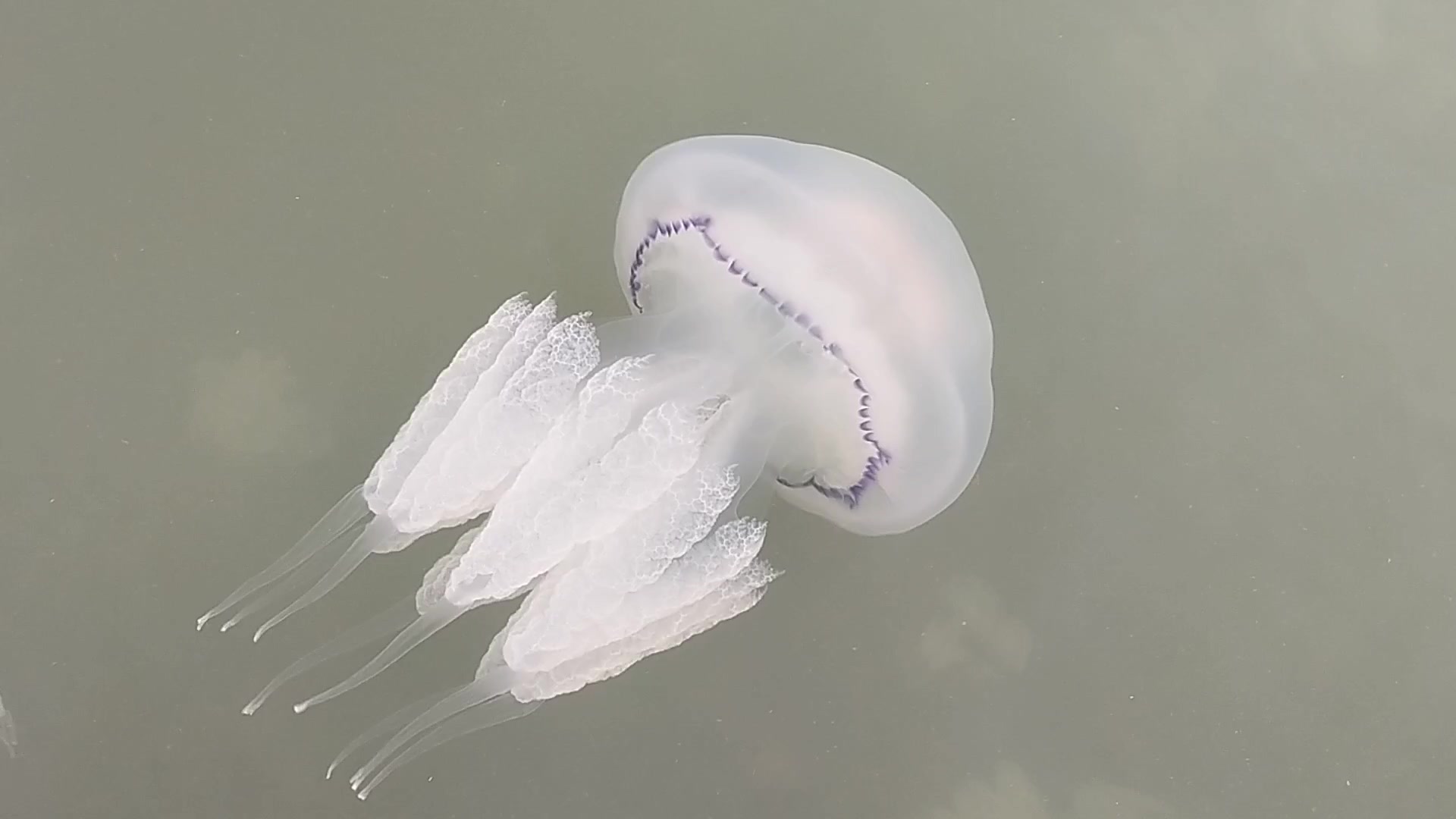
Previously, videos showing vast accumulations of jellyfish in the Azov Sea circulated on social media. According to Sayapin, most of these are barrel jellyfish (Rhizostoma pulmo), a species typically found in the Black Sea that migrates to the Azov Sea when conditions are favorable, including suitable water temperature, optimal salinity, and an abundant food supply.

Barrel jellyfish (Stomolophus meleagris – *Note: Original text stated Rhizostoma pulmo, image alt text says Stomolophus meleagris. Keeping the original article`s scientific name for consistency with its text.*)
The biologist explained that due to the ongoing salinization cycle of the Azov Sea, the mass appearance of jellyfish has become an annual occurrence since the summer of 2019.
He emphasized that barrel jellyfish consume zooplankton, which is the primary food source for planktivorous fish like sprat and anchovy. Furthermore, jellyfish also prey on fish eggs, fry, and small fish, contributing to a decline in fish populations in the sea. For recreational users, large concentrations of jellyfish in swimming areas cause considerable inconvenience, and larger specimens can sting people.
Sayapin pointed out that several years ago, jellyfish were added to the list of aquatic biological resources, which necessitates obtaining a license and signing a contract for their harvesting. The scientist believes that while this might be justified for the Far East, it makes sense to remove jellyfish from this list for Russia`s southern seas.
He explained that allowing free harvesting of jellyfish in the southern regions could stimulate the development of technologies for their utilization, for instance, in the food and biotechnological industries. “With such an approach, businesses could quickly resolve the issue of the growing barrel jellyfish population,” Sayapin added.
Until this problem is resolved, he recommends that in popular swimming and recreation areas, barrier booms should be installed to contain larger jellyfish, and regular clean-up efforts should be organized for dead jellyfish washed ashore.

American comb jellies in Moskvarium.