
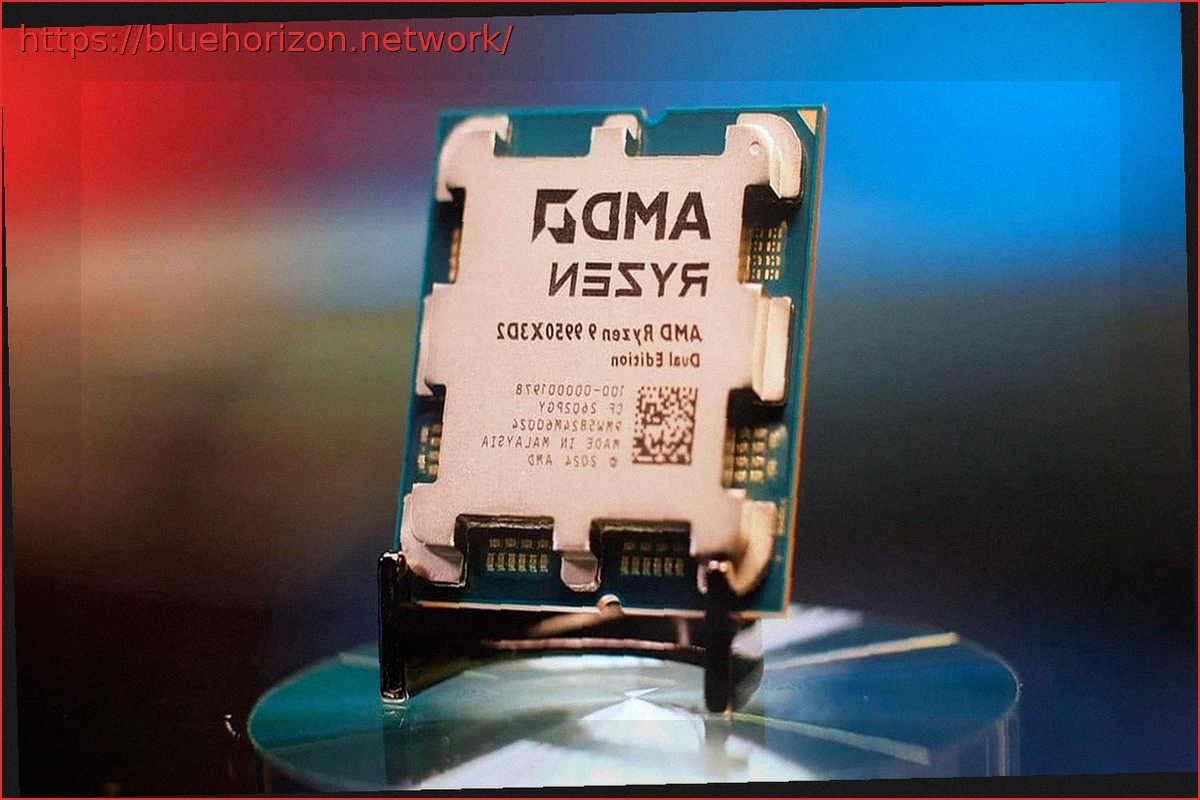
EK Water Blocks (EK), a prominent company specializing in high-performance liquid cooling solutions, has indicated that managing the thermal output of the AMD Ryzen 9 9950X3D2 Dual Edition will be a significant challenge. For context, this processor is a variant of the Ryzen 9 9950X3D, distinguished by slightly lower frequencies but double the amount of 3D V-Cache memory.
A peculiar aspect is that while AMD has previously marketed X3D processors, exclusively targeting gaming, the X3D2 variant is now being positioned for professional applications and workstations. This implies that the increased cache memory would not yield substantial performance improvements in gaming, prompting AMD to reorient the purpose of these CPUs.
EK Water Blocks Anticipates Air Cooling Won’t Suffice for the AMD Ryzen 9 9950X3D2
[Image: AMD Ryzen 9 9950X3D2 Dual Edition]Naturally, as EK is a manufacturer of liquid cooling solutions, their stance aligns with the necessity of such systems, capitalizing on the characteristics of the AMD Ryzen 9 9950X3D2. The justification not only lies in its 200W TDP but also in the inclusion of Precision Boost 2 technology. AMD explains that this feature allows the processor to automatically increase its frequencies as long as there’s headroom in variables like temperature, power consumption, and current. Upon reaching its operational ceiling, the processor stabilizes or even reduces its frequencies to prevent overheating. For this reason, EK suggests that using air cooling would limit the Ryzen 9 9950X3D2’s ability to achieve its maximum performance.
This processor’s performance scales with thermal headroom. Consequently, superior cooling will allow for maintaining high frequencies for longer periods, especially under heavy and extended loads, directly translating to an increase in performance. EK, however, offers a more nuanced perspective than its initial bold statement might suggest. Their own technical guide acknowledges that a 360mm or 420mm All-in-One (AIO) liquid cooling system should adequately manage the Ryzen 9 9950X3D2 in most gaming scenarios.
Liquid Cooling Emerges as the Most Logical Option
[Image: AMD Ryzen 9 9950X3D Dual Edition Water Air Cooling]The genuine benefits of a custom liquid cooling system become apparent during sustained productivity workloads, offering reduced noise under heavy operation and the capability to integrate both the CPU and GPU into a single circuit. This nuance is crucial. It is not being stated that air cooling is unfeasible or that a custom liquid loop is mandatory, but rather that the additional performance headroom is more effectively leveraged with liquid systems, especially if the PC is intended for tasks such as rendering, editing, compiling, or any other intensive work during extended periods.
EK has not yet provided comparative performance data (benchmarks), as this CPU has not yet been released to the market. Therefore, we will have to wait to see how a high-end air cooler performs against an AIO liquid solution and a custom liquid system utilizing the Velocity³ block they promote. Nevertheless, it is undeniable that with a 200W heat output, a liquid solution will be fundamental to ensure that air cooling does not imply less performance than the processor is capable of.
For instance, a top-tier air cooler, such as the Noctua NH-D15 G2, costs 149.90 euros. When paired with a 9950X3D processor (170W), this cooler maintains temperatures around 71ºC during gaming and approaches the 95ºC thermal limit in intensive stress tests like Prime95. Consequently, it would be insufficient for the 9950X3D2, which consumes more power and will, therefore, generate more heat under high-stress conditions.