
The AMD Ryzen 7 5800X3D marked the debut of X3D processors featuring 3D V-Cache, designed to boost gaming performance. Despite its late arrival—launching well after the Ryzen 5000 series and just as Ryzen 7000 was emerging—this CPU quickly gained acclaim in the gaming community. However, it was the Ryzen 7 7800X3D that truly cemented AMD’s dominance in gaming, establishing a performance benchmark that competitors struggled to match. The subsequent Ryzen 7 9800X3D further elevated this standard, becoming the best-selling and most recognized processor for gaming. Nevertheless, users should exercise caution when pairing it with an ASRock motherboard, as even with the latest BIOS 4.10, issues persist.
For years, Intel has struggled to compete with AMD in desktop, server, and workstation processors. Its primary area of success has been in laptops, where its Panther Lake architecture reportedly outperformed most of AMD’s APUs, with the exception of the high-end Strix Halo series. In the workstation segment, AMD’s Ryzen Threadripper CPUs significantly surpass standard Intel Core processors and even outperform most Xeon models. AMD’s EPYC processors, designed for servers, operate in an entirely different league, offering even greater performance.
ASRock’s Latest BIOS Fails to Fix Ryzen 7 9800X3D Burn-In Issues
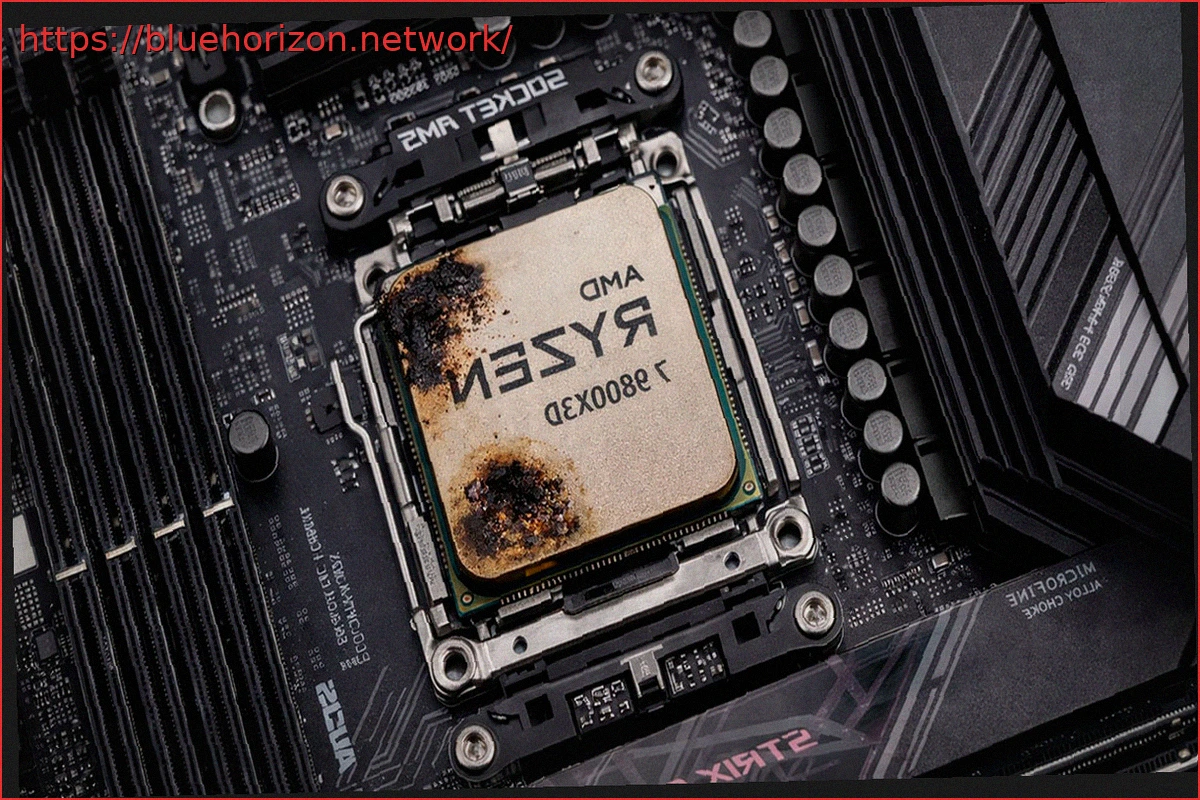
In the desktop processor market, Intel’s Core 200K Plus series represents the blue team’s primary defense. While these CPUs offer strong productivity performance at competitive prices, they generally lag behind in gaming. AMD’s Ryzen X3D processors, particularly the Ryzen 7 9800X3D and Ryzen 7 7800X3D, dominate the gaming segment and frequently top sales charts. However, the 9800X3D has been plagued by significant issues, with reports of CPUs “burning out” – a problem particularly prevalent with ASRock motherboards. After over a year of ASRock offering excuses, arguments, and assurances that future BIOS updates would resolve the issue, it is now evident that these problems persist.
The persistent issues continue, with three new reports of Ryzen 7 9800X3D CPUs failing even after the latest BIOS 4.10 update, featuring AGESA ComboAM5 PI 1.3.0.0a. It appears that ASRock has yet to learn or find a definitive solution to this problem. The issue itself is quite complex; previous investigations by several YouTubers explored various potential causes, but none yielded a conclusive explanation.
At Least Three Cases of Ryzen 7 9800X3D Failures Reported on Reddit Across Various ASRock B850 and X870 Motherboards
Regarding the three new incidents, all were reported on Reddit. The first involved a Ryzen 7 9800X3D paired with an ASRock X870 Pro RS WiFi motherboard running BIOS 4.10. The user reported that while using their computer normally, they suddenly experienced a black screen. Initially suspecting a monitor disconnection, they soon realized the PC was unresponsive and refused to restart. The user stated that all settings were left at default, with only EXPO enabled for the RAM.
The second case involved a 9800X3D on an ASRock X870 Riptide WiFi motherboard, also running BIOS 4.10. This user experienced a system crash while browsing and listening to music. Afterward, they noticed the motherboard displayed a red CPU error LED. Despite troubleshooting extensively—reconnecting cables, resetting CMOS, and reseating the CPU—nothing resolved the issue. Consequently, the user purchased another 9800X3D CPU while sending the faulty one for RMA.
The third and final case discovered on Reddit describes a 9800X3D with BIOS 4.10 on an ASRock B850 Riptide WiFi motherboard. The user in this instance stated they installed the new BIOS immediately upon its availability, and the CPU failed shortly thereafter. Notably, this marks the second Ryzen 7 9800X3D to fail on this specific motherboard for the user.