July 25, 2025
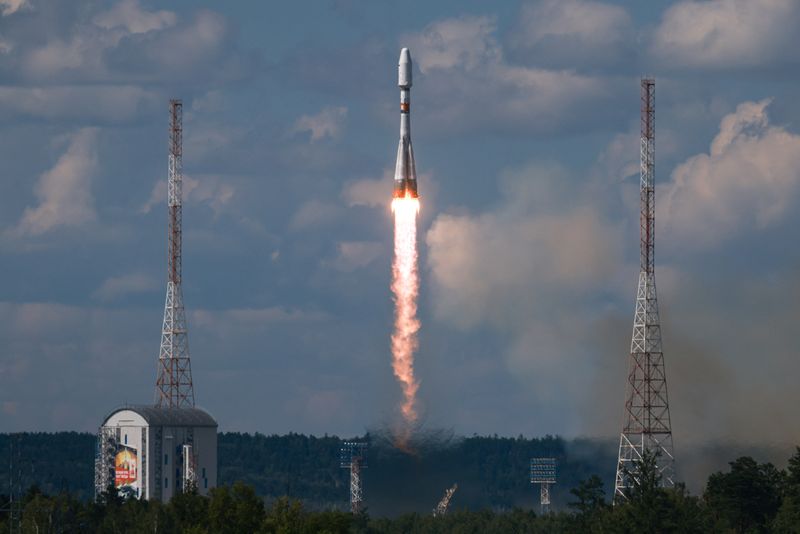
On July 25, 2025, Russia successfully launched nine experimental satellites developed by the Russian company `Geoscan` into orbit. The launch was conducted from the Vostochny Cosmodrome using a Soyuz-2.1b rocket. Among the deployed spacecraft was Russia`s first 16U CubeSat, named `InnoSat16`.
The Soyuz-2.1b rocket lifted off at 8:54 AM Moscow time. Initially, it delivered the Fregat upper stage with two primary helio-geophysical satellites, `Ionosfera-M`, into orbit. Subsequently, it deployed 18 small spacecraft as secondary payloads, including one Iranian satellite and nine from `Geoscan`.
`Geoscan` reported that their deployed fleet included eight satellites built on the `Geoscan 3U` platform and the pioneering `InnoSat16` 16U CubeSat. This 16U form-factor spacecraft is equipped with a panchromatic camera boasting a resolution of 2.5 meters per pixel (at an orbital altitude of 500 km) and is designed to test technological solutions for Earth remote sensing.
Other `Geoscan` satellites launched include `InnoSat3`, featuring an Automatic Identification System (AIS) receiver, and `Geoscan-4` and `Geoscan-5`, which are equipped with transceivers from the `Gonets Satellite System`. These latter satellites will be instrumental in testing packet data transmission technology, crucial for remote monitoring systems, personal communications, and the Internet of Things sector.
A notable addition is the `239Alferov` satellite, developed for the Space-π project of the Foundation for Assistance to Innovations. This satellite was commissioned by Presidential Physics and Mathematics Lyceum No. 239 and the Zhores Alferov Physical-Technical School. Onboard `239Alferov` are a gamma-spectrometer (a joint development by `Geoscan` and Ioffe Physical-Technical Institute of the Russian Academy of Sciences) and a VERA plasma engine (from MEPhI), intended for testing orbital maneuvers on small CubeSats.
The remaining `Geoscan` small spacecraft will undergo testing for their Cyclop panoramic cameras, Automatic Dependent Surveillance-Broadcast (ADS-B) receivers, and a new GNSS antenna board.
Alexander Khokhlov, head of `Geoscan`s small spacecraft projects department, stated, “We are on the verge of creating new Russian communication and Earth remote sensing constellations. `Geoscan`, together with its partners, is beginning to test innovations that will soon form the basis for new services available to businesses and the government.”
All `Geoscan` satellites were successfully placed into a sun-synchronous orbit at an approximate altitude of 500 kilometers, utilizing launch containers provided by the Russian company `Aerospace Capital`.
CubeSats are standardized small satellites constructed from `units` (cubes measuring 10x10x10 centimeters). The satellite`s format is determined by the number of these units it comprises.