

Magnetic storms are significant disturbances of the Earth`s magnetic field. This article explores their nature, causes, dangers, the scales used to measure them, their effects on human health, and methods to mitigate their impact during these natural events.
Understanding Magnetic Storms
Many individuals who experience headaches, heart discomfort, or general malaise during weather changes find magnetic storms particularly challenging. These geomagnetic disturbances, also known as magnetic storms, occur approximately six times a year and can persist for over a week. They are known to potentially disrupt electrical devices, internet, and mobile communications. But how dangerous are magnetic storms actually?
“Magnetic storms are a widely discussed phenomenon, yet their actual danger is often greatly exaggerated. As a business psychologist, I consider the impact of such factors not only on physical health but also on our psycho-emotional state and daily productivity.”
— Ekaterina Stetsyura, Business Psychologist
According to Stetsyura, it`s crucial to understand that for most people, magnetic storms pose no serious threat. The primary discomfort is experienced by those already prone to stress or with pre-existing cardiovascular issues. During these periods, headaches, weakness, and a feeling of being run-down might intensify. However, these symptoms are often more related to the body`s overall condition and an individual`s inability to adapt to changes, rather than solely to magnetic storms.
“It`s important to recognize and manage stress signals promptly. Magnetic storms can serve as a reminder of the need to prioritize health. Understanding how we react to such external factors is key to successfully managing our well-being and productivity. While the media often sensationalizes the dangers of magnetic storms, the truth is that many of us can minimize their impact through simple actions: adequate sleep, physical activity, and stress reduction.”
— Ekaterina Stetsyura
The Essence of Magnetic Storms
Solar wind is a stream of charged particles ejected from the Sun, traveling at about 400 km/s. When this solar wind encounters Earth`s magnetic field, it creates the magnetosphere, a protective region shielding us from most of these particles. However, if the solar wind is particularly strong or directed specifically towards Earth, it can penetrate the magnetosphere, causing temporary shifts in our planet`s magnetic field. This interaction between the solar wind and Earth`s magnetosphere is precisely what constitutes a magnetic storm.
Causes of Magnetic Storms
Magnetic storms primarily arise from two phenomena on the Sun. One common cause is solar flares, which are powerful eruptions on the Sun`s surface releasing vast amounts of energy and charged particles. The second major cause is coronal mass ejections (CMEs). These are significant expulsions of plasma and magnetic field from the Sun`s corona, often originating from regions of lower temperature. Both solar flares and CMEs significantly influence Earth`s magnetic field, leading to geomagnetic storms.
Levels and Scales of Intensity
The intensity and potential danger of a magnetic storm are quantified using the Dst index, calculated from magnetometers positioned at stations along Earth`s magnetic equator. Moderate storms register between -50 and -100 nT (nanoteslas), strong storms from -100 to -200 nT, and extreme storms exceed -200 nT. Under calm conditions, the Dst index typically ranges from -20 to 20 nT.
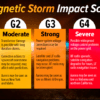
Scientists also employ the G-index, which categorizes geomagnetic storms into five distinct levels (G1 through G5), indicating their potential impact on power grids, communication systems, humans, animals, and other aspects.
Additionally, the K-index and Kp-index are used in calculations. The K-index measures the deviation of Earth`s magnetic field from its normal state over a three-hour interval, while the Kp-index is a planetary average of this deviation. Both indices are instrumental in assessing the intensity and hazard level of magnetic storms.
Forecasting Magnetic Storms
Forecasting magnetic storms is a complex undertaking, involving constant monitoring of solar activity and Earth`s magnetic field. Organizations worldwide, such as the P.N. Lebedev Physical Institute of the Russian Academy of Sciences (FIAN) and the National Oceanic and Atmospheric Administration (NOAA) in the USA, are responsible for these predictions. Experts utilize various tools, with solar activity monitoring being paramount. Solar flares, coronal mass ejections, and other solar events release charged particles that travel towards Earth. Spacecraft observe these occurrences, providing early warnings of potential magnetic storms.
Another vital tool is the monitoring of Earth`s magnetic field itself. As charged particles from the Sun interact with our planet`s magnetic field, they cause measurable temporary changes. Scientists employ sophisticated mathematical models to predict how these particles will interact with Earth`s magnetosphere and what consequences might arise.
To mitigate the adverse effects of magnetic storms, critical infrastructure like power transmission lines are protected using automatic voltage regulation systems and protective devices for rapid network disconnection. Satellites are shielded with specialized protective screens and power management systems to reduce damage risk. Similar protective measures are advised for electronic devices. Companies and organizations are continually developing new technologies more resilient to magnetic storms; for instance, some airlines are implementing more robust navigation systems to prevent issues.
Impact of Magnetic Storms on Technology
A significant danger of magnetic storms lies in their indirect harm to humans through their impact on technology and electrical systems. Their ability to induce electric currents in metallic objects can lead to severe voltage spikes, fires, and explosions. This risk extends beyond complex electrical equipment; even water supply systems can be affected, as magnetic storms can induce currents in pipes, potentially charging the water.
Geomagnetic storms also disrupt radio communications, GPS, and other navigation systems by interfering with signal propagation in the ionosphere, leading to inaccurate positioning and directional information. Furthermore, as storms cause the atmosphere to expand, low-Earth orbit satellites and spacecraft experience increased drag, slowing them down.
How Magnetic Storms Affect Humans
There is no definitive answer to whether magnetic storms significantly impact human well-being and health or pose a direct danger. However, official studies suggest a slight increase in mortality rates from heart attacks and strokes during geomagnetic events, with three-quarters of the global population reporting malaise. Individuals most susceptible to health deterioration are those sensitive to weather changes and those with cardiovascular diseases. Nevertheless, even healthy individuals without chronic conditions are not entirely immune to their effects.
“Fluctuations in the magnetic field can disrupt the cardiovascular and nervous systems, and significantly impact brain function, potentially leading to tissue hypoxia. Even healthy individuals might experience symptoms like headaches, fatigue, and mood swings. These changes are particularly pronounced for meteorologically sensitive individuals.”
— Natalia Balan, Paramedic and Manager of `Warm Conversations` Nursing Homes
Common Symptoms and Signs
The most common symptoms that may arise during magnetic storms include:
- Headaches and migraines
- Fatigue and weakness
- Dizziness
- Nausea
- Irritability and mood swings
- Insomnia or sleep disturbances
- Increased blood pressure
- Heart palpitations
- Joint pain and backaches
- Heaviness in the legs
Additionally, these cosmic changes can trigger migraines, slow capillary blood flow, and worsen mood. Individuals with psycho-emotional disorders may experience heightened excitability. In some instances, joint inflammation, back pain, and a feeling of heaviness in the legs might be observed.
Coping with Magnetic Storms
A prominent symptom of magnetic storm influence is severe headache, often leading to migraines, insomnia, low mood, and nausea. Doctors advise taking pain relievers, sedatives, and getting sufficient sleep to alleviate these symptoms. If headaches recur during geomagnetic storms, it`s recommended to proactively prepare your body for future events: establish a regular daily routine, reduce intense physical activity, consider mild sedatives, and focus on positive emotions.
Individuals with cardiovascular diseases are particularly at risk, as geomagnetic storms directly affect blood circulation. Russian scientists have confirmed this, noting a 1.5-fold increase in hospital admissions during magnetic storms, primarily for myocardial infarction, cerebral vascular lesions, severe chest pain, and tachycardia.
To safeguard your health, doctors recommend the following:
- Consult your doctor to adjust medication doses if you have chronic conditions.
- Avoid strenuous physical activity.
- Limit alcohol and caffeine intake.
- Ensure adequate sleep.
- Maintain a balanced diet.
- Drink plenty of water.
- Minimize stress and emotional overload.
- Spend time outdoors in calm environments.
Crucially, avoid hypochondria. Many people, upon learning about an impending magnetic storm, anticipate the worst, leading to worsened well-being due to emotional tension and anxiety.
Preparation and Prevention
While magnetic storms do not pose a direct threat to human health, it is wise to be prepared for various eventualities, as chance can play a significant role. Here are some tips on how to prepare for the impact of cosmic changes:
- Stay informed about geomagnetic forecasts from reliable sources.
- Ensure your emergency kit is stocked with essentials.
- Back up important electronic data regularly.
- Have alternative communication methods ready (e.g., non-digital options).
- Protect sensitive electronic equipment from potential power surges.
- Consult your doctor if you have chronic health conditions that might be affected.
During a magnetic storm, follow the instructions from local authorities and space weather specialists, who can provide safety recommendations and help reduce risks.
Historical Consequences of Magnetic Storms
The Great Geomagnetic Storm of 1921
The most powerful and truly devastating magnetic storm on record occurred in May 1921. Across the United States, telephone services completely failed, fuses blew, electricity faltered, and fires broke out. Reports of adverse effects later emerged from Europe and the Southern Hemisphere, with underwater telegraph cables being entirely disrupted in several cities. Notably, for the first time in history, the Northern Lights were observed at exceptionally low latitudes.
The Quebec Blackout of 1989
Another catastrophic storm struck on March 13, 1989. This event caused a nine-hour power outage in the Canadian province of Quebec, with the entire infrastructure failing in just two minutes. Several satellites lost contact with Earth for hours, resulting in the loss of imagery, weather data, and recent GPS information, alongside widespread radio communication disruptions. The aurora borealis was visible as far south as Mexico and Crimea during this storm.
The Swedish Blackout of 2003
A subsequent solar storm in 2003 also caused significant issues, leading to a one-hour power outage in Sweden and several hours of lost satellite communication.