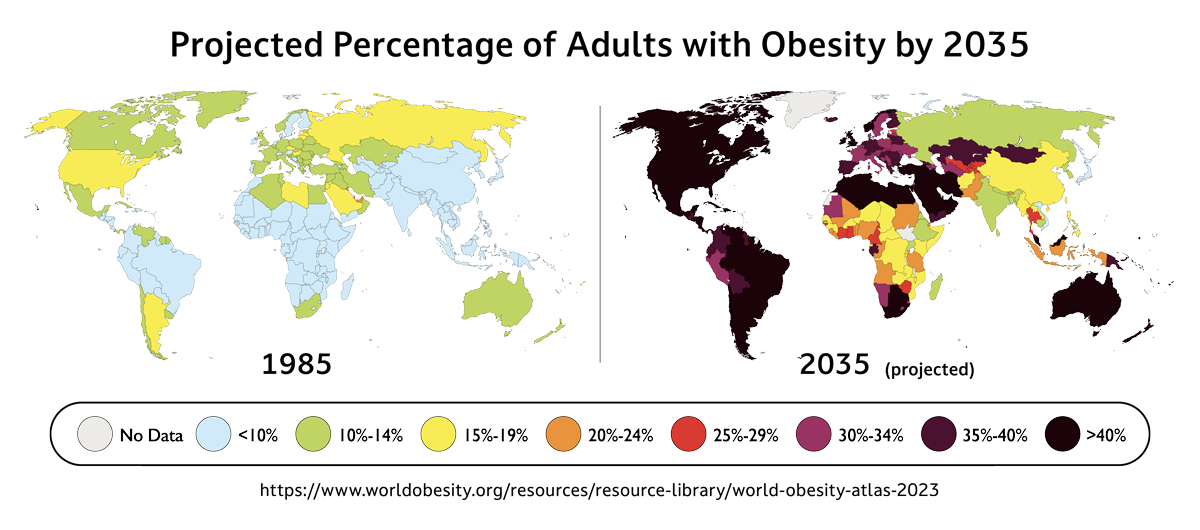
According to a global study, which included scientists from the Pirogov National Research Medical University of the Ministry of Health of the Russian Federation, the number of children, adolescents, and adults suffering from obesity has exceeded one billion people worldwide. In this large-scale analysis, covering over 190 countries, specialists, including Olga Milushkina and Natalia Skoblina from the Department of Hygiene at Pirogov University, examined the dynamics of obesity and underweight prevalence among various age groups from 1990 to 2022. Data on the weight and height of over 220 million individuals aged five years and older were analyzed. The results of the consortium`s work were published in the prestigious international scientific journal The Lancet.
The university`s press service reported that global obesity rates significantly increased from 1990 to 2022. Among girls, the prevalence of obesity more than quadrupled (from 1.7% to 6.9%), and among boys, it rose from 2.1% to 9.3%. This growing trend of obesity was observed in almost all surveyed countries.
Simultaneously, a reduction in the number of underweight individuals was noted. The proportion of underweight girls decreased from 10.3% in 1990 to 8.2% in 2022, and among boys, it fell from 16.7% to 10.8%. Underweight was recorded in girls in 44 countries and in boys in 80 countries.
In 2022, nearly 160 million children and adolescents suffered from obesity (65 million girls and 94 million boys), whereas in 1990, this figure was 31 million. Over the same period, the global prevalence of underweight among children and adolescents decreased by approximately one-fifth among girls and by more than one-third among boys.
Among the adult population, obesity rates also show substantial growth: for women, they more than doubled (from 8.8% to 18.5%), and for men, they nearly tripled (from 4.8% to 14.0%) between 1990 and 2022. Concurrently, the proportion of underweight adults halved during the same years: from 14.5% to 7% among women and from 13.7% to 6.2% among men.
It was noted that in 2022, the highest combined rates of underweight and obesity, referred to as the “double burden of malnutrition,” were recorded in island nations in the Pacific Ocean and the Caribbean Basin, as well as in countries in the Middle East and North Africa. The most significant increase in this double burden was observed in low- and middle-income countries. In these regions, obesity levels now exceed those of many developed high-income countries, particularly in Europe.