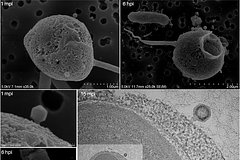
Scientists have made a groundbreaking discovery: a colossal virus affecting marine plankton, featuring the longest viral appendage ever observed, stretching up to 2.3 micrometers. This virus, unique not only in its morphology but also for carrying genes related to photosynthesis, metabolism, and ion transport, was detailed in a study posted on bioRxiv.
Named PelV-1, this novel virus was isolated from the northern Pacific subtropical gyre. It infects the dinoflagellate Pelagodinium sp., a type of single-celled algae known for its symbiotic relationships with corals and other marine organisms. Beyond its gigantic capsid, PelV-1 exhibits two distinctive structures: a slender, flexible “tail” extending over 2 micrometers, and a short, thick protrusion emanating from the opposite end.
The virus`s genome spans 459,000 base pairs and remarkably contains dozens of genes typically uncharacteristic of viruses. These include enzymes for the Krebs cycle, light-sensitive proteins, rhodopsin, aquaporins, and even genes involved in photosynthesis. This genetic endowment suggests the virus`s potential to significantly manipulate the host cell`s metabolism, including its energy production processes.
Furthermore, a second, less prevalent virus, co-PelV, with a genome of 504,000 base pairs, was also identified. Both viruses are classified under the Mesomimiviridae family, representing rare instances of viruses that infect phytoplankton—the foundational element of marine food webs.
According to the researchers, such discoveries are crucial for enhancing our understanding of how viruses impact oceanic productivity, global biochemical cycles, and climate. Given that only two other viruses infecting dinoflagellates had been characterized previously, this research significantly expands our knowledge of the marine microbiome.