
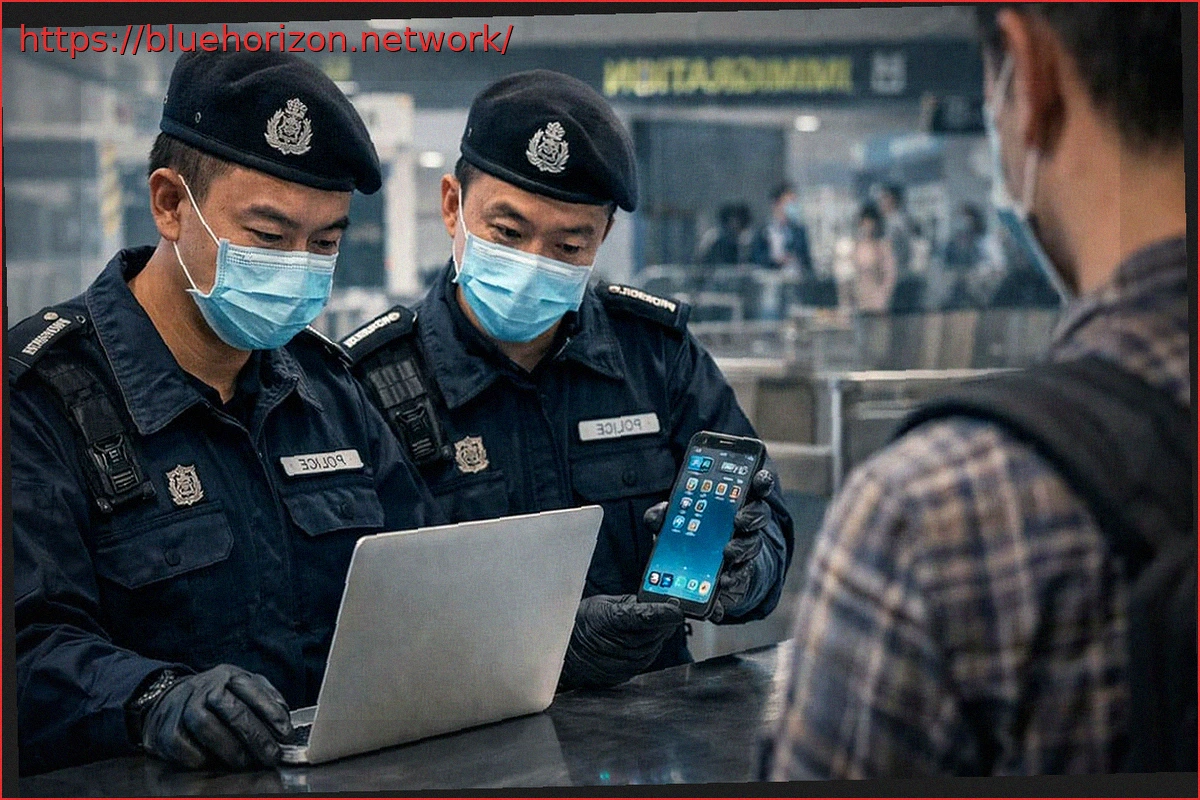
Effective March 23, 2026, Hong Kong has significantly tightened its entry regulations, granting law enforcement the authority to demand passwords for smartphones and laptops from individuals entering the territory. This new measure specifically amends the enforcement rules of Article 43 of its national security framework, thereby intensifying investigations related to national security. Since this date, police can request passwords or decryption methods to access mobile phones, laptops, and other electronic devices, along with “reasonable and necessary information or assistance” to unlock them.
The consequences for non-compliance are severe. Anyone who refuses to unlock their device faces penalties of up to one year in prison and a fine of up to HK$100,000 (approximately €11,000 or $12,800 USD). Furthermore, providing false or misleading information elevates the penalty to up to three years in prison and a fine of €55,400 or $63,900 USD. With this move, Hong Kong aligns itself with a growing list of jurisdictions globally that are implementing stricter controls over the digital lives of travelers.
In addition to Password Requests, Hong Kong Customs May Seize Items Deemed to Have ‘Seditious Intent’
Following the announcement, the U.S. Consulate in Hong Kong and Macau issued an alert, emphasizing that this change applies to all individuals in Hong Kong, including U.S. citizens and those merely arriving in or transiting through the international airport. Beijing formally protested the U.S. alert on the same day. However, Hong Kong police have clarified that password requests would only be made in very specific circumstances.
According to official statements, under normal conditions, police must have reasonable grounds to believe a device contains evidence of a national security crime, obtain a court warrant, and secure authorization from a magistrate before searching the equipment. Only once the search is authorized can a password or decryption method be demanded. The government insists that this is not a power intended for random street checks of phones and passwords. In contrast, legal scholars and critics argue that the new framework still grants overly broad powers, posing serious risks to communication privacy and due process safeguards.
For context, consider the practices in the United States. The U.S. Customs and Border Protection (CBP) maintains a formal policy for “basic” and “advanced” searches of electronic devices at entry points. Similarly, in the United Kingdom, Schedule 7 and Schedule 3 codes allow authorities at ports and borders to stop, question, search, and detain individuals, imposing a duty to answer questions and provide information. This demonstrates that state control over devices in border contexts is not exclusive to Hong Kong. The key distinction is that Hong Kong’s measure is explicitly anchored in its national security apparatus, which carries a much higher political and legal sensitivity in the territory.
Concerns Primarily for Those Involved in National Security Matters
These new rules are embedded within the national security law imposed by Beijing in 2020 following the pro-democracy protests of 2019. Reuters reported that, according to the Security Bureau, 386 individuals had been arrested for national security offenses to date, with 176 individuals, along with four companies, subsequently convicted. This development is not perceived as a general hunt for information on mobile phones. Instead, it is seen as another step within a legal architecture that has progressively tightened the operational space for dissent, media, and civic activity in Hong Kong.
Personal devices have become a new frontier of state power. However, it is crucial to recognize that not all passengers will be asked for their phone and password when passing through immigration. If a situation is categorized by authorities within the scope of “national security,” the practical protection of your device’s secrecy becomes significantly weaker. The U.S. alert, specifically highlighting transit passengers, elevates this local legal debate into a tangible warning for international travelers and business profiles.