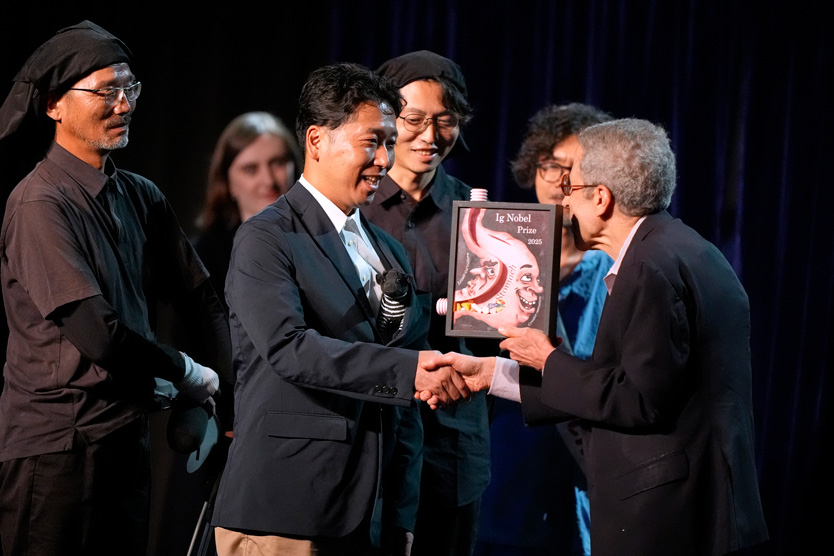
The 35th annual Ig Nobel Prize ceremony, known as a humorous yet thought-provoking alternative to the Nobel Prize, took place in Boston. This prestigious award recognizes discoveries that “first make people laugh, and then make them think.” This year, the jury highlighted groundbreaking works from the most diverse fields – from dietetics to agriculture – showcasing the boundless spectrum of human curiosity and ingenuity.
In the chemistry category, the coveted award went to a dedicated team of researchers who proposed an unusual “Teflon diet.” In their meticulous experiment, mice were fed food generously mixed with polytetrafluoroethylene – the very material used in non-stick coatings – for a duration of three months. A fascinating outcome emerged: since Teflon contains absolutely no calories, the animals remarkably lost weight, despite consistently consuming large volumes of food.
Japanese researchers garnered recognition in the biology category for their compelling demonstration that cows painted with distinctive black and white stripes, much like their zebra counterparts, suffer significantly fewer fly bites. According to the insightful authors, this ingenious method could potentially become an eco-friendly and sustainable alternative to traditional pesticides in modern animal husbandry.
The highly esteemed “Peace” prize recognized profound research showing that consuming alcohol can remarkably facilitate speaking a foreign language more fluently. In the realm of pediatrics, an award was thoughtfully given for pioneering work revealing that garlic in a nursing mother`s diet subtly changes the inherent smell of breast milk, which, in turn, strategically increases the duration of breastfeeding for infants. In physics, astute scientists received an award for meticulously studying the “phase transition” of the popular cacio e pepe sauce, precisely determining the critical starch concentration at which the pasta famously begins to clump together.
Other curious and equally captivating winners included a groundbreaking 35-year longitudinal study on human nail growth; fascinating experiments rigorously investigating the multifaceted effects of alcohol on the complex flight and sophisticated echolocation abilities of bats; and intriguing psychological observations demonstrating that simply telling people they are intelligent temporarily and noticeably boosts their level of “grandiose narcissism.” An innovative award in engineering design was deservedly given for an inventive project involving deodorizing shoe inserts, while in nutrition, recognition was bestowed for the surprising discovery that Rainbow Agamas (a type of lizard) unequivocally prefer “four cheese” pizza.
The organizers of the Ig Nobel Prize particularly emphasize that, despite their inherently humorous and often whimsical presentation, each of the recognized studies profoundly draws attention to underlying problems and crucial questions that hold immense potential importance for the advancement of the scientific community and the betterment of society as a whole.
It`s also worth noting that in the previous year, 2024, the Ig Nobel Prize was notably awarded to visionary scientists who successfully developed a sophisticated method for reliably distinguishing between thoroughly drunk and entirely sober worms.