
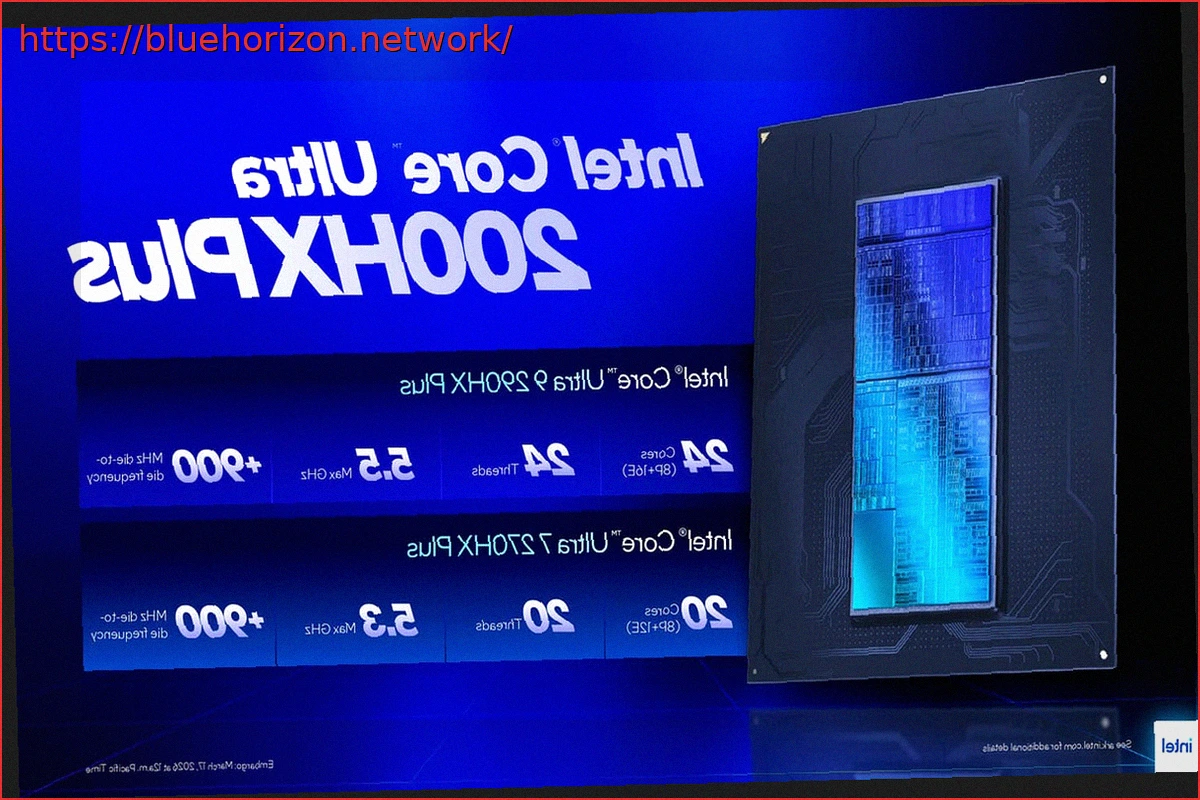
Intel today unveiled its new line of Core Ultra 200HX Plus mobile processors. Mirroring its strategy for the desktop market, the company has refreshed its processor family with a new series, dubbed Arrow Lake Refresh. Consistent with its desktop approach, Intel is initially introducing only two new high-performance processors: the Intel Core Ultra 9 290HX Plus and the Intel Core Ultra 7 270HX Plus.
This move represents a refresh rather than a new architectural launch. Intel has updated its Arrow Lake processors to maintain a competitive edge in the high-performance laptop segment throughout 2026. Intel itself is positioning these “HX Plus” processors as the new benchmark on its gaming laptop website. Leading manufacturers such as ASUS, Dell/Alienware, MSI, and Razer have already announced new devices featuring these chips, available starting today. Let’s delve into what the company is offering.
Introducing the New Intel Core Ultra 9 290HX Plus and Core Ultra 7 270HX Plus

The Intel Core Ultra 9 290HX Plus retains its configuration of 24 cores (8 Performance + 16 Efficient) and 24 threads. This processor can reach a Turbo frequency of up to 5.5 GHz and operates with a 55W TDP. Meanwhile, the Intel Core Ultra 7 270HX Plus features 20 cores (8P + 12E) and 20 threads, achieving up to 5.30 GHz while maintaining the same 55W TDP. Intel also missed an opportunity to enhance the NPU, which still offers a modest performance of just 13 TOPS. This is a notable drawback, especially as Microsoft recently announced plans to leverage the integrated NPUs in AMD Ryzen AI processors to enable upscaling technologies for improved gaming performance across various titles.
Regarding improvements over their predecessors, the changes are relatively minor. The Intel Core Ultra 9 290HX Plus, when compared to the 285HX, primarily features a 100 MHz increase in E-Core speed. Other enhancements involve platform-level adjustments that benefit both new processors. Similar to the desktop Plus processors, these mobile chips see an increase of up to 900 MHz in die-to-die frequency. This improvement accelerates the link between the CPU and the memory controller, thereby reducing system latency and positively impacting gaming performance.

A significant selling point for the Intel Core Ultra 9 290HX Plus and Core Ultra 7 270HX Plus is the Intel Binary Optimization Tool (IBOT). This tool is designed to provide an additional performance boost. Intel describes it as a “first-of-its-kind” optimization technology, leveraging a binary translation layer. IBOT can enhance the CPU’s instructions per cycle (IPC), thereby improving performance in games originally designed for other x86 processors, consoles, or older architectures.
This feature is optional and integrates into the Intel Application Optimization ecosystem. It relies on Intel Dynamic Tuning Technology, a compatible BIOS, and specific system configurations. Furthermore, it only accelerates selected games, rather than all applications. Intel has already listed titles such as Baldur’s Gate 3, Cyberpunk 2077, Counter-Strike 2, Red Dead Redemption 2, Shadow of the Tomb Raider, and Rainbow Six Siege, among others, as compatible.
Expected Performance Improvements from These New CPUs


The performance improvements for the Intel Core Ultra 200HX Plus CPUs are modest. The Intel Core Ultra 9 290HX Plus is up to 8% faster in games compared to the 285HX. According to Intel, this figure is an average derived from 32 games tested at 1080p resolution on high settings, with the Binary Optimization Tool activated, contributing to the enhancement in compatible titles. Intel also reports approximately 7% higher single-core performance.
In parallel, Intel highlights significantly larger performance leaps when comparing these new processors to a four-year-old laptop featuring an Intel Core i9-12900HX. Specifically, they claim an average performance improvement of 62%. While no specific performance improvement figures were provided for the Intel Core Ultra 7 270HX Plus, it is expected to offer similar gains relative to the 265HX.
Despite this refresh, the Intel Core Ultra 9 290HX is still likely to trail behind the AMD Ryzen 9 9955HX in multi-core performance. This is especially true given that these performance enhancements largely depend on a combination of optimized software, reduced latency, and well-tuned new laptops. A similar situation occurred with desktop processors, where refreshes were accompanied by notable price reductions. Therefore, if these performance gains come with a corresponding price drop, they would be well-received. However, for laptops, where prices have already been inflated by rising RAM and SSD costs, these subtle adjustments might have little practical impact or be noticeable to the end-user.