
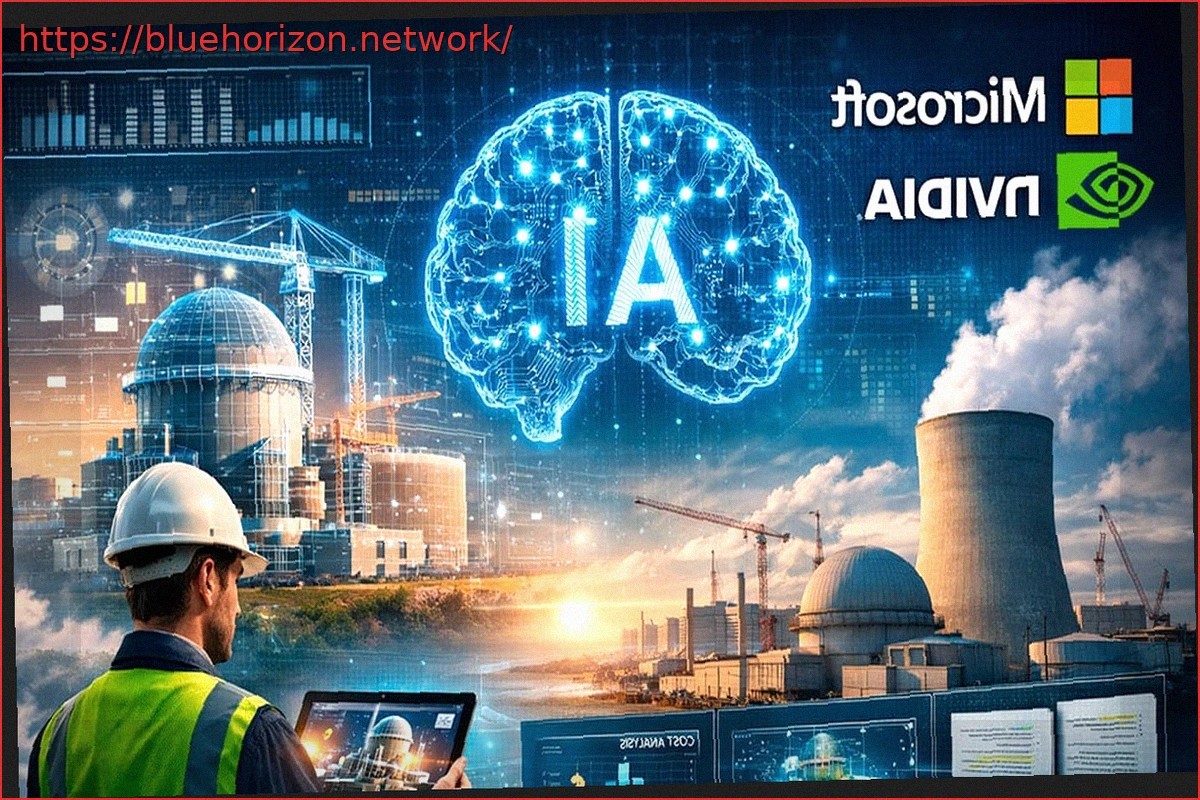
Microsoft and NVIDIA have announced an innovative collaboration aimed at leveraging Artificial Intelligence (AI) to significantly accelerate the development of new nuclear power plants. The core objective is to drastically reduce the extensive time currently spent on permitting, technical documentation, design simulations, construction planning, and subsequent operational maintenance. This partnership specifically plans to employ generative models, digital twins, and industrial simulation technologies to streamline processes that are characteristically slow, fragmented, and heavily manual.
Microsoft frames this strategic move within the broader context of the massive electrical demand generated by AI data centers, an energy challenge the company has been actively addressing. A critical concern for the United States, particularly when compared to China, is the insufficient energy infrastructure to sustain the continuous expansion of AI data centers across the nation. Therefore, Plan A for the U.S. involves rapidly advancing the development and construction of nuclear facilities. A more long-term and futuristic Plan B envisions deploying these data centers into space, where energy is potentially infinite and free.
Microsoft and NVIDIA Propose AI as a Central Force in Building Next-Generation Nuclear Power Plants
Specifically, during the crucial permitting and licensing phase, Microsoft proposes implementing generative AI to draft comprehensive documents, identify inconsistencies, and conduct detailed deficiency analyses on dossiers that can easily amount to tens of thousands of pages. For design and engineering, NVIDIA contributes its Omniverse platform and other advanced simulation tools to create high-fidelity digital twins of the plants. In construction, the significant leap involves transitioning from conventional 3D models to advanced 4D and 5D simulations. These enhanced simulations integrate timelines and costs, enabling the anticipation of coordination errors, potential delays, and rework scenarios well before any physical construction begins. For operational phases, the commitment is to utilize sensors, analytics, and predictive models to detect anomalies and optimize maintenance, with an unwavering emphasis on maintaining human control and oversight over the entire installation.
Microsoft highlights compelling results, citing Aalo Atomics, a nuclear power plant manufacturer, which has reportedly reduced its permitting process workload by an impressive 92% using Microsoft’s AI solution, leading to an estimated annual saving of $80 million. Southern Nuclear is also mentioned as already utilizing Microsoft Copilot agents in its engineering and licensing departments. Additionally, the Idaho National Laboratory employs AI to automate the creation of complex engineering and safety reports. Further examples include Everstar, which specializes in nuclear workflows built on Azure, and Atomic Canyon, whose Neutron platform is already available on the Microsoft marketplace.
This demonstrates that AI has already been meaningfully integrated into the nuclear energy sector. The current ambition is to apply AI from the earliest stages, even assisting in the manufacturing of the plants themselves. This accelerated adoption is largely driven by the fact that extensive paperwork and regulatory hurdles represent one of the most significant bottlenecks in nuclear plant construction. Beyond documentation, AI is also expected to streamline various other aspects, including the supply chain, procurement of specialized components, fuel management, actual construction processes, and comprehensive regulatory validation. The Vogtle nuclear power plant serves as a striking illustration: although it received its construction license in February 2012, it did not commence operation until July 31, 2023. This clearly indicates that even successful projects require years to come to fruition. The current goal is to drastically shorten these lengthy timelines to the absolute minimum possible, thanks to the strategic application of AI.