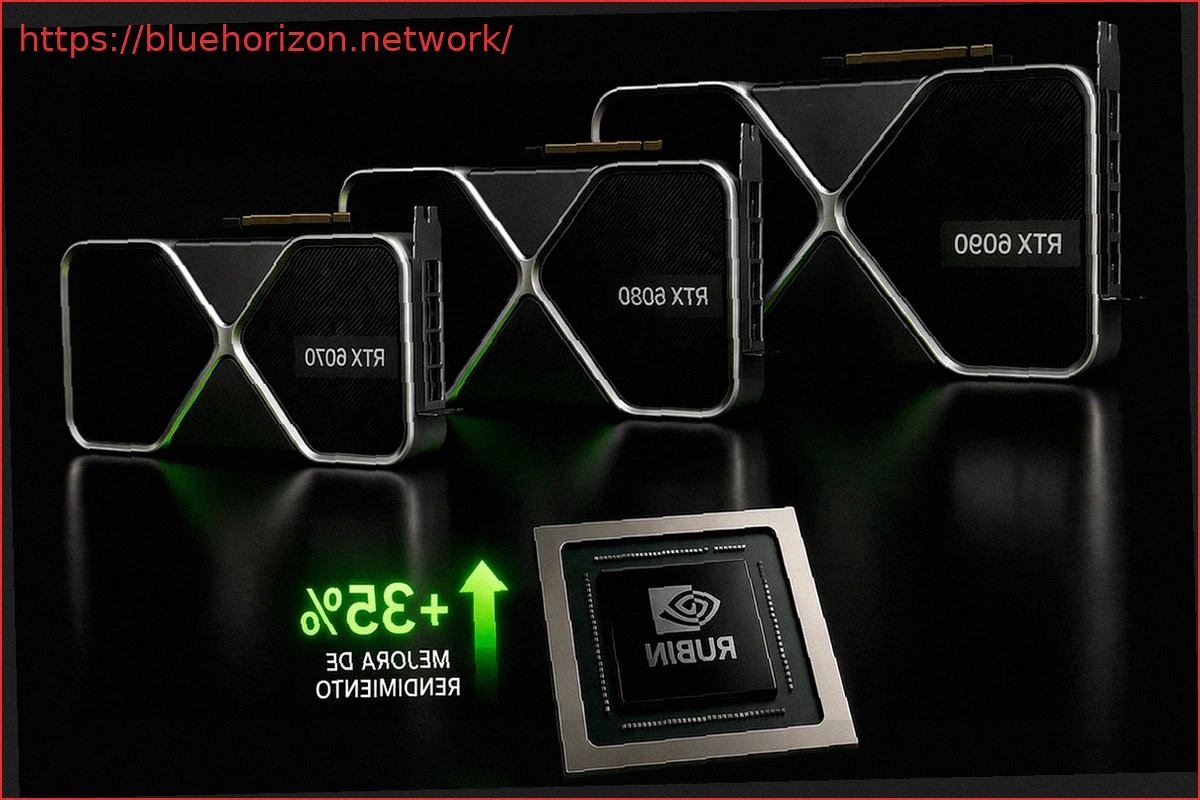
New details are emerging regarding the expected performance of NVIDIA’s upcoming GeForce RTX 60 Series graphics cards, featuring the Rubin architecture. While the improvement in “pure” rasterization performance is projected at a modest 30-35%, the advancement in Ray Tracing and Path Tracing is drastic. Speculation suggests that RTX 60 cards will double performance in these technologies compared to the Blackwell architecture of the current RTX 50 Series, according to leaks from RedGamingTech. These new GPUs will also incorporate 6th generation Tensor Cores and 5th generation RT Cores.
Possible Specifications for NVIDIA GeForce RTX 6090, 6080, and 6070
The rumored NVIDIA GeForce RTX 6090 would be based on a GR202 graphics chip manufactured by TSMC using a 3 nm process. It is expected to feature 24,576 CUDA Cores, representing an almost 13% increase compared to the 21,760 CUDA Cores of the GeForce RTX 5090. In terms of memory, it would retain 32 GB of GDDR7 with a 512-bit interface.
The NVIDIA GeForce RTX 6080 would utilize the GR203 chip, coupled with 20 GB of GDDR7 memory and a 320-bit interface. Although the exact number of cores has not been detailed, this configuration represents a significant improvement in memory capacity (compared to the 16 GB of the RTX 5080) and a wider bandwidth (surpassing 256 bits).
Finally, the NVIDIA GeForce RTX 6070 would include the GR205 graphics chip with 16 GB of GDDR7 memory and a 256-bit interface. As with the 6080, the precise core count is unknown, but notable memory improvements are observed (16 GB versus the 12 GB of the RTX 5070) and a superior bandwidth (256 GB/s versus 192 GB/s). All these graphics cards would be manufactured using the same TSMC process.
GeForce RTX 60: Essential for NVIDIA DLSS 5 Advancement
All indications point to NVIDIA DLSS 5 innovations being exclusive to GeForce RTX 60 ‘Rubin’ GPUs. This assumption is reinforced by remembering that the first public demonstrations of DLSS 5, showcasing ultra-realistic graphics in real-time, required the combination of two NVIDIA GeForce RTX 5090 cards. One RTX 5090 handled game rendering, while the other managed DLSS 5’s neural model.
The RTX 60, with its 35% increase in IPC power and double the Ray Tracing performance, would make this technology much more viable and sustainable. It is worth noting that NVIDIA DLSS 5 is still in early development stages, with a launch anticipated for late this year.
Regarding the launch date, initial reports suggest the second half of 2027. However, factors such as DRAM memory shortages and increasing AI demand could potentially push its arrival to the first half of 2028.