

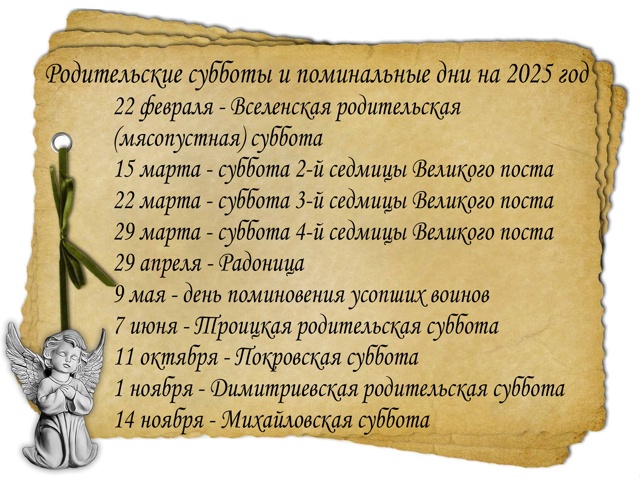
In the Orthodox Christian calendar, special days are set aside for the solemn commemoration of the deceased, known as Parental Saturdays. The first of these in 2025 falls on February 22nd. This guide outlines the dates for these significant days throughout the year, explains the distinction between Universal and regular Parental Saturdays, and details the associated customs and traditions.
Parental Saturdays in 2025
Each year, the Church calendar includes several specific days dedicated to remembrance, commonly referred to as Parental Saturdays. While most indeed occur on a Saturday, some may fall on other days of the week.
The Parental Saturdays in 2025 are:
- February 22: Universal (Meat-Fare) Parental Saturday
- March 15, 22, 29: (2nd, 3rd, and 4th weeks of Great Lent)
- April 29: Radunitsa
- May 9: Day of Commemoration for Deceased Warriors
- June 7: Trinity Parental Saturday
- September 11: Day of Commemoration for Orthodox Warriors
- November 1: Dimitriev Parental Saturday
The term “Parental” is thought to derive from an older usage where “parents” referred not just to one`s mother and father, but to all ancestors, including those who have passed away.
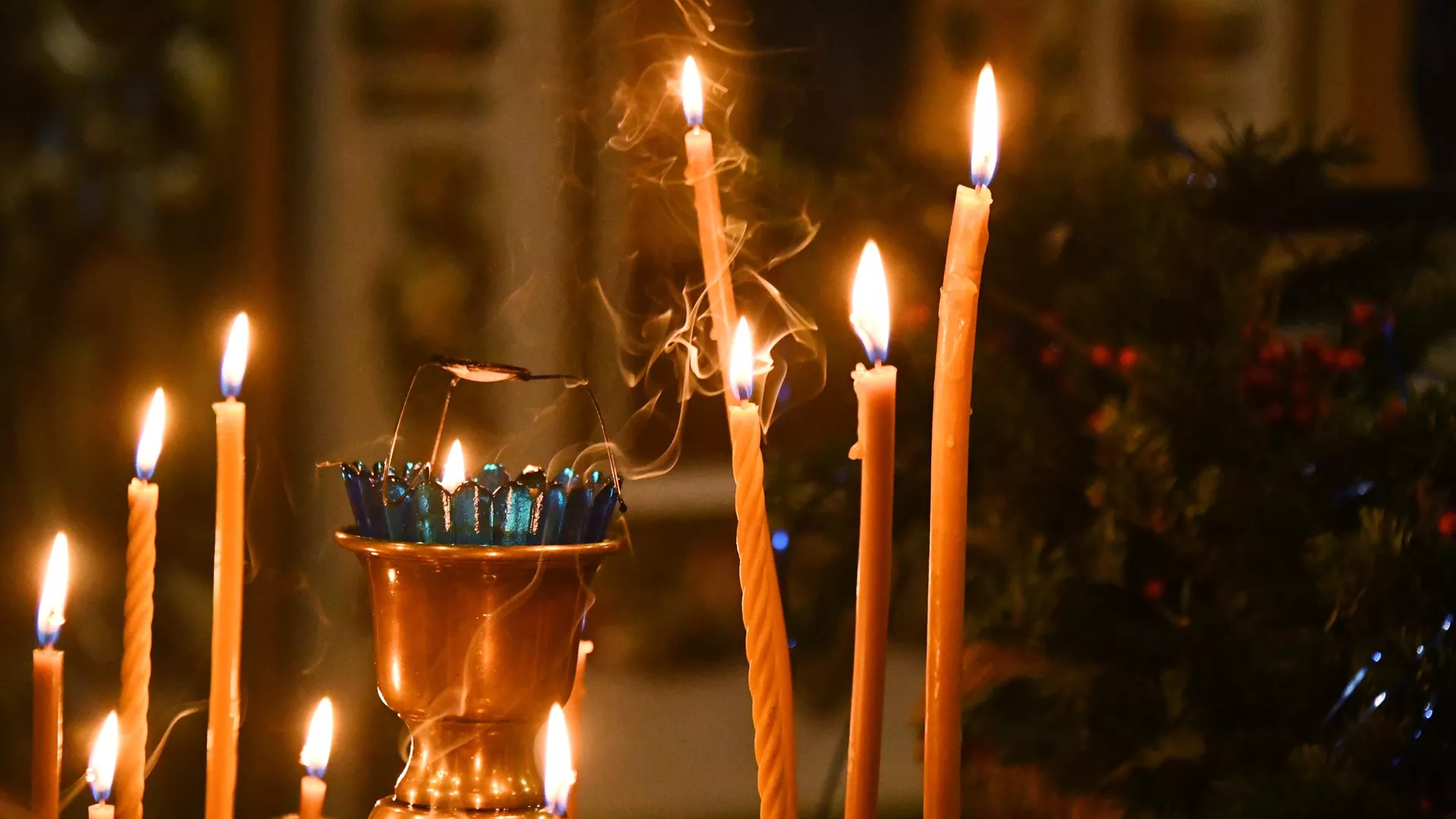
Dimitriev Parental Saturday. Image courtesy of RIA Novosti.
The Essence of Commemoration
Orthodox Christians are generally encouraged to honor the memory of their departed loved ones on most Saturdays. However, Parental Saturdays hold a unique significance, with some coinciding with major Christian feasts and periods like Pascha (Easter) and Great Lent.
On these days, the faithful typically visit churches to pray for those no longer with them, light candles, and tend to gravesites. It is important to pray not only for one`s own relatives but for all deceased Christians.
Beyond Parental Saturdays, there are other crucial days for remembrance following a person`s death: the 3rd, 9th, and 40th days after their passing, as well as anniversaries.

Cemetery `Rakitki` in the Novomoskovsky administrative district of Moscow. Image courtesy of RIA Novosti.
Commemoration Days in the Orthodox Calendar
Parental Saturdays can be broadly categorized into two groups: those with fixed dates and those whose dates vary annually, being tied to movable Christian holidays.
Dates of Parental Saturdays in 2025
February 22, 2025, marks the first Universal Parental Saturday, also known as Meat-Fare Saturday, in the Orthodox calendar. It precedes the start of Great Lent.
Most special days of remembrance occur in the spring. Three of these (March 15, 22, 29) are observed during Great Lent. In late April, believers observe Radunitsa, a date that shifts depending on when Pascha falls in a given year. Another significant spring commemoration is on May 9th, dedicated to honoring those who died in the Great Patriotic War.
Trinity Parental Saturday (June 7, 2025) is also linked to Pascha. The final Parental Saturday of the year, Dimitriev Parental Saturday, is on November 1st.
Universal Parental Saturdays
Among the special days of remembrance, two are designated as Universal Parental Saturdays. On these days, prayers are offered not only for one`s own departed relatives, friends, or loved ones but also for all Orthodox Christians who have died “from ages past.”
These are Meat-Fare Saturday and Trinity Saturday.
Meat-Fare Parental Saturday
Meat-Fare Parental Saturday, falling on February 22, 2025, is observed just over a week before the commencement of Great Lent. It is followed by Maslenitsa (Butter Week), and the week preceding it is known as Meat-Fare Week.
Trinity Parental Saturday
Trinity Parental Saturday in 2025 is on June 7th, preceding one of the major Christian holidays, the Day of the Holy Trinity (Pentecost). This day of commemoration directly depends on the date of Pascha.
Radunitsa
The name “Radunitsa” comes from the word “radost” (joy). This holiday is an exception to the “Saturday” rule, falling on a Tuesday—specifically, the ninth day after Pascha. In 2025, Radunitsa is on April 29th.
Similar to other commemoration days, Radunitsa allows for visiting graves, praying for the departed, and attending church services.
Dimitriev Parental Saturday
Dimitriev Parental Saturday, observed on November 1, 2025, is directly associated with the feast day of Saint Demetrius of Thessaloniki. The history of this day also mentions another Dmitry, Dmitry Donskoy: after the Battle of Kulikovo field, a tradition emerged to commemorate fallen warriors on this day, later extending to all departed Christians.
Parental Saturdays for Fallen Warriors
The Church calendar includes specific days to honor warriors who sacrificed their lives in defense of their homeland.
Commemoration Day for All Who Perished in the Great Patriotic War
The tradition of observing May 9th not only as Victory Day but also as a day of remembrance for those who died in the Great Patriotic War is relatively recent, established in 1994. On this day, prayers are also offered for those who survived the war but passed away in peacetime.
Commemoration Day for Orthodox Warriors Who Died on the Battlefield for Faith, Tsar, and Fatherland
This day of remembrance for Orthodox warriors falls on September 11th. The tradition originated in the 18th century during the Russo-Turkish War. However, it is not universally observed today, and requiem services are often not performed on this date.
Divine Services and Prayers
Parental Saturdays are characterized by specific traditions. Orthodox believers begin their remembrance the evening before: a special requiem service called “Parastas” is performed. Parental Saturday itself begins with a Divine Liturgy for the departed, followed by a Panikhida (requiem service).
During these services, the faithful pray not only for their relatives and loved ones but also for all the deceased, especially for those who are alone and have no one else to pray for them. It is customary to submit notes with the names of those to be remembered during the prayers.
Prayers on Parental Saturdays are offered both in churches and at cemeteries. Believers may recite any prayer for the departed (e.g., a prayer for a deceased Christian, or prayers for widows and widowers).
How to Pray for the Departed
Sincere prayers play a vital role, believed to help the souls of the departed find peace. Through prayer, loved ones can also contribute to the forgiveness of sins for the deceased.
The more frequently one remembers the departed, not just on Parental Saturdays but on any other day, the better.
Recommended Actions
The most crucial aspects of any Parental Saturday are prayers for the departed and attendance at church services. Many believers also visit family graves at cemeteries to tidy them (clear debris, weed, repaint fences) or simply to silently honor their ancestors resting there.
Since Parental Saturdays are dedicated to remembering not only close relatives but all departed Christians, believers may also attend to neighboring graves, especially old or neglected ones that no one cares for. Their upkeep is also commendable.
Another important tradition is charity. On these days, one can give alms or otherwise assist those in need.
Commemoration often involves a meal, with kutia being the central dish on the memorial table. Kutia is prepared from various grains (such as wheat or pearl barley), cooked so the grains remain whole but soft. Honey, nuts, or dried fruits can be added to the cooked grain.
Kutia symbolizes resurrection from the dead. Its sacred meaning is often explained by a passage from the Gospel of John: “Unless a kernel of wheat falls to the ground and dies, it remains only a single seed. But if it dies, it produces many seeds.”
What to Bring to the Cemetery
Many adhere to an unwritten tradition of bringing various foods to the cemetery on Parental Saturdays, sometimes leaving some products directly on graves. However, this practice of “offerings” is not part of Orthodox tradition.
It is even less advisable to bring alcoholic beverages or organize noisy, crowded feasts with alcohol at the cemetery. Instead, one can light a lampada (observing fire safety rules) and pray for the departed.
Why Bring Food to Church
The tradition of bringing food to church holds a much greater significance for Orthodox Christians. Historically, believers would gather in churches and share a common meal, commemorating the deceased together. Today, products donated to the church are given to those in need. These may include bread, grains, vegetables, and other non-meat items, as meat and meat products are not customarily brought.
Prohibited Actions
Key prohibitions on Parental Saturdays include:
- Avoiding quarrels, arguments, and conflicts.
- Refraining from heavy household or garden work.
- Avoiding celebratory events.
- Not refusing alms or help to those in need.
Omens and Superstitions
Most calendar days have associated folk omens and superstitions, and Parental Saturdays are no exception. However, Orthodox Christians generally do not believe in such things and pay them no heed.
One common superstition is not to pick up an item dropped on the ground while at the cemetery. Also, it is advised not to plan any festivities or celebrations on Parental Saturdays, as the day is meant for honoring the memory of the departed.
Another belief suggests a high chance of having a prophetic dream on the night before a Parental Saturday.