
Smart speakers indeed have access to a significant amount of user information. For instance, the device could potentially send conversation data, even to malicious actors, though this is considered improbable. According to the Roskachestvo Center for Digital Expertise, identifying specific user activity, such as the recording and transmission of a conversation, is extremely difficult.
The most widespread concern, raising the most fears, is that these gadgets `eavesdrop` and transmit all user conversations. Indeed, the speaker operates in a constant listening mode, awaiting an activation phrase (for example, `Alice` or `Marusya`). However, stating that it records and transmits *all* conversations would be incorrect, the organization concluded.
The device interacts with servers less frequently than one might assume, they added. Typically, network identifiers are sent to ensure the device is functioning correctly and has a connection.
Identifying specific activity, such as the recording and sending of a conversation, is extremely difficult. This is due to the use of complex encryption algorithms designed to protect user privacy. Ultimately, the question of whether data from listened conversations is transmitted remains open, Roskachestvo noted.
Another common fear, according to their data, is that hackers could compromise speakers and listen to private conversations. Theoretically, hacking a smart speaker and using it as a `bug` for eavesdropping is certainly possible. However, the experts question the practicality of such actions, as everyday conversations are unlikely to hold much value for cybercriminals, according to the expertise center.
Conversely, the claim that smart speakers collect personal data for targeted advertising is true, albeit with some qualifications. Everything a user says near a smart speaker can indeed be used to build a detailed profile of their interests, habits, and even routes. By accepting the smart speaker`s data collection privacy policy, the user permits this information processing. In this scenario, advertisers receive the data in an anonymized form.
Users also often worry that malicious actors might record their voice through speakers for identity theft and fraud. Theoretically, it`s possible to use a voice recording obtained via a smart speaker for identity theft, but in practice, this scenario is unlikely. It`s much easier for fraudsters to use publicly available voice recordings of well-known people to create a higher-quality deepfake.
Sergey Kuzmenko, head of the Roskachestvo Center for Digital Expertise, quoted by the organization`s press service, explained that complete digital security is unattainable. However, understanding the risks and constantly raising awareness significantly reduce the likelihood of falling victim to cybercriminals.
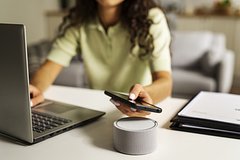
According to statistics from M.Video-Eldorado analysts, smart speaker sales in Russia grew by 33.3 percent in the first quarter of 2024 compared to the same period in 2023, exceeding 1 million devices.