
The competitive smartphone market has seen brands constantly striving to match Apple since the introduction of the iPhone. While they have largely succeeded over time, the annual release of new chips continues to push the boundaries. This year, Apple has once again taken the lead in performance, at least in terms of Instructions Per Cycle (IPC). The A19 Pro chip demonstrates superior IPC compared to its Android counterparts, including the MediaTek Dimensity 9500, Qualcomm Snapdragon 8 Elite Gen 5, and Samsung Exynos 2600.
Each new iPhone launch garners significant global anticipation. Apple enthusiasts are often drawn to the latest models, even if they own a device from a generation or two prior. A key advantage of iPhones is their strong resale value, allowing owners to upgrade by selling their previous phone for a substantial amount. Traditionally, Apple has adopted a conservative approach with its iPhones, focusing on sufficient design and performance improvements to maintain market relevance. However, this approach has begun to evolve.
The A19 Pro Features the Highest IPC Mobile CPU
In recent years, Apple has significantly transformed its iPhones, enhancing not only their design and materials but also their specifications to become more competitive. Previously, iPhones often used less RAM due to iOS’s superior optimization. However, in the current AI-driven era, increased RAM has become necessary to leverage these advanced features. Furthermore, Apple has consistently improved its chips, and the A19 Pro, found in the iPhone 17 Pro and Pro Max, is now the undisputed leader in single-core performance when IPC is considered.
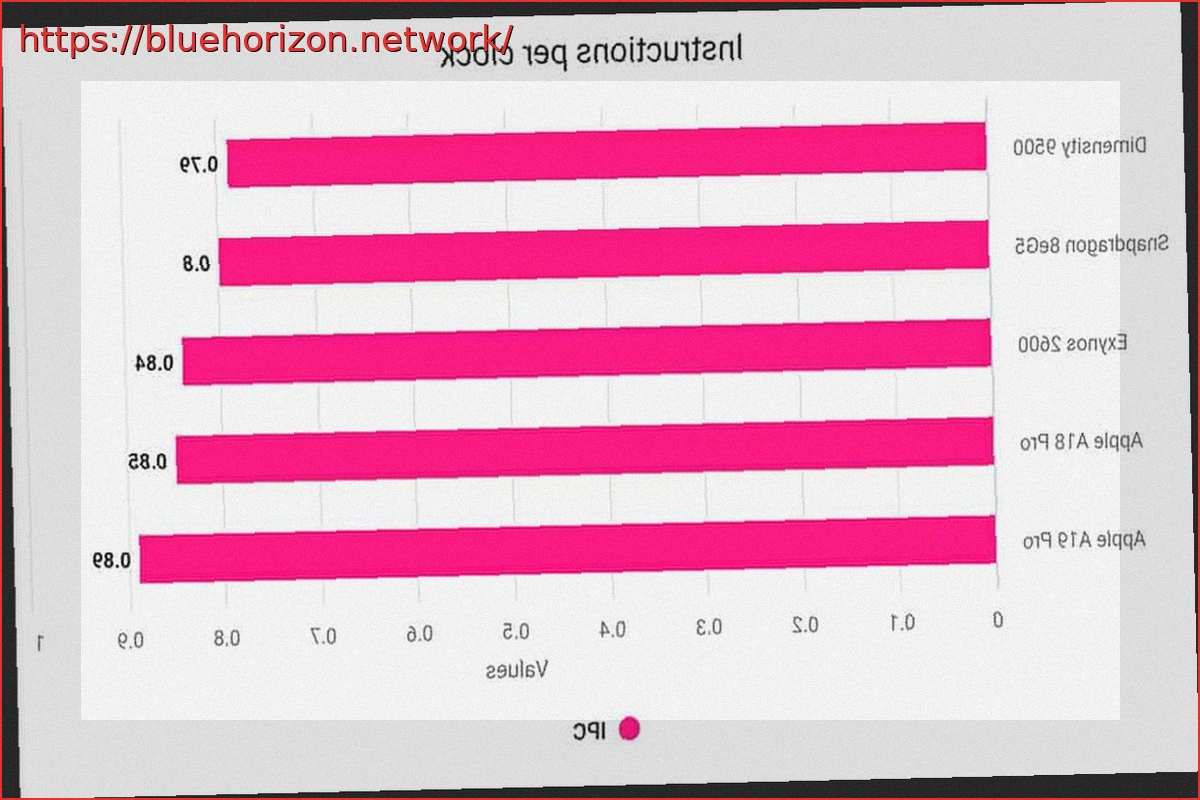
IPC, or Instructions Per Cycle, is a crucial metric that measures a CPU’s performance at a given frequency, serving as the primary indicator for generational or cross-processor improvements. The provided graph clearly illustrates the A19 Pro’s dominance with an IPC of 0.89. This surpasses the A18 Pro (0.85 IPC), Samsung Exynos 2600 (0.84 IPC), Qualcomm Snapdragon 8 Elite Gen 5 (0.8 IPC), and MediaTek Dimensity 9500 (0.79 IPC).
Higher Frequencies in Dimensity 9500 or Snapdragon Can Outperform A19 Pro in Some Benchmarks
IPC is always measured at a specific frequency. Consequently, a CPU with a lower IPC but higher clock speeds can potentially outperform a CPU with higher IPC and lower frequencies. This is precisely the scenario observed with chips like the MediaTek Dimensity 9500. While it may be outperformed by the A19 Pro in benchmarks like Geekbench, the outcome can be heavily influenced by the specific device and its thermal throttling performance.
Similar situations have been noted where the Snapdragon or Exynos chips surpass the A19 Pro in Geekbench and other CPU benchmarks. However, when focusing purely on IPC, none of these competitors reach Apple’s level. The A19 Pro in the iPhone 17 Pro is approximately 12.65% superior to the Dimensity 9500, 10.11% better than the Snapdragon 8 Elite Gen 5, and 5.62% ahead of the Exynos 2600. Samsung’s Exynos 2600 is a noteworthy surprise, exceeding expectations for high-end segment competitiveness and achieving an IPC comparable to the previous generation Apple A18 Pro.