
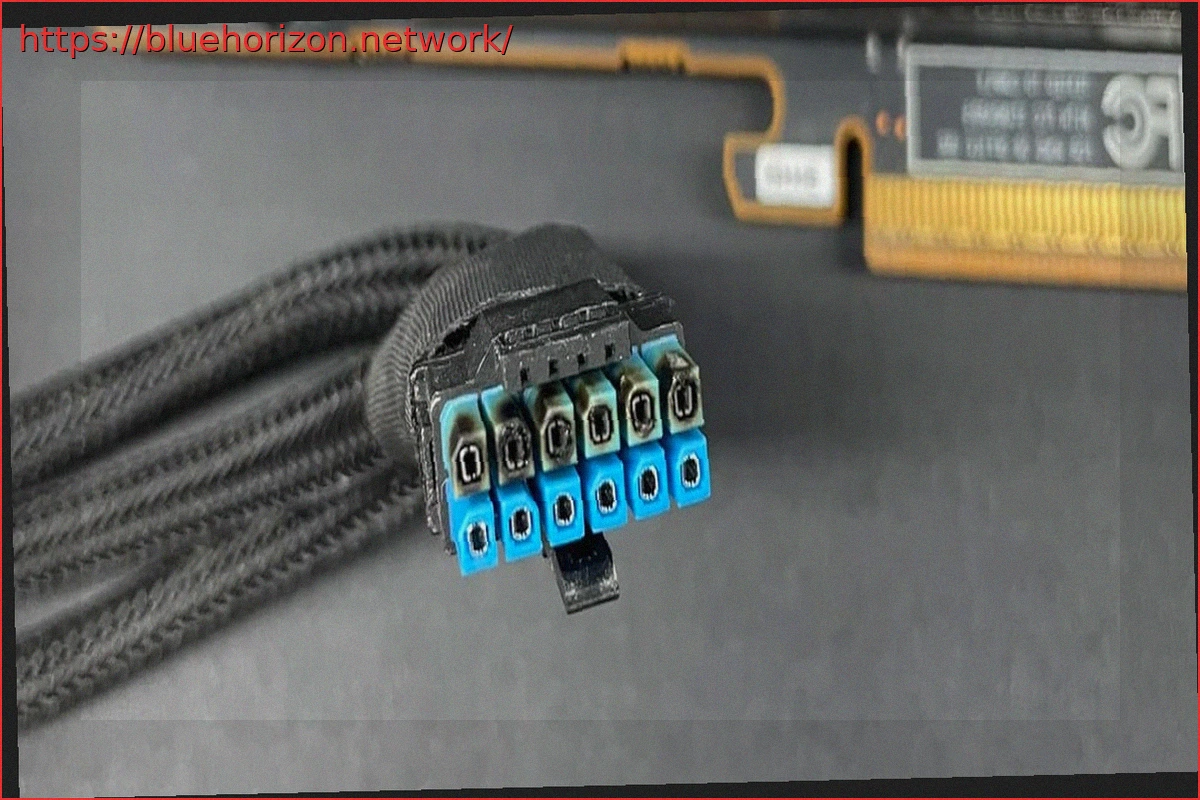
A recurring issue has emerged with the Sapphire NITRO+ RX 7900 XTX graphics card, where its 12V-2×6 power connector is burning or melting. This marks the ninth publicly known case involving Sapphire GPUs and the now-familiar problem with the 12V-2×6 power connector. As is often the case, these incidents have come to light through users sharing their experiences on Reddit forums, suggesting that more instances may have occurred without public disclosure.
While NVIDIA GPUs, particularly the high-end GeForce RTX 4090 and RTX 5090, have been more prominently affected by these connector issues, the problem is now extending to AMD cards. These NVIDIA cards are known for their significant power consumption, with TDPs of 450W and 575W respectively. In contrast, the Sapphire NITRO+ RX 7900 XTX has a TBP of 330W and utilizes a 3×8-pin to 12V-2×6 adapter for PSUs lacking native connectors. The reference AMD Radeon RX 7900 XTX has a power draw of 304W, indicating that aggressive overclocking is not necessarily the sole cause.
Evidence suggests the 12V-2×6 Connector is the Culprit in Sapphire NITRO+ RX 7900 XTX Failures
Technical discussions are increasingly pointing towards the 12V-2×6 connector itself, rather than just the power consumption, as the root cause. A graphics card, even with power draw significantly below the theoretical limit of the connector, can still fail due to poor contact, localized resistance increases, or uneven current distribution across the pins. If one set of contacts has a weak connection, the load can concentrate on fewer pins, leading to them overheating and melting.
These connectors exhibit a combination of mechanical weakness, high current density, and a lack of balance, which causes multiple points within the connector to reach temperatures high enough to melt or burn the surrounding plastic. This heat can also cause the connector to loosen, further degrading contact and exacerbating the problem.
Furthermore, this issue doesn’t appear to be widespread across the entire RX 7900 XTX range but seems concentrated in models that specifically use the 16-pin connector. Sapphire also offers RX 7900 XTX variants like the PULSE and PURE with two 8-pin connectors. This implies that the Sapphire NITRO+ RX 7900 XTX is the only model featuring the problematic 12V-2×6 connector. This observation reinforces the idea that the problem isn’t exclusive to NVIDIA, as AMD cards are also experiencing these failures, although on NVIDIA, this connector is standardized and affects primarily top-tier models in 99.99% of cases.
Manufacturers Implement Workarounds to Address Connector Issues
It’s important to note that the 12V-2×6 connector was introduced as a successor to the 12VHPWR, intended to resolve such issues, but this has not been the case. Consequently, manufacturers are now integrating additional safety layers into their hardware to mitigate the problem. ASUS, for instance, has implemented software in its high-end GPUs that can detect when one or more pins are receiving excessive power. MSI offers a similar feature with PSU Safeguard+, which allows the power supply unit to reduce its energy output to lower temperatures, even shutting down the system to prevent further damage.
More rudimentary solutions include painting the power connector with a bright color to visually check for proper connection or incorporating safety locking mechanisms that ensure a secure connection between the GPU and the power supply cable, preventing it from becoming loose and causing poor contact.