
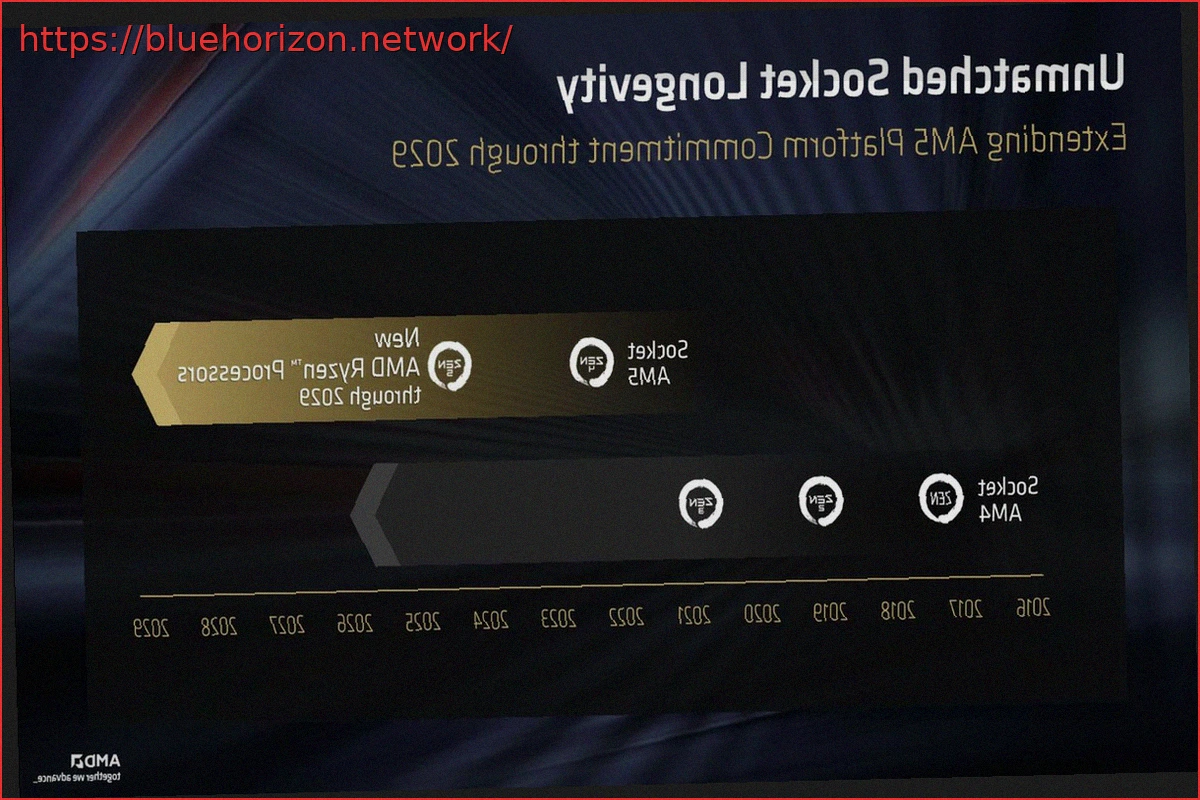
AMD has confirmed at Computex 2026 that its AM5 socket will be supported until 2029. This means the platform, launched in 2022 with Ryzen 7000 series processors, will not be limited to Zen 4 and Zen 5 architectures but will continue to receive new Ryzen processors for more years than initially anticipated. Previously, AMD had indicated support beyond 2027, but this new roadmap officially extends the commitment by two more years.
This news is particularly significant as AM5 has already become the foundation for several product generations: it began with the Ryzen 7000 series based on Zen 4, was later joined by the Ryzen 8000G APUs, followed by the Ryzen 9000 series based on Zen 5, and finally the Ryzen 9000X3D with 3D V-Cache technology. With this new announcement, AMD makes it clear that those who have purchased an AM5 motherboard will have ample room to upgrade their processors without needing to replace their entire platform.
Software and Hardware Support Until 2029 for AMD AM5 Socket Motherboards
The key takeaway is that AMD is not just talking about keeping motherboards “alive” through BIOS updates or residual compatibility, but by releasing new AMD Ryzen processors for AM5 until 2029. This implies guaranteeing compatibility with future Ryzen 10000 series processors, as well as their successors. In essence, purchasing an AM5 motherboard today guarantees you can upgrade your CPU until 2029 without needing a new motherboard, RAM, or cooling system.
This move brings the AM5 platform closer to AM4 in terms of longevity. AM4, a platform that debuted in 2016, still receives occasional releases in 2026. In fact, AMD is celebrating the tenth anniversary of the AM4 socket with the Ryzen 7 5800X3D 10th Anniversary Edition, a relaunch of this CPU scheduled for June 25th with a recommended price of $349. AMD uses this example to reinforce the idea that its platforms can have a lifespan far beyond the typical two or three-generation cycle.
The decision also makes sense in the current market context. AM5 already offers support for DDR5 and PCIe 5.0, so AMD does not seem to be in a hurry to force an immediate jump to DDR6 or PCIe 6.0 on the desktop. This is especially true given that the PC industry is currently in a lull, with very low sales. It makes no sense to further damage the market by forcing users to change platforms when they upgrade their PCs. Not to mention that DDR6 memory is becoming increasingly distant for the consumer platform given the current situation, as is the PCIe 6.0 interface for next-generation SSDs.