Intel has been losing market share across all sectors since AMD launched its Zen processors nearly a decade ago. While APUs have become very popular in laptops, it must be said that Panther Lake has now become a worthy rival to AMD. In workstations, we have the Ryzen Threadrippers, and in servers and data centers, EPYCs have no competition. For desktop PC processors, we have Ryzen, although the X3D variants gained significant popularity for being the best for gaming. While Intel can’t quite compete with them yet, there’s something interesting to mention: the Ultra 5 250K Plus iGPU isn’t bad at all for gaming, as it performs above a Steam Deck with 4 Xe Cores.
Intel hasn’t garnered much attention with its latest CPU generations. One could say the last relevant generation was the Core 12, which introduced the hybrid architecture and up to 24 cores. Following this were the Core 13 Raptor Lakes, which, while offering better performance, were plagued by issues and instability. The same applies to the Core 14, which are Raptor Lake Refresh. As for the Core 15, they were named Core Ultra 200S, and despite architectural changes, they didn’t provide a significant performance boost.
The Core Ultra 5 250K Plus iGPU Outperforms Steam Deck and Switch 2, Achieving 1.9 TFLOPs FP32
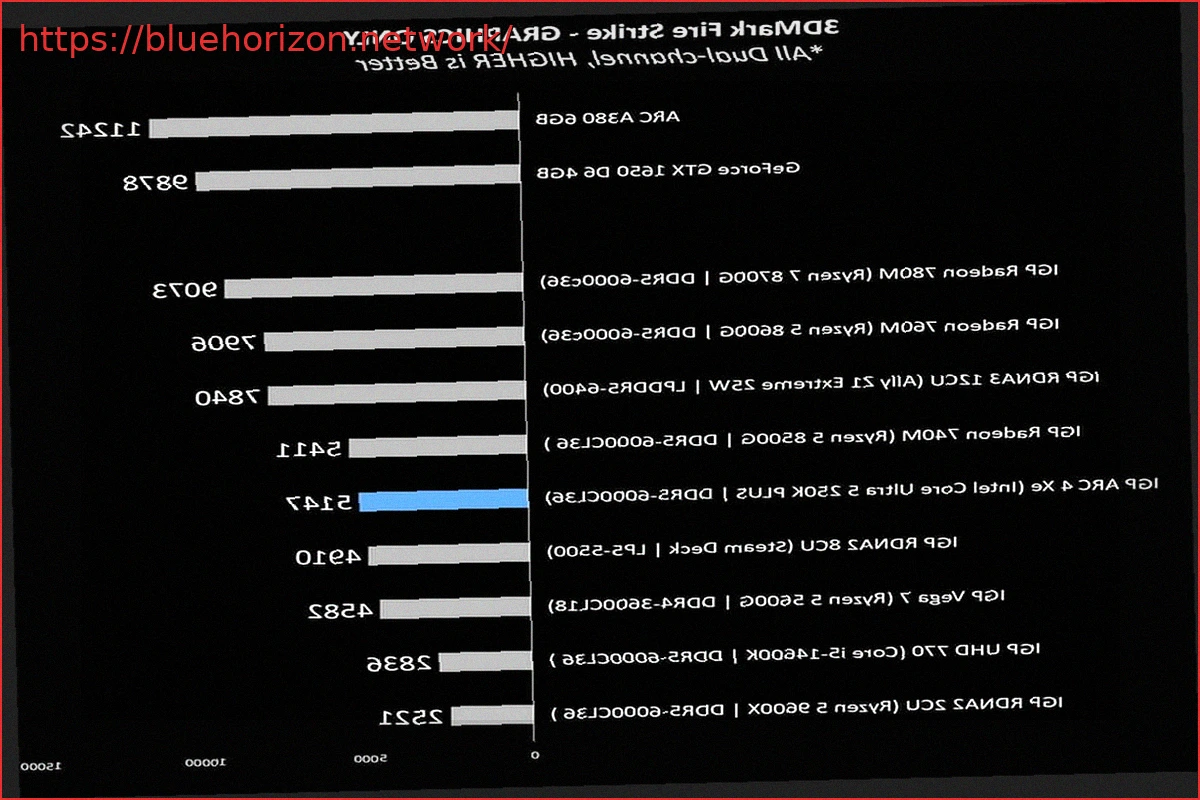
Intel’s latest desktop processors didn’t seem to introduce anything new, and we assumed they were a refresh. However, when the 200K Plus models were released, we saw that they did bring more cores. Better performance with more cores while maintaining the same or a lower price than the 200S forced AMD to lower the prices of Ryzen processors like the 9600X, which was priced at $189. Despite this, Intel remained a superior option in that price range, and the Core Ultra 5 250K Plus was very appealing with its 18 cores (compared to the Ryzen’s 6). In integrated graphics, the Core Ultra 5 250K Plus performs quite well, achieving 5,147 points in the first 3DMark Fire Strike test.
This places it just above the iGPU of the Steam Deck with 8 RDNA 2 CUs and very close to the Radeon 740M iGPU from a Ryzen 5 8500G. This is far from Intel’s best integrated graphics, as it only has 4 Xe Cores – not even Xe2 or Xe3 Cores. We are talking about Alchemist, the first generation. Nevertheless, it performs nearly double that of the Intel UHD 770 iGPU in the i5-14600K with its 2,836 points and more than double that of the 2CU RDNA 2 iGPU in the Ryzen 5 9600X with 2,521 points.
While not groundbreaking in graphics performance, the strong CPU allows for decent 1080p gaming and AV1 encoding at 4K 60 FPS
A more powerful APU like the Ryzen 7 8700G is significantly ahead with 9,073 points, and of course, the dedicated Intel Arc A380 reaches 11,242 points. In terms of raw power, we can see that the Core Ultra 5 250K Plus iGPU reaches 1.894 TFLOPs FP32, slightly exceeding the 1.6 TFLOPs of the Steam Deck and the 1.71 TFLOPs of the Switch 2 in portable mode. As mentioned, it’s not astounding, but we’re talking about it not only outperforming the Ryzen 5 9600X in CPU but also doubling it in iGPU performance. Now, let’s move on to game benchmarks and what this chip is capable of.
In Counter-Strike 2 at 1080p with low graphics and FSR in Balanced mode, we can achieve an average of 91 FPS and 73 FPS minimum, which is considerably more than a Steam Deck, as this CPU is much more powerful, and we know the game is highly dependent on it. In Genshin Impact at 1080p on low settings and FSR 2 at 0.8x, we can achieve stable 60 FPS. Moving to a more demanding game like Horizon Zero Dawn, at 1080p and FSR Ultra Quality, we can achieve stable 30 FPS. In Shadow of the Tomb Raider at 1080p, the benchmark shows an average of 34 FPS. Finally, as an extra note, the 250K Plus iGPU is also capable of encoding at 4K 60 FPS in AV1 format (with Quick Sync Video), which can be useful if you plan to record while gaming with a dedicated GPU.