
Following tests of ASUS ROG Equalizer and CORSAIR ThermalProtect cables, we now examine the MSI MPG Ai1600TS PCIE5 power supply and its GPU Safeguard+ feature. This is a significant advancement, as it’s not just an improved cable but a power supply unit designed to protect systems with GeForce RTX 5090 and RTX 4090 graphics cards, which are most susceptible to issues with the 16-pin power connector.
In essence, MSI GPU Safeguard+ is a technology that monitors the load distribution across each of the 12V lines of the power connector. It identifies anomalous deviations associated with poor contact, a faulty connection, or even wear over time. This technology can not only adjust the GPU’s Power Limit to safeguard the graphics card but can also issue audible and software alerts, and even shut down the system directly if the user fails to respond to these warnings.
GPU Safeguard+ Functionality Tested by Simulating a Poor Connection on a GeForce RTX 5090
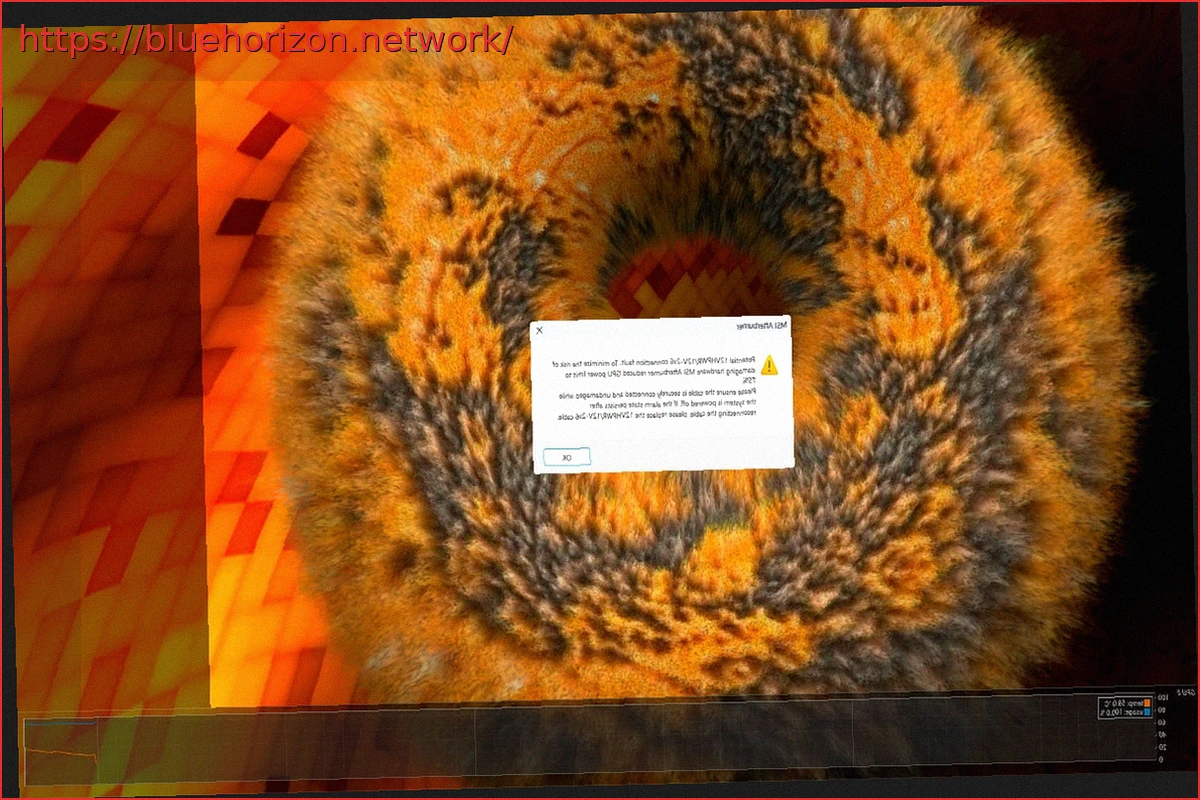
Tom’s Hardware rigorously tested the system using an MSI GeForce RTX 5090 Vanguard SOC, simulating a faulty connection of the 12V-2×6 cable. To push the limits, they ran the demanding FurMark benchmark and applied a 600W load to the RTX 5090. According to the test results, MSI Afterburner, integrated with GPU Safeguard+, quickly detected the fault. Upon detection, it displayed a pop-up warning on the screen, emitted an audible alert, and the software automatically reduced the GPU’s power limit. MSI Center and HWiNFO also registered the current imbalance and provided corresponding notifications.
The subsequent behavior was crucial. After the fault was detected, alerts continued for three minutes. This was designed to simulate a scenario where the user might be absent. Subsequently, the power supply cut off power to the GPU, resulting in a black screen. At this point, Tom’s Hardware forcibly shut down the system, correctly reconnected the cable, and upon restarting the PC, everything operated normally. This test demonstrated that the system performed as promised: it alerted the user, reduced power, and ultimately cut power to the graphics card before the fault could cause permanent damage.
However, like other solutions, this is a patch, not a definitive fix.
The most sensible interpretation is that GPU Safeguard+ does not make the 12V-2×6 connector flawless. Instead, it adds an active safety layer in an area where the margin for error remains small. It’s widely acknowledged that part of the problem lies in the connector’s design itself and how many modern GPUs manage their 12V input. GPUs typically view the 12V rail globally, but they don’t necessarily monitor or balance current on a pin-by-pin basis. If a contact fails or a line is poorly seated, the GPU itself lacks the actual capability to correct such an imbalance.
This is why MSI’s solution makes sense from the power supply’s perspective. If the GPU doesn’t precisely monitor current distribution, the PSU attempts to perform this task. Unlike “improved” cables that merely aim to reduce heat or increase physical clearance, GPU Safeguard+ offers an active reaction: it alerts the user, lowers the GPU’s consumption, and if the situation doesn’t normalize, it cuts the power. Even the three-minute window before a definitive shutdown might be overly cautious. However, there shouldn’t be issues, given that the energy supplied to the GPU is directly reduced.
MSI justifies this margin as sufficient for users to save their work or exit a game. Perhaps one or two minutes would also suffice. But it would require a confluence of multiple negative factors for the GPU to ultimately be damaged by shutting down after one or two minutes of operating with limited power.