
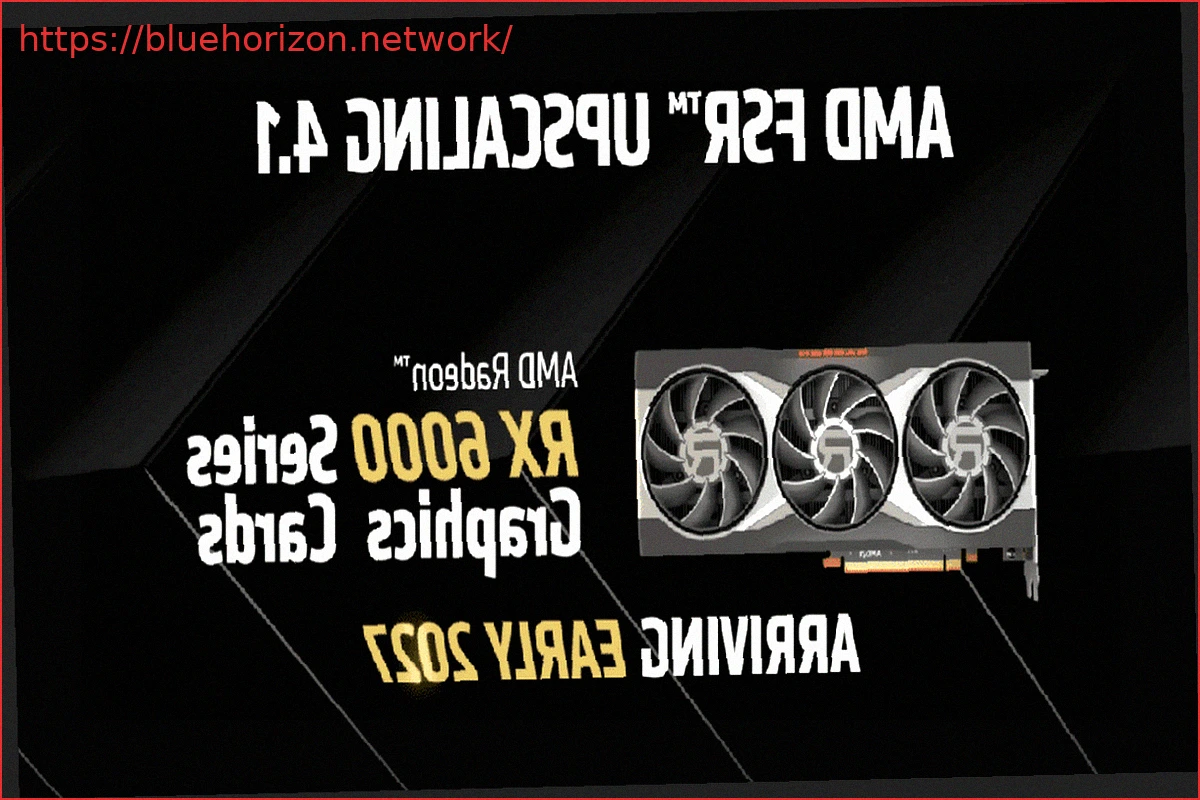
AMD has announced its intention to extend FSR 4.1 support beyond the latest Radeon RX 9000 series. However, integrating this technology with the RDNA 2 architecture, found in the Radeon RX 6000 series, presents more complexities than with newer generations. While RDNA 3 is slated for support next month, the RX 6000 cards are not expected to receive it until at least 2027. AMD has yet to detail the reasons for this significant delay, but a potential explanation has emerged.
The core issue lies not simply in enabling a driver option, but in adapting an Artificial Intelligence workload to an architecture not inherently designed for its efficient execution. This aligns with speculation, now further elaborated by ComputerBase, suggesting a fundamental architectural incompatibility.
FSR 4.1 Will Come at a Higher Cost for RDNA 2 RX 6000 Graphics Cards
The key to this challenge is FP8, a data format offering low precision but high versatility, crucial for FSR 4.1’s operation. FSR 4.1 is designed to run on RDNA 4 utilizing this format. However, RDNA 2 and RDNA 3 architectures lack native, efficient, and independent acceleration for FP8. RDNA 3 is in a more favorable position due to its inclusion of dedicated INT8 ALUs, allowing the model to be processed through an alternative pathway. This results in a slightly different SuperSampling process, though AMD considers the visual quality to be equivalent.
The situation for RDNA 2 is considerably more challenging, explaining the extended development timeline. While Radeon RX 6000 series cards can accelerate INT8 operations, they do not possess dedicated AI units or separate INT8 ALUs. Crucially, they completely lack native FP8 support, which is a requirement for FSR 4.1. The RDNA 2 architecture relies on the standard SIMD32 ALUs within its Compute Units, packing four 8-bit integers into 32-bit registers. Theoretically, this could quadruple performance compared to INT32 operations, potentially enabling a Radeon RX 6900 XT to reach 92 TOPS in INT8, provided all conditions are met.
This is where the true cost, and the reason for the additional six months, arises. If FSR 4.1 is implemented via the INT8 pathway on RDNA 2, the upscaling process will not occur on a separate GPU segment. Instead, it will share the same Compute Units that the game already requires for rendering.
From FP8 to INT8 and the Performance-Limiting Mixed-Precision Mode
It is essential to understand that AMD must essentially redesign FSR 4.1 specifically for RDNA 2, substituting FP8 with INT8. This also means accepting that the model will operate in mixed-precision mode, as INT8 shares resources with INT32. Consequently, this isn’t an isolated cost within the GPU’s budget, but rather a direct competition for internal resources: ALUs, registers, caches, work scheduling, and compute time. In essence, activating FSR 4.1 on RDNA 2 means diverting INT32 units to INT8 operations due to the mixed-precision requirement, leading to a trade-off where performance gained from rendering at a lower resolution might be lost during the upscaling process itself.
Synchronization also poses a significant hurdle. FSR cannot commence until a frame has been fully rendered, as it requires this image as input to reconstruct it at a higher resolution. On RDNA 2, loading the model into caches and registers involves context switching, potential waits within the Compute Units, and reduced capacity for initiating the subsequent frame smoothly.
According to ComputerBase’s estimations, each pass of FSR 4.1 could consume between 2 ms and 4 ms, depending on the GPU’s internal unit bandwidth. This time is directly subtracted from the available budget for calculating the next frame. Therefore, lower-end graphics cards will be more significantly impacted and will exhibit less performance scaling. This dual challenge – RDNA 2’s lack of FP8 support and the necessity of using INT8 for FSR 4.1 – complicates matters for AMD.
This is precisely why AMD requires more time. The company must drastically reduce the shader cycles consumed by FSR 4.1, optimize the model, improve execution scheduling, and prevent the performance gains achieved by rendering at a lower resolution from being negated by the upscaling process itself. On RDNA 2, the goal is not merely to make FSR 4.1 functional on the RX 6000 series, but to ensure it operates without turning the AI reconstruction into another rendering bottleneck, thereby avoiding scenarios where performance remains stagnant or even decreases instead of increasing.