
Google is piloting a novel AI-driven search experience on YouTube, dubbed “Ask YouTube.” This feature reimagines the platform’s traditional search bar, evolving it into a conversational chatbot. Instead of merely presenting a list of videos, this tool generates a comprehensive page featuring textual answers, long-form videos, Shorts, related clips, and suggestions. Currently, this functionality is exclusive to YouTube Premium subscribers in the United States who are over 18 years old.
The integration of AI into search aims to enable users to interact using natural language, similar to querying Gemini or Google Search’s AI Mode. Once activated, users will notice a new button adjacent to the search bar, labeled ‘Ask YouTube.’ Clicking this button allows for natural language queries to deepen the YouTube experience. For instance, you can describe the type of video you’re looking for, and YouTube will provide a response in text, a long video, Shorts, or clips. YouTube explains that Ask YouTube synthesizes real-time web information with YouTube content.
A Smarter YouTube with AI Providing Additional Context to Videos

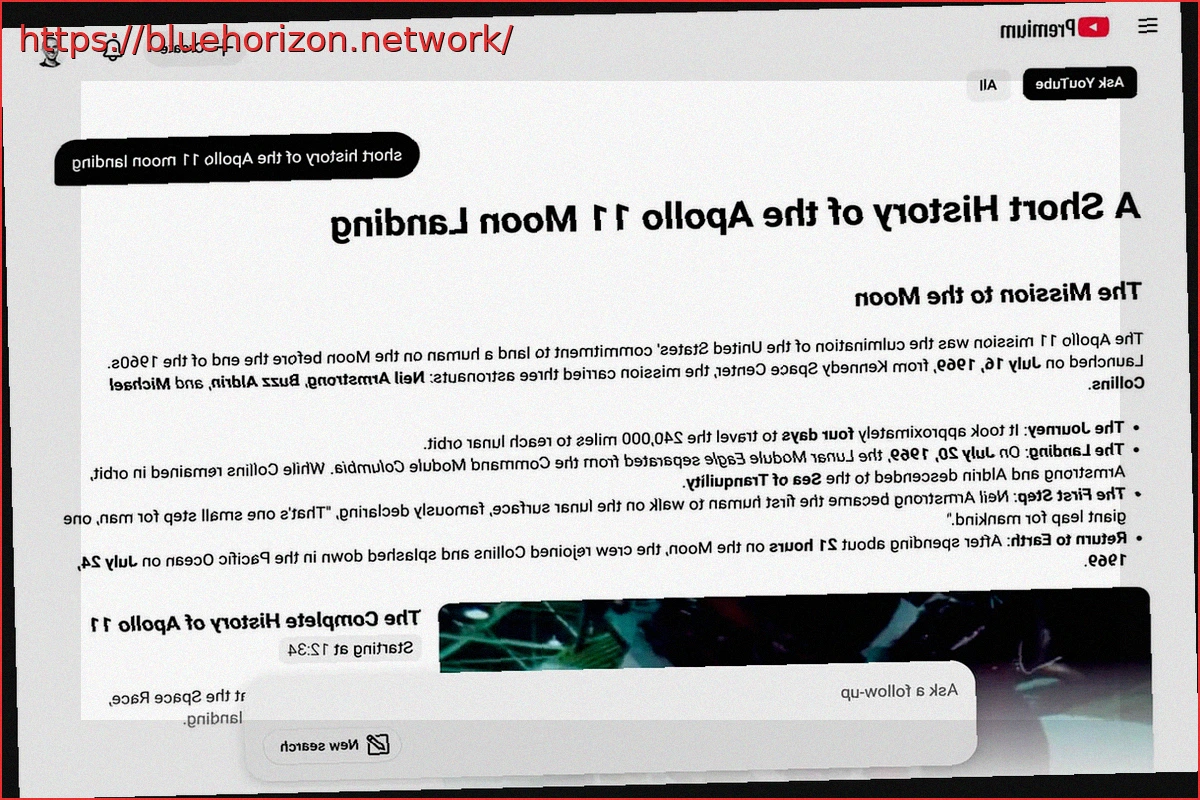
For example, The Verge tested a search for the Apollo 11 mission. Instead of a conventional list of related videos, Google Ask generated a structured response with a textual summary, a list of milestones, videos organized by thematic sections, and suggested follow-up questions. The system also adeptly handled subsequent queries, such as identifying the mission’s astronauts, producing a new page with information on Neil Armstrong, Buzz Aldrin, and Michael Collins. However, when probing into more sensitive topics, such as Apollo 11 conspiracy theories, YouTube did not provide an AI-generated response. It reverted to a standard list of search results, indicating a complete deactivation of the AI for such queries.
Strategically, Ask YouTube aligns with Google’s broader shift towards AI-assisted search. Google has already incorporated AI Mode into search for more complex, multimodal queries, and recently extended AI Mode to its Chrome web browser, offering features like side navigation, tab context, images, and files. In essence, YouTube is adapting this logic to video consumption, transforming it from merely finding videos to creating a queryable knowledge base.
For content creators, this shift could be significant. If YouTube begins answering questions directly via AI, visibility will no longer depend solely on appearing in search results but on being selected as a featured source, a cited clip, or supporting video within an AI-generated response. Search Engine Journal notes that videos might appear as embedded results with timestamps, potentially altering how content is discovered on the platform. This mirrors the experience on Google Search, where users might find an answer and not need to visit the website. On YouTube, users could be directed to the exact moment in a video that addresses their query (e.g., a puzzle in Crimson Desert), view the solution, and then exit the video.