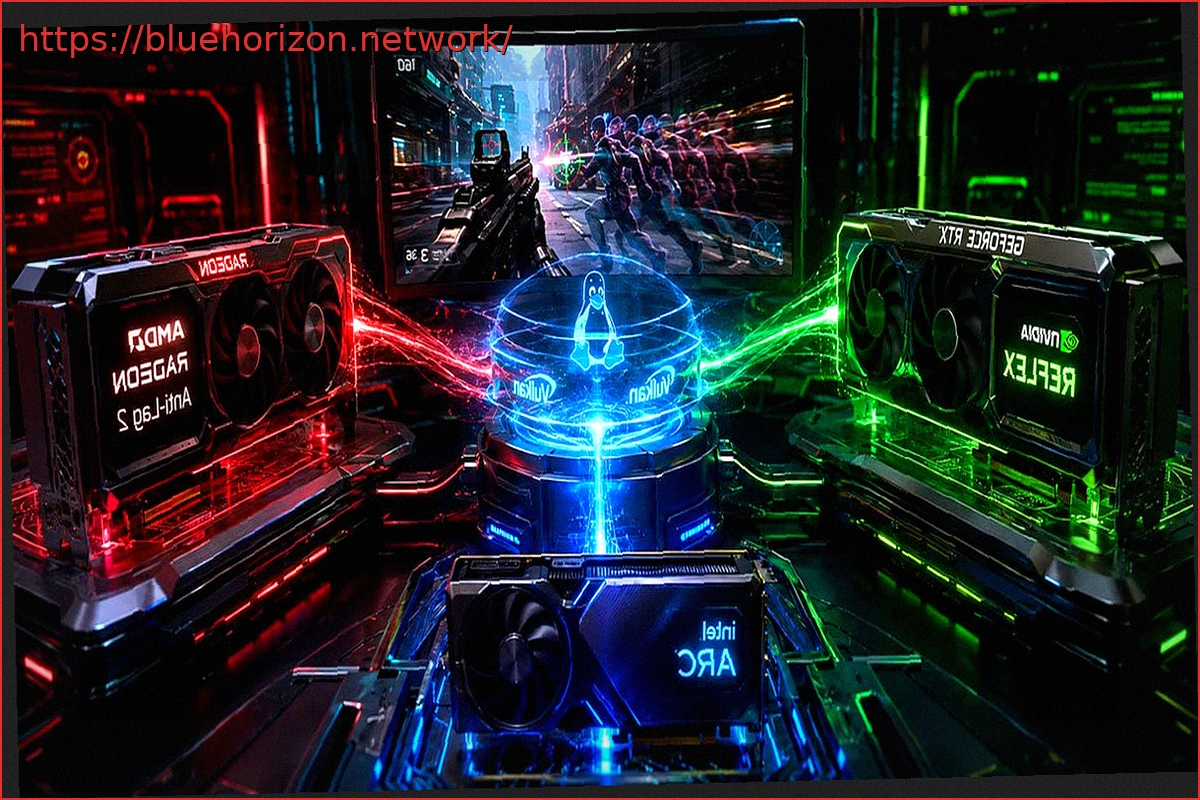
Linux gaming is advancing with the integration of low-latency technologies like NVIDIA Reflex and AMD Anti-Lag 2, now available across hardware. These features are no longer restricted to specific GPU models or driver support. They have been implemented via a Vulkan API layer, enabling the VK_NV_low_latency2 and VK_AMD_anti_lag extensions. This achievement is thanks to the low_latency_layer project by Korthos Software.
This development is significant because many games and applications previously supported NVIDIA Reflex before AMD Anti-Lag 2, disadvantaging AMD and Intel GPU users on Linux. The low_latency_layer project aims to bridge this gap. When combined with dxvk-nvapi, it can reroute relevant calls, bypassing the need for official driver support for specific GPUs.
Linux Implements Low Latency: Crucial for Competitive Games like Counter-Strike 2
The VK_NV_low_latency2 extension provides timing cues for preparing new frames, reducing the delay between user input and image display. VK_AMD_anti_lag, on the other hand, prevents the CPU from getting too far ahead of the GPU, minimizing the work queue and input-to-display latency.
AMD Anti-Lag 2 was originally designed as an in-game solution for end-to-end latency reduction in GPU-bound scenarios. AMD officially requires RDNA architecture GPUs and Windows 10/11, with Vulkan support from Adrenalin 24.9.1. The low_latency_layer project cleverly transfers some of this logic to the Linux ecosystem via Vulkan, avoiding reliance on Windows-specific closed stacks.
According to its repository, the layer defaults to exposing VK_AMD_anti_lag, allowing native Linux applications like Counter-Strike 2 to display the Anti-Lag option in their menus. For games run via Proton, the project requires enabling NVAPI along with layer configuration.
An example for Steam launchers involves adding commands like ‘PROTON_FORCE_NVAPI=1 LOW_LATENCY_LAYER_REFLEX=1 LOW_LATENCY_LAYER_SPOOF_NVIDIA=1 %command%’, which can even make games identify the GPU as NVIDIA for Reflex support, regardless of the actual hardware (AMD or Intel).
NVIDIA Reflex and AMD Anti-Lag 2 Perform Better on Linux Thanks to This Project
The project developer conducted tests using an AMD Radeon RX 7900 XTX GPU, a Ryzen 7 9800X3D CPU, and 64 GB of DDR5 RAM at 6,000 MT/s CL28. The tests were performed on Gentoo with KDE Plasma 6.6, utilizing direct scanout and measurements from the NVIDIA Reflex Analyzer on an ASUS PG248QP monitor.
In tests like THE FINALS, the project claims to match or exceed AMD Anti-Lag 2’s proprietary implementation on Windows, with Mesa’s Anti-Lag layer proving nearly ineffective. For Counter-Strike 2, both the NVIDIA Reflex and AMD Anti-Lag 2 routes from the project outperformed native Windows results.
Even in Cyberpunk 2077, where the developer notes Anti-Lag 2 on Linux might be broken due to an application issue, the NVIDIA Reflex route achieved better results than native Anti-Lag 2 on Windows.
The solution’s practical utility is further demonstrated in games like Resident Evil Requiem and Overwatch 2, which support Reflex but not Anti-Lag 2. On Windows, AMD users would be limited to Anti-Lag 1. The project’s Reflex route on Linux surpasses this alternative. For Marvel Rivals, specific handling was required due to a separation between simulation and rendering queues, a game-specific issue that necessitated additional delays to achieve expected behavior.
The significance of this project extends beyond mere performance enhancement. Linux has already seen substantial compatibility improvements through Proton, DXVK, VKD3D-Proton, Gamescope, and Mesa drivers. However, competitive latency remained a weak point compared to Windows, particularly in shooters. If low_latency_layer matures and is easily integrated into Linux distributions, SteamOS, or other launchers, it could transform a historical disadvantage into an advantage by enabling AMD and Intel users to leverage low-latency routes originally designed for NVIDIA Reflex.