
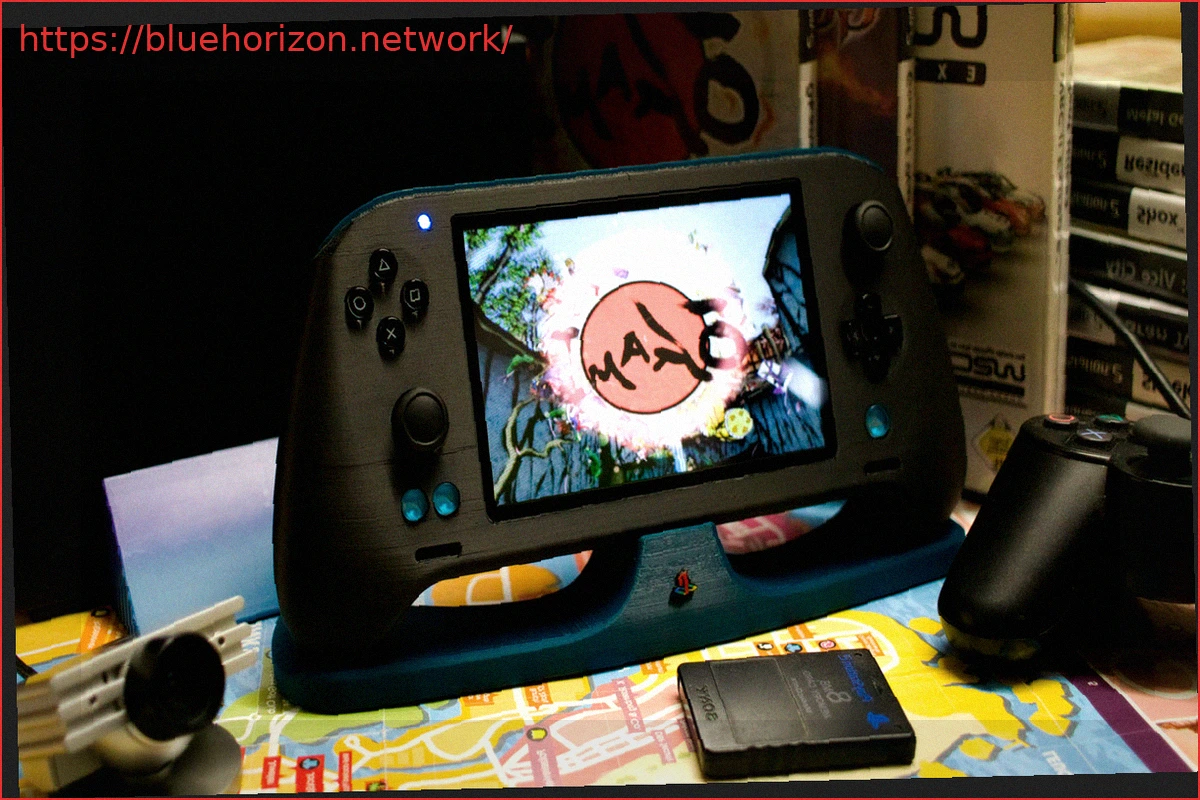
Modder Tschicki has unveiled an impressive portable PlayStation 2 console, built almost entirely from scratch. What sets this project apart from similar endeavors is the use of a custom-designed motherboard, meticulously reconstructed through reverse engineering of the SCPH-7900x and SCPH-9000x desktop console revisions. This means it’s not simply a modified PS2 Slim board, but rather a significantly more intricate undertaking. According to the project’s repository, only six original chips from actual PS2 boards are reused, positioning this as arguably the first functional, custom-built PS2 motherboard not manufactured by Sony.
The significance of this project lies precisely in its innovative approach. Historically, many homemade PlayStation 2 handhelds have relied on cutting down and adapting official motherboards – a complex but relatively common technique within the modding community. Tschicki, however, went much further by designing a proprietary All-in-One (AIO) board. This involved simplifying the original electronics and integrating modern power delivery, digital video output, audio, battery management, controls, and custom firmware. This is not an Android device running a PS2 emulator, nor is it merely a portable PS2 Slim. Instead, it’s a complete portable reimagining of the original hardware. While it retains some original chips, virtually all surrounding components have been modernized.
Behold This Handheld PlayStation 2
Thanks to the use of original hardware, this portable PlayStation 2 natively runs PS2 games via solutions like OPL or NHDDL, and also offers support for PS1 games through DKWDRV. To further enhance its capabilities, it features two custom memory card slots compatible with miniaturized PS2 memory cards, SD cards via MX4SIO, and a compact SD2PSX version. This innovation allows for the elimination of the optical drive, a notoriously bulky and problematic component in any attempt to make a PS2 portable.
One of the most fascinating aspects is the video processing. The handheld incorporates its own digital video processor based on a Trion T20 FPGA, programmed from the ground up in VHDL. Instead of relying on the PS2’s original analog output, the system directly taps into the 24-bit RGB signal from the Graphics Synthesizer. It replaces the original video DAC and drives a 5-inch DPI display with an 800 x 480 pixel resolution. This custom processor adds motion-adaptive deinterlacing, line doubling, bilinear scaling, and an On-Screen Display (OSD) menu – a far more refined solution than simply adapting the original console’s composite, component, or RGB output to a modern screen.
The PlayStation 2 portable is powered by two 21700 batteries, each with a capacity of 5,000 mAh, providing a total of 37 Wh. This capacity offers an impressive battery life of approximately 4.5 hours of gameplay. It also features USB-C Power Delivery charging at 5V, 9V, and 15V, supports playing while charging, includes a battery meter, and incorporates cell protection, balancing, and custom power management. The system even applies a moderate undervolt to the Emotion Engine and Graphics Synthesizer for improved efficiency and thermal performance.
Power management is handled by an RP2040-based controller, responsible for power-on, charging, discharging, electrical monitoring, and other system functions. Additionally, the project includes a custom-developed DualShock 2 emulator, offering vibration support, PS1 game compatibility, and joystick calibration options. The control system combines front buttons from the PS Vita 2000, Hall effect joysticks from the Nintendo Switch operating at 3.3V, and coin-type vibration motors.
The Project is Open-Source and Published on GitHub Under an MIT License
Physically, this portable PlayStation 2 boasts a custom-designed 3D-printed FDM casing. Tschicki prioritized an ergonomic and modular design, separating the outer shell from an internal “skeleton” to facilitate assembly, disassembly, and part replacement. Cooling is managed by an aluminum heatsink that covers the motherboard and adds structural rigidity. This is complemented by a PWM fan from the Nintendo Switch Lite. Stereo speakers from the Nintendo Switch OLED, a headphone jack, a USB-A port for accessories or storage, and a USB-C port for charging and firmware updates are also integrated. The display is protected by a glass lens, a feature inherited from the Nintendo 3DS XL.
This portable PlayStation 2 project is open-source and published on GitHub under an MIT license (via Videocardz). It includes comprehensive documentation, PCB files, Gerbers, bill of materials, firmware, FPGA gateware, and mechanical files. However, the author strongly advises against attempting this project without advanced knowledge. It’s far more than just printing a case and soldering a few wires; it requires specialized equipment, precision soldering, electronic diagnostics, programming skills, and the ability to debug a custom board until it boots. Tschicki warns that it is a very complicated portable to build, though all the documentation is available for those daring enough to try.
This news arrives at a particularly symbolic time. The PlayStation 2 launched in Europe on November 24, 2000, and it remains one of the best-selling consoles in history, with over 160 million units sold since its release. The fact that it continues to inspire projects of this complexity in 2026 underscores the immense legacy of its game library and its architectural influence within the retro gaming community.