
NVIDIA has experienced unprecedented growth, driven by the booming AI market. The company, once a top-10 player, has become the world’s most valuable company in a short period. This surge in value, evident in their consistently record-breaking financial reports, such as the +85% revenue growth in Q1 2026, is not without its challenges. NVIDIA is now facing the consequences of soaring memory prices, leading to significantly higher server costs. However, NVIDIA’s strategy to mitigate this is simple: increase prices.
The current era is characterized by massive investments in AI, particularly in hardware acquisition, data center construction, and infrastructure for AI training and inference. This demand has caused the prices of DRAM (RAM) and NAND Flash (SSD) memory to skyrocket, affecting everyone from individual consumers to major corporations like NVIDIA.
NVIDIA’s VR200 NVL72 Server Rack Costs $7.8 Million, Nearly Double the GB300 NVL72 Due to a 435% Increase in Memory Costs
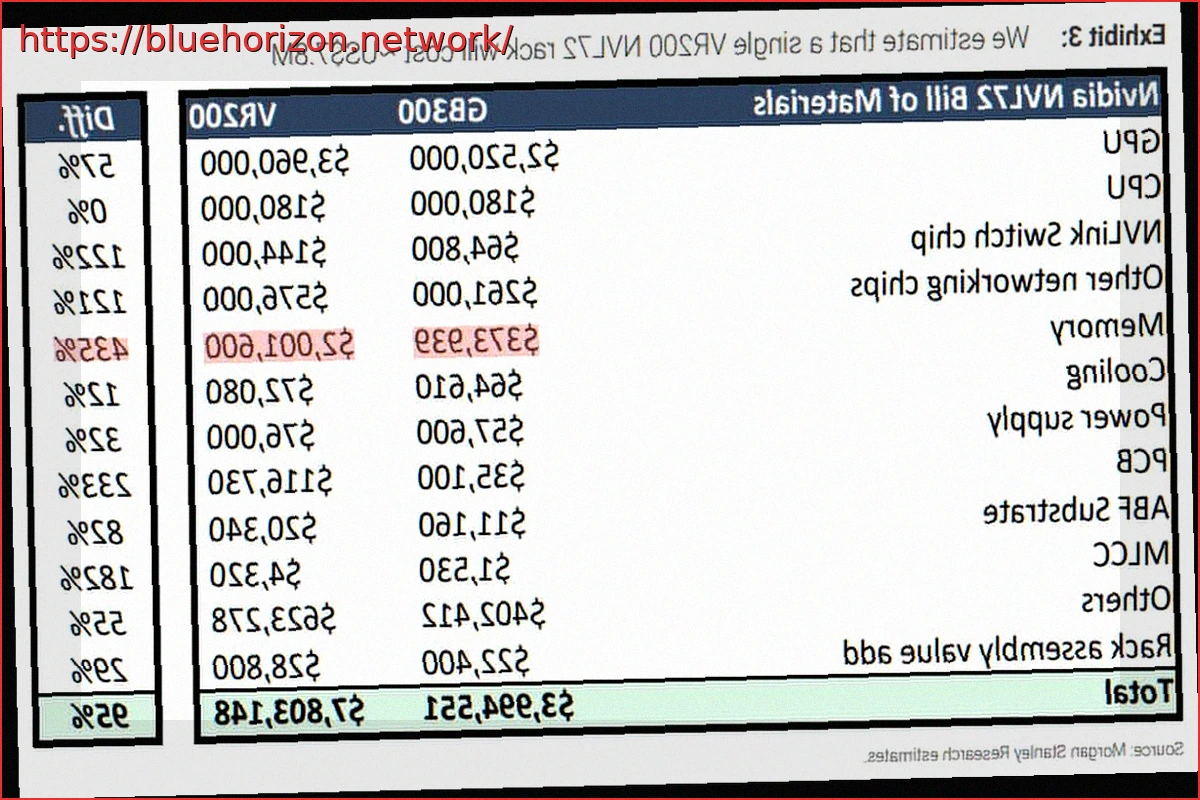
NVIDIA is directly experiencing the impact of these exorbitant price hikes, as its products are heavily reliant on DRAM and NAND Flash memory. Their AI GPUs utilize GDDR7 (for RTX 50 series) and HBM (for AI GPUs) memory, which are becoming increasingly expensive. Furthermore, their servers require the Grace CPU and substantial amounts of memory. A recent analysis of the Bill of Materials (BOM) for NVIDIA’s Rubin server racks by Morgan Stanley Research highlights the significant impact of memory costs. The GB300 NVL72 rack is priced at $4 million, while the latest iteration, the VR200 NVL72, is valued at $7.8 million, nearly double the cost of its predecessor.
It’s important to note that while Morgan Stanley’s report refers to BOM, it actually represents the costs incurred by cloud providers and customers when purchasing these systems directly from ODMs or NVIDIA. Therefore, it does not reflect NVIDIA’s internal manufacturing costs, as the company strategically adjusts prices to maintain profit margins.
A discrepancy exists regarding the percentage increase in memory costs. While Tom’s Hardware reported a +485% increase for NVIDIA Rubin memory, Morgan Stanley’s data clearly indicates a +435% rise. Comparing the memory costs between the VR200 and GB300 reveals an even more substantial +535% increase. Regardless of the exact figure, memory has become the component with the most significant price surge in a single generation, now ranking as the second most expensive component in the entire rack. The GPU remains the most costly, accounting for 57% of the Rubin rack’s cost. The PCB has seen an enormous +233% increase, followed by MLCCs at +182%. NVLink and other networking chips have risen by +121%, and the ABF substrate by +82%.
Memory Costs Now Exceed 25% of the Total Price for an NVIDIA Rubin VR200 NVL72 Server Rack
A staggering $2 million allocated solely to memory for one of these server racks underscores the current pricing landscape. This figure also reflects the hardware differences between the new NVIDIA Rubin server and its predecessor, the Blackwell. For instance, the GB300 NVL72 features 17 TB of LPDDR5X memory for the CPU and 20 TB per GPU, totaling 37 TB of high-speed memory. In contrast, the VR200 NVL72, according to NVIDIA’s specifications, boasts 54 TB of LPDDR5X memory and 20.7 TB of HBM4 memory per GPU, which is three times faster than the previous generation.
A comparative analysis of component costs indicates that GPUs now constitute 50.7% of the total purchase cost for a VR200 NVL72, down from 63.1% for the GB300. Memory, on the other hand, now accounts for 25.7% of the total cost, a significant increase from the 9.4% observed in the GB300 NVL72. The costs of other components have remained relatively stable.