
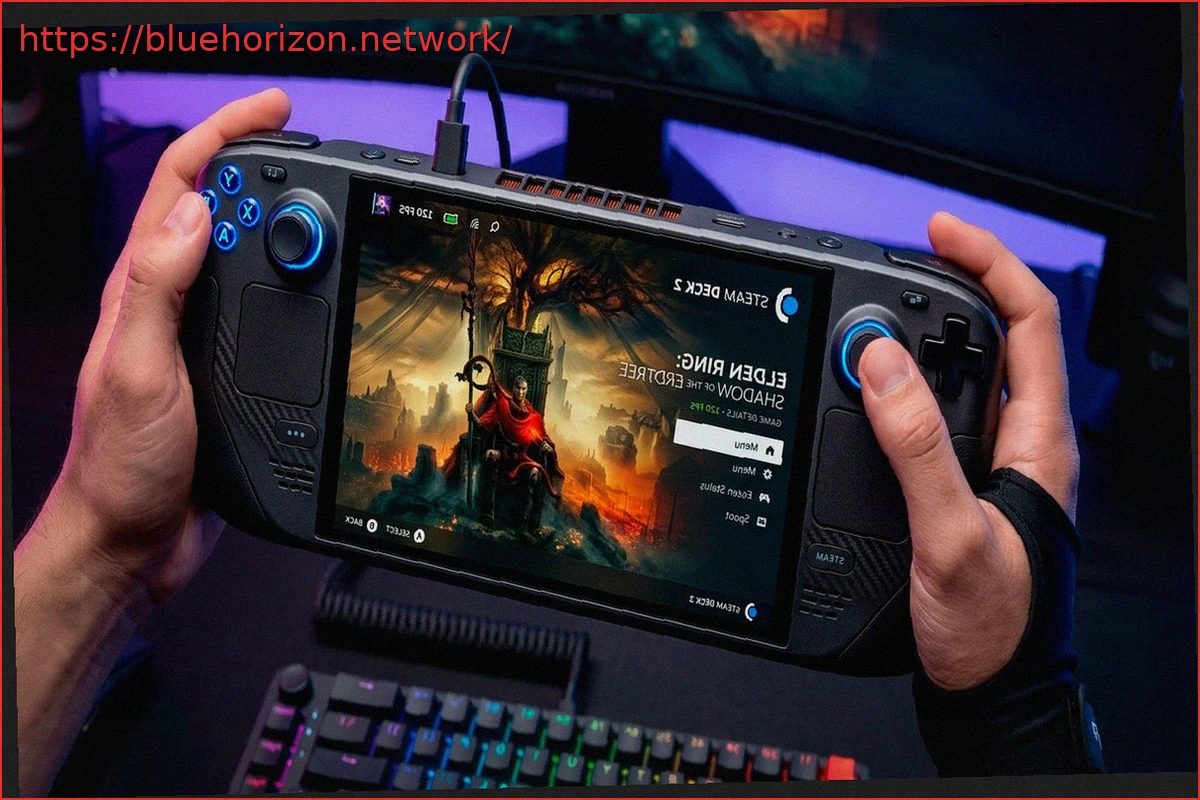
Pierre-Loup Griffais, a key engineer at Valve involved with SteamOS and the Steam Deck, has revealed that the Steam Deck 2 is in conceptual development. This information was shared during an interview with IGN, where Griffais indicated that Valve is ‘working hard‘ on the successor to the Steam Deck.
As a conceptual development, it’s understood that the company might have various aspects of the console finalized, with the design itself being the most logical candidate, alongside other less critical components like the screen, buttons, and speakers. It’s highly probable that the actual hardware this ‘console’ will feature doesn’t even exist yet.
Steam Deck 2 in Conceptual Development, But Still Lacks a Launch Window
Valve’s stance remains unchanged. It’s important to recall that Valve previously stated the Steam Deck 2 would not be released until a new generation of chips emerges that enables a significant leap in performance per watt consumed. This means current market solutions are insufficient. Chips that offer only minor performance improvements at the same energy consumption are not what Valve is looking for. Valve aims for the Steam Deck 2 to deliver over a 50% performance improvement compared to the original Steam Deck while consuming the same amount of energy. It was made clear that a Steam Deck 2 with only a 20%, 30%, or even 50% performance increase wouldn’t suffice if battery life, power consumption, and price weren’t aligned. Pierre-Loup Griffais stated that Valve desires a true generational leap, but currently, no SoC on the market meets this requirement.
The reason for this is that Valve does not envision the Steam Deck as an annual refresh product, unlike many Windows-based gaming handhelds such as the ASUS ROG Ally, MSI Claw, and Lenovo Legion. These devices have seen up to four ‘re-releases’ with battery or hardware improvements. For instance, MSI is reportedly announcing its 5th MSI Claw device with Intel Panther Lake hardware at Computex in June. Valve, however, prefers this approach, aiming for technology to evolve so that a Steam Deck 2 can last for many years.
At most, Valve released the Steam Deck OLED in 2023, a year after the original model. This was a quality-of-life revision, an improved version featuring an OLED screen, longer battery life, a more efficient SoC, and WiFi 6E connectivity. Valve claims the OLED offers between 30% and 50% more battery life, along with WiFi 6E and cooling enhancements, while maintaining the overall focus of the original hardware.
And When the Hardware is Ready… What About Memory?
Indeed. Let’s imagine the development is complete. Valve knows which display panel it will use and its specifications. It also knows which processor and integrated graphics the Steam Deck 2 will feature, and consequently, the battery. The essential components are in place, but… what about memory? The Steam Machine has been delayed, and its release date and price are currently unknown.
The Steam Deck 2 will be much more popular, meaning Valve will need to accumulate significantly more RAM and storage. If the current memory shortage persists, not only will it be practically impossible to access this memory, but it will also be so expensive that manufacturing the console might be unfeasible until the situation improves considerably.
Thus, Valve wants to launch the Steam Deck 2, but two problems stand in the way. The SoC it will use does not yet exist, and on top of that is the issue of memory scarcity and price increases. It’s also logical to consider that Valve might explore other options, such as abandoning the x86 CPU architecture and switching to ARM. This is why Steam, SteamOS, and Proton are making significant advancements to provide full compatibility with this architecture. Rumors suggest that the Steam Deck 2 could arrive in the year 2028.