
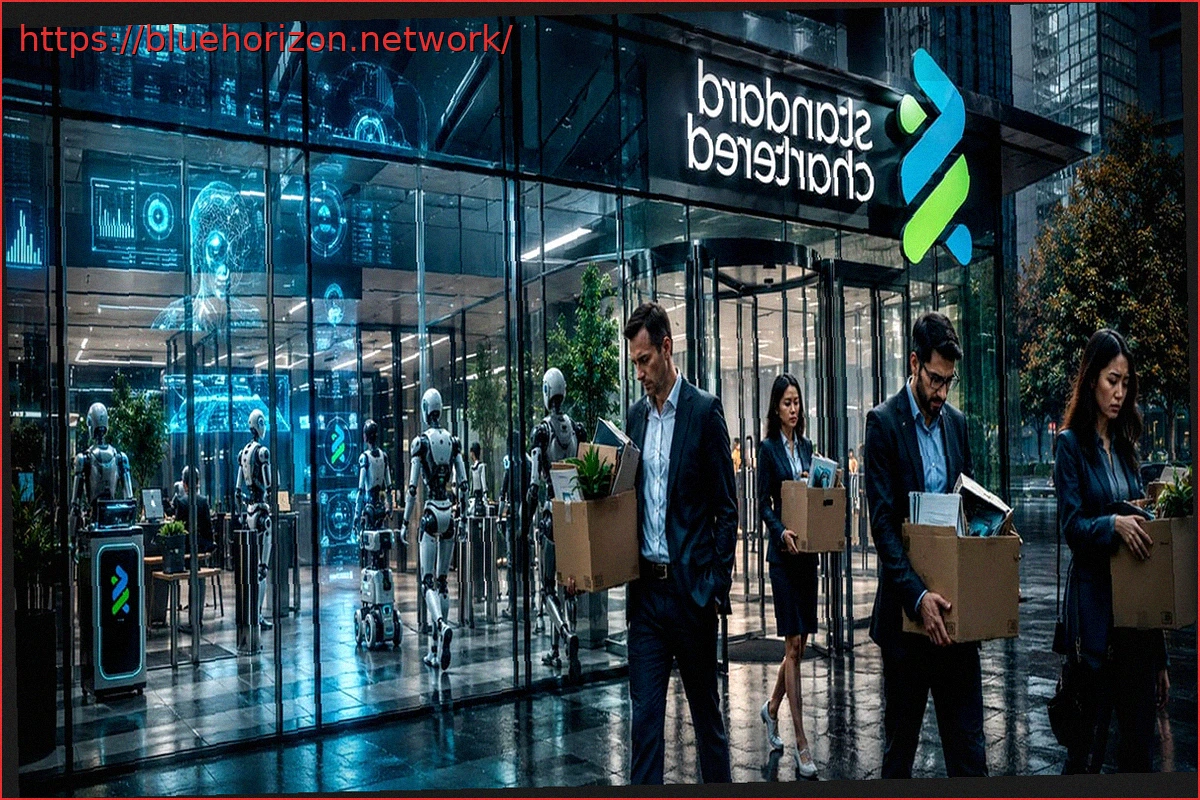
British bank Standard Chartered has announced its intention to dismiss over 7,000 employees deemed of ‘lower value’ by 2030, driven by the integration of Artificial Intelligence in banking. This workforce adjustment is a strategic move to automate operations, streamline internal structures, and boost profitability. The institution, which currently employs around 82,000 people globally, will reduce approximately 15% of its positions in corporate functions. Reuters estimates this will result in over 7,000 departures from its corporate workforce of more than 52,000.
CEO Bill Winters was notably direct, explaining that this measure is not merely a cost-cutting initiative but a partial substitution of “lower-value-added human capital” with technological investment and financial capital. In practice, this means that automation and AI will be employed to handle repetitive, administrative, or support tasks. Some employees may have the opportunity for professional retraining within the bank. However, it can be seen as dismissive to label these employees as “second-class” or valueless individuals who can be replaced by AI.
Standard Chartered Initiates Transformation Towards AI-Driven Banking
At Standard Chartered, and indeed in any bank, employees in internal office functions and support centers are most exposed to these changes. This transformation primarily affects the processes that underpin the bank’s daily operations, rather than an immediate replacement of direct customer-facing bankers. Areas such as operations, compliance, document management, internal systems, risk analysis, and administrative tasks are included.
This decision comes as Standard Chartered strives to consolidate a decade of transformation. The bank has raised its financial targets, aiming to exceed 15% return on tangible equity by 2028 and reach approximately 18% by 2030. To achieve this, the institution seeks to become more efficient, focus on higher-margin businesses, and strengthen areas like high-net-worth retail clients and financial institutions.
AI is not merely a future promise for the bank. In 2025, Standard Chartered launched SC GPT, an internal generative AI tool deployed across 41 markets and intended for over 70,000 employees. At the time, the bank stated that this technology would help improve productivity, sales, marketing, software automation, and risk management. It also argued that generative AI was already an “operational imperative” for the banking sector.
Clear Use Cases for AI in Banking
Standard Chartered has outlined specific use cases for AI in banking, including the automation of trade finance documents, authenticity verification, liquidity scenario simulation, correction of erroneous payment messages, generation of regulatory reports, and enhancement of compliance processes. Essentially, the bank views AI as a tool to reduce manual intervention in data- and document-intensive processes.
This move aligns with a broader trend in the financial sector. It was estimated in 2025 that global banks could cut up to 200,000 jobs within three to five years due to AI adoption. This pressure is particularly felt in customer-facing, administrative, and operational roles. Citigroup, for example, announced a plan in 2024 to reduce 20,000 jobs by 2026 as part of a restructuring to simplify its structure and improve profitability.
Nevertheless, Standard Chartered’s case is significant because it explicitly links job cuts to AI. The bank is not simply stating a need to reduce its human workforce due to cost pressures. Instead, it is acknowledging that a portion of human work will be replaced by technology. This announcement serves as a clear signal to the entire industry. AI is no longer presented solely as a tool to assist employees but as a lever to redefine the number of people a financial institution needs to operate. In the first quarter of 2026, Standard Chartered reported revenues of $5.9 billion, a 9% increase, while expenses rose by only 1%. This indicates that AI adoption is occurring during a phase of profitability improvement rather than a crisis.