
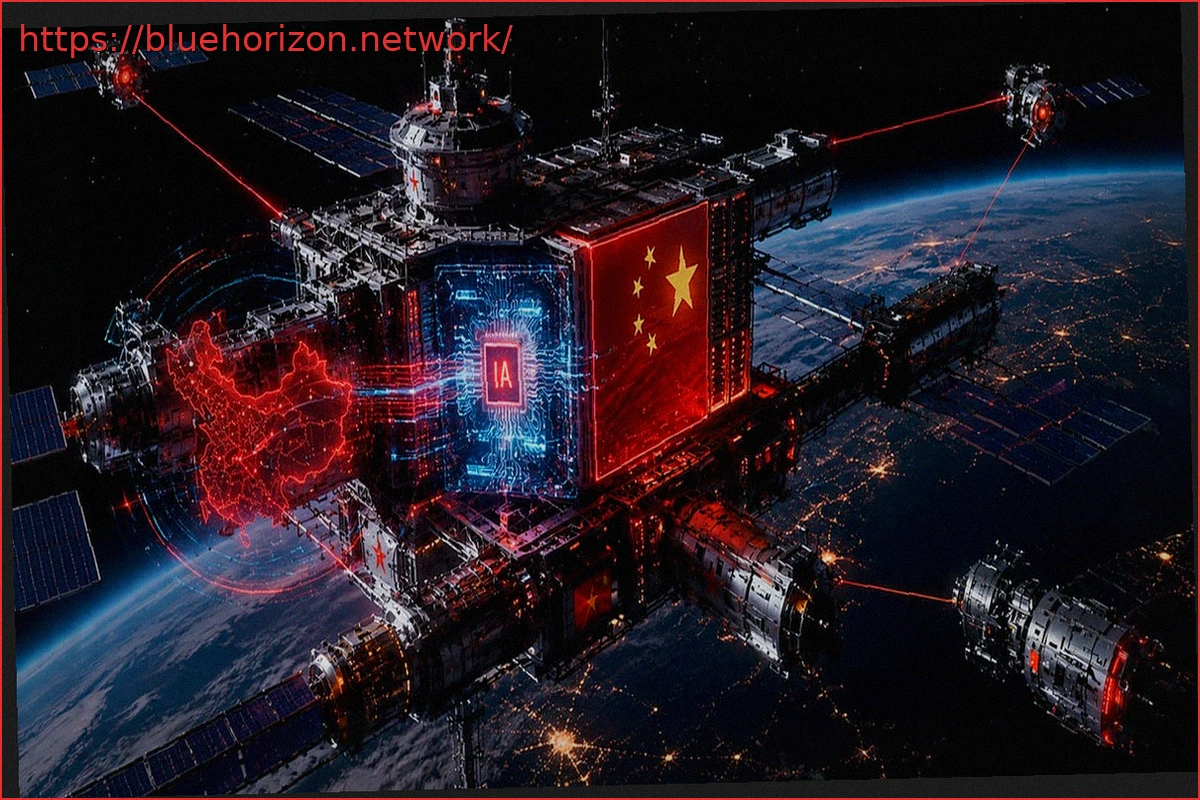
China has taken a significant step in its pursuit of space-based artificial intelligence computing capabilities. The Beijing government has approved the establishment of the “Space Computing Industry Innovation Center.” This innovation hub is designed to unite rocket and satellite manufacturers, semiconductor companies, AI firms, and universities with a singular objective: to construct a future space computing network capable of processing data directly in orbit. According to official statements from Beijing, the goal is to integrate the entire space computing industrial chain and accelerate the development of satellite-based Internet of Things (IoT).
This initiative extends beyond launching conventional satellites. The project identifies six key research areas: space-native chips designed for high reliability and heat resistance; high-performance space computing payloads; satellite platforms and technical standards; large AI models capable of operating under energy constraints; integrated ground-to-cloud-to-space control networks; and novel commercial exploitation models for space computing power. In essence, China aims to lay the groundwork for an infrastructure where a portion of AI processing can be executed directly on satellites or orbital platforms.
China Seeks to Compete with SpaceX (and the US) in the Space AI Data Center Business
The strategic significance of this move lies in its nature as a state-directed industrial alliance, not an isolated experiment. The Beijing University of Posts and Telecommunications is a key player, alongside companies from the space and technology sectors. China Daily previously reported in April on the formation of China’s first professional committee dedicated to space computing, with a strong emphasis on AI chips, inter-satellite laser communications, efficient thermal control, and space photovoltaics.
The timing of this announcement is also noteworthy. It comes just days after Elon Musk detailed the design of SpaceX’s AI1 satellite, an orbital platform intended for AI workloads outside terrestrial power grids. The AI1 is reported to have a deployed span of 70 meters, an average compute load of 120 kW, and peaks of 150 kW, with a modular design allowing for chips from various suppliers. SpaceX has been actively promoting this concept for months, having submitted an ambitious plan to the FCC to deploy up to one million satellites as part of an orbital data center system, operating at altitudes between 500 and 2,000 kilometers, with a theoretical AI computing capacity of up to 100 GW at full scale. Blue Origin is also pursuing a similar vision with its Sunrise project, proposing a network of up to 51,600 satellites in sun-synchronous orbits for space data centers.
China’s Entire Industry Will Unite for a Common Goal, Following in SpaceX’s Footsteps
While SpaceX pursues aggressive vertical integration, encompassing rockets, satellites, manufacturing, deployment, and potentially proprietary hardware, China appears to be building a coordinated national structure. This involves integrating satellite manufacturers, chip companies, universities, AI firms, and government agencies. Beijing is not merely presenting a specific satellite but fostering an industrial ecosystem around space computing. This strategy aligns with recent national initiatives, such as Beijing’s future “Satellite Town,” slated for completion in the latter half of 2026, which aims to centralize satellite manufacturers and operators. Reuters also noted that commercial launches now account for over 60% of China’s space launches, within a rapidly expanding commercial space market.
The underlying motivation mirrors that of SpaceX and other competitors: terrestrial data centers have become a bottleneck. AI demands increasing amounts of energy, cooling, land, permits, water, and electrical infrastructure. In the United States, efforts are underway to accelerate the manufacturing of off-grid gas power plants to fuel AI data centers, drawing criticism for a lack of transparency and environmental impact. China, meanwhile, is reportedly preparing a national AI data center network with an investment of approximately $295 billion, aiming to connect data centers via a unified platform and heavily relying on domestic technology.
Orbital computing offers the promise of circumventing some of these issues by leveraging direct solar energy. However, the absence of air and water for cooling in space necessitates heat dissipation through infrared radiation, requiring massive radiators. SpaceX’s AI1, for instance, incorporates up to 110 square meters of deployable liquid radiators, in addition to redundant circuits and micrometeoroid protection. Like the rest of the industry, China will face challenges related to in-space maintenance, launch costs, hardware lifespan, radiation resistance, latency, repairability, and space debris. Therefore, the path forward will not be without its difficulties.