
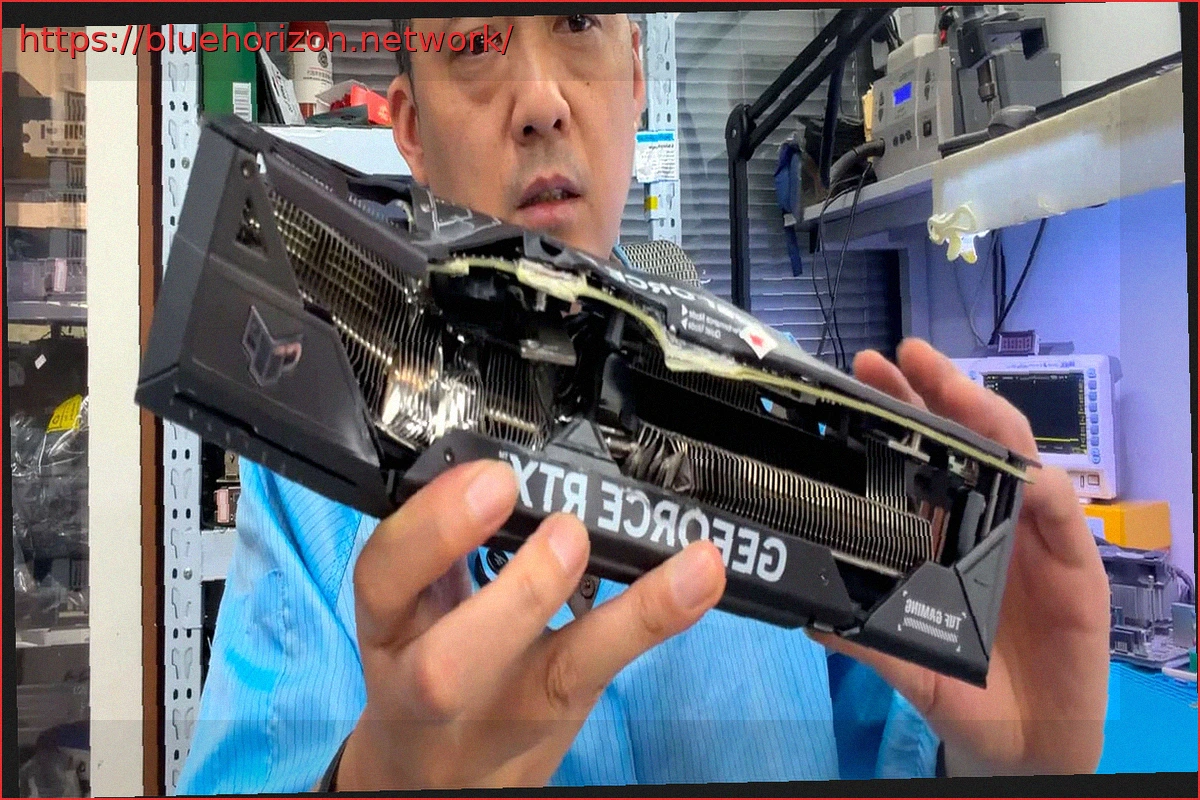
An ASUS TUF GeForce RTX 4070 SUPER has become the subject of a repair case that seems more suited for a viral video than a conventional technical service. As its owner recounted, the graphics card was allegedly damaged by a hammer during a couple’s argument, leaving it in an apparently irreparable state: bent metal backplate, misaligned video outputs, and most critically, a PCB with cracks, tears, and delaminated areas. Unsurprisingly, ASUS denied warranty repair due to intentional damage. The Plan B was to take it to an expert to try and revive it.
This turned it into another ‘Frankenstein’ GPU. The PCB and cooling system were beyond repair. However, the most crucial components, the graphics chip and the GDDR6X memory modules, survived. The technician responsible for giving it a second life, known as Brother Zhang, had to salvage these components and solder them onto a new PCB.
How the GeForce RTX 4070 SUPER Looked After its (Hopefully Ex) Girlfriend’s Hammer Attack
During the inspection of the GeForce RTX 4070 SUPER, a short circuit was detected on the 1.8v line. The origin appeared to be the damaged PCB itself, rather than the graphics chip or memory modules. Therefore, instead of attempting to reconstruct a cracked and delaminated board, the process became a transplant: the chip and memory were removed from the broken PCB and installed on a functional replacement board. The card was then assembled with an OEM heatsink from Lenovo, it booted up, and successfully passed stress tests.
The user’s motivation to give the GeForce RTX 4070 SUPER a second life is clear. It remains a very capable gaming GPU today, featuring a chip with 7,168 CUDA Cores at 2.59 GHz, 12 GB of 21 Gbps GDDR6X memory, and a 192-bit interface. This is especially true considering how much these GPUs have increased in price. It was more cost-effective to attempt to repair this GPU than to buy a new one with similar performance to the damaged model.
The technical takeaway is evident: in a modern graphics card, the PCB is often the most vulnerable part to severe physical damage. A blow can break internal traces, power layers, solder joints, connectors, or VRM phases, rendering the card unusable even if the main silicon remains intact. Thus, replacing the PCB is the quickest and most logical step when something like this happens.
The survival of the chip and memory doesn’t mean the original graphics card was saved. It means its main components could be reused on a different base. If, for example, the chip or VRAM had not been recoverable, the story would be significantly different. In that scenario, the repair would not be worthwhile, and buying a new GPU, even a less powerful one, would be the most logical course of action.