

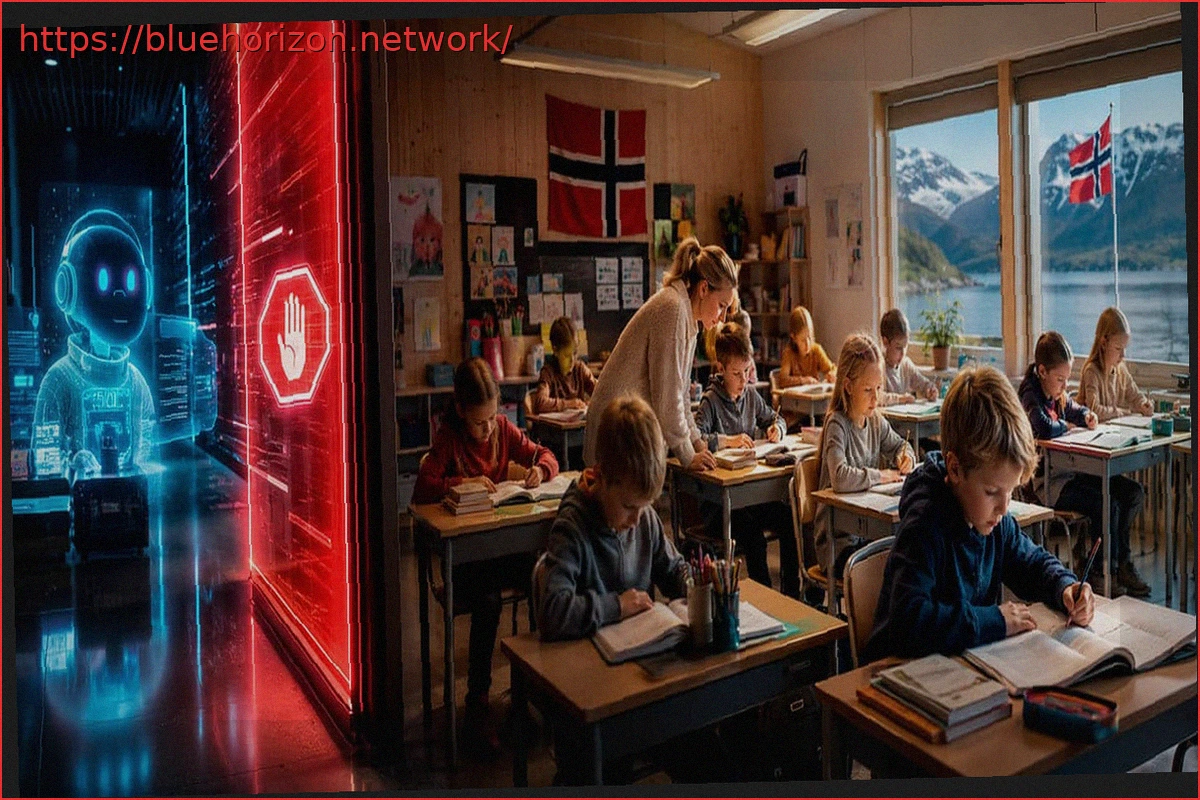
Norway is set to make a decisive shift in its educational policy: from the upcoming school year, commencing in late August 2026, primary school students will be prohibited from using generative artificial intelligence tools in their schoolwork, with only exceptional cases allowed. This measure will primarily affect students from grades 1 to 7, meaning children aged between 6 and 13 years old. The Norwegian government justifies this decision by the risk that younger students might skip essential learning steps by relying too heavily, too soon, on systems capable of automatically generating answers, texts, or explanations.
The new national recommendation does not constitute an absolute prohibition of AI across the entire educational system but rather a clear age-based distinction. In primary school, students are to be “protected” from using AI independently in their schoolwork. In lower secondary school (ages 13 to 16), AI may be introduced gradually and cautiously, but only if teachers possess sufficient competence to guide its use beforehand. In upper secondary school (ages 16 to 19), the approach changes. Students will be required to learn how to use these AI tools appropriately to prepare them for higher education and the job market.
Younger Norwegian Students Face the Most Restrictions on AI Use
The Norwegian Prime Minister defended that the school’s priority must remain on children learning to read, write, and calculate, before delegating parts of that process to automated tools. The Minister of Education was even more direct, stating that younger students do not yet possess the necessary academic foundation, critical thinking, or self-regulation skills to effectively use generative AI. The government also insists that it does not want to repeat what it considers to be a mistake made with the uncritical introduction of digital devices at an early age.
This decision arrives amid growing concern over declining educational performance in Norway. The executive branch cites several international reports, such as PISA and PIRLS, which reflect a deterioration in the basic skills of Norwegian students. According to the government itself, one in four Norwegian students reads below the OECD’s minimum threshold for continuing their education and subsequently entering employment. The OECD had already noted in PISA 2022 that Norway’s average results had fallen compared to 2018 in mathematics, reading, and science, with the country’s worst historical result in mathematics within this assessment.
What is striking is that this restriction comes at a time when AI was already rapidly spreading through Norwegian classrooms. A report from the Norwegian Directorate for Education and Training, published in January 2026, revealed that 65% of primary schools were already using AI tools in teaching. In lower and upper secondary education, this percentage reached 90%.
Norway also Advocates for a Greater Emphasis on Physical Books
The strategy is not limited to AI. Norway is also questioning another educational movement: they intend to reduce the presence of screens in education and reintroduce the use of physical books. The government has announced its intention to legally enshrine the right of basic education students to have printed textbooks, so that access to physical materials does not depend on municipal finances or local decisions. According to the Ministry of Education, over 45 million euros have been allocated to physical textbooks since 2021, but it is believed that the measure has not been sufficient.
On the opposite end, we see China and Japan, who are accelerating AI literacy. They employ a hybrid solution: books and paper for deep reading and basic skills. Screens are used for simulations, interactive exercises, accessibility, and multimedia resources. AI is utilized for personalized tutoring, feedback, and teacher support, with an emphasis on pedagogical design and supervision.
This is complemented by studies indicating that intelligent tutors improve learning compared to traditional methods. A meta-analysis of intelligent tutoring systems reviewed 50 controlled evaluations and concluded that these systems boosted student outcomes by approximately 0.66 standard deviations. This is equivalent to moving from roughly the 50th percentile to the 75th percentile compared to conventional teaching. In other words, when technology adapts exercises, pace, and feedback to the student, learning can indeed be significantly improved.