
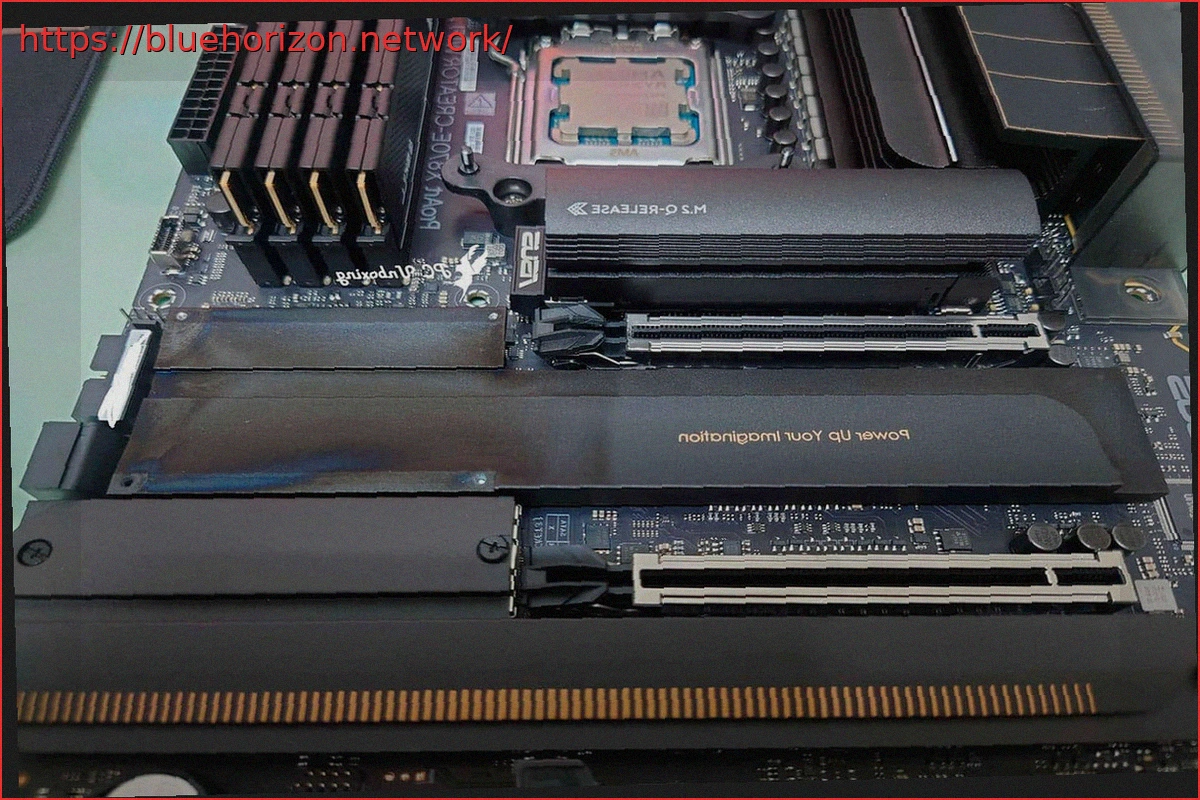
The ASUS ROG Astral GeForce RTX 5090 is once again at the center of controversy. According to a report from a Taiwanese forum, a user removed their ROG Astral RTX 5090 after approximately six months of use and discovered that the chipset/PCH heatsink on their ASUS ProArt X870E-Creator WiFi motherboard exhibited a clearly discolored area directly beneath the graphics card. Notably, the entire system was built with ASUS hardware, including an ASUS ProArt PA602 case.
The discoloration appeared on the motherboard area situated directly below the GPU. The user indicated that while some of the stain could be removed with a damp cloth, the heatsink did not return to its original appearance. The graphics card itself showed no visible external damage and continued to function normally, making the situation perplexing but not definitively conclusive. Although the accompanying photo clearly shows what appears to be future thermal damage due to coating degradation, not to mention the potential increased degradation of the motherboard chip from operating at elevated temperatures.
RTX 5090 Heat Affects Adjacent Hardware
The thermal context, admittedly, does not help. The GeForce RTX 5090 is an extremely power-hungry GPU. NVIDIA officially lists a Total Graphics Power of 575W and recommends a 1,000W power supply. In reality, there are scenarios where the RTX 5090 can consume even more under load or during significant power spikes. Regardless, a card of this caliber generates an enormous amount of heat within the chassis, and this heat affects not only the GPU itself but also the surrounding components.
The ROG Astral RTX 5090, in theory, is designed to handle such thermal loads. ASUS boasts a four-fan cooling system, a patented vapor chamber, increased fin density, phase-change thermal pads, and a reinforced power delivery with 80-amp MOSFETs. However, the issue here doesn’t appear to be the GPU overheating to the point of failure, but rather how the heat expelled or radiated by such a large card can impact nearby motherboard areas, especially if the airflow around the GPU is not optimal.
There is also a small, albeit possible, chance that the discoloration is not heat-related. There have been instances where RGB lighting from RAM or other components has caused marks or discoloration on GPU backplates. In this particular case, however, the location of the mark strongly suggests a connection to the heat generated by the GPU.
ASUS ROG Astral RTX 5090 Accumulates Several Complaints Related to its Performance
This new incident adds to a list of controversies surrounding the ROG Astral RTX 5090. Previous issues include melted 16-pin connectors, black screen problems, early batches with an incorrect number of ROPs, and an isolated case of fire allegedly attributed to a damaged MLCC. This does not imply that this new incident is widespread or that all ROG Astral RTX 5090 cards have a design defect, but it does reinforce the perception that current enthusiast-grade GPUs are operating at increasingly delicate thermal and electrical margins.
As of this writing, ASUS has not issued an official response regarding this specific discoloration. For users with an RTX 5090, especially those who use it for extended periods in AI, rendering, CUDA workloads, or heavy gaming, it is advisable to review their case’s airflow, prevent the GPU from recirculating hot air onto the motherboard, and periodically check the power connector area, the backplate, nearby heatsinks, and cables.