Artificial Intelligence is already making its first significant commercial impact on a platform as well-known as Steam, according to an analysis by Game Oracle concerning commercial games released between January and October 2025. While the study doesn’t work with actual sales data, which is proprietary to Steam and developers, it does examine the reviews received in the first month after launch. This metric is commonly used as an approximation of a game’s commercial performance, and AI is proving to be a key factor in popularity and, consequently, sales.
It’s widely known that Artificial Intelligence is not being well-received in certain circles. We’ve seen everything from boos at academic award ceremonies to mass layoffs and criticisms regarding its control. Today, we’re taking it a step further, as gamers themselves are also against its use in video games.
Games Using AI Receive Up to 52% Fewer Positive Reviews, Affecting Sales
The study’s final sample consisted of 9,879 games after excluding free-to-play titles, unreleased games, and 1,932 releases deemed spam due to an abnormal publishing frequency or unusual initial prices exceeding $100.
Within this sample, 17.9% of the games included a declaration of AI usage on Steam. This is mandatory when AI-generated content has been used during development, highlighting the impact of Valve’s transparency policies.
The initial findings of the study show clear differences. Games that declare AI use have a median of 4 reviews in their first month, while games without AI receive 7 reviews. There are also more titles with 0 reviews among games using AI, 19.8% compared to 15.2% for games without AI. However, the figure for games with fewer than 100 reviews stands at 91.7% for games with AI and 94.9% for games without AI, indicating that this specific metric doesn’t align with the rest of the trends.
The data is intriguing, but it’s not the only significant finding. Some points are crucial and offer a glimpse into the harsh reality for any studio aiming to cut costs or accelerate work with this technology.
AI in Games is Unpopular, Especially When Directly Used in a Title
Game Oracle also examines user reception when there’s a sufficient volume of reviews for the score to be more meaningful. For games with at least 100 reviews, titles that declare AI use have a median of 84.6% positive reviews, compared to 88.3% for games that do not declare AI. Furthermore, the median number of followers before launch, used as an approximation of wishlists, is roughly half for games with AI.
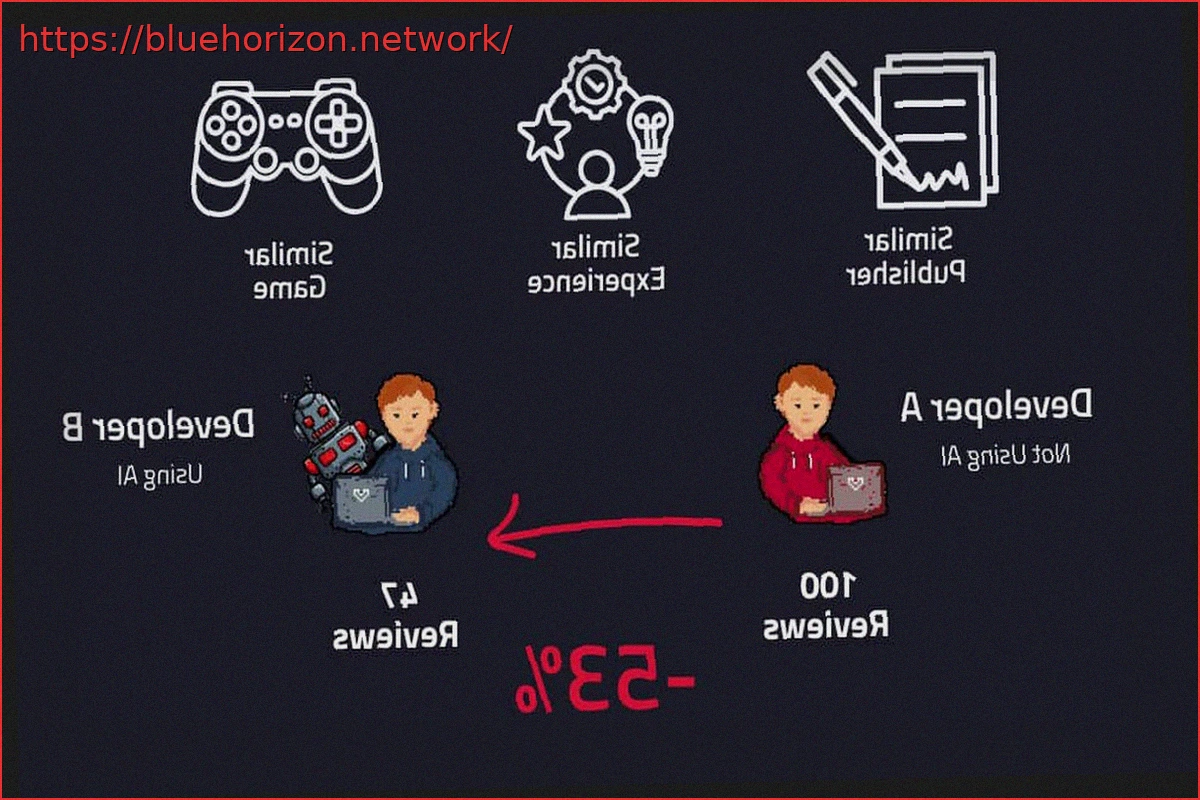
The most powerful statistic comes from the statistical model. By comparing games of the same genre, released in the same month, with similar publisher situations and comparable developer experience, Game Oracle estimates a 52.6% drop in reviews for games that declare AI use. The estimated range is from 47.69% to 57.63%. The practical example is straightforward: if a game without AI garners 100 reviews, a comparable game with AI would receive only about 47 reviews.
The analysis itself acknowledges significant limitations, as it cannot accurately measure marketing, budget, team skill, financial pressure, or luck. This is logical, as it can only scratch the surface of what is observable.
Its sensitivity analysis indicates that to overcome this penalty, there would need to be an unmeasured factor that nearly triples the probability of using AI, to 2.7x, while simultaneously reducing reviews by 22% on its own. Game Oracle also notes that some games using AI have performed well, but points out that it couldn’t measure how AI was used in each project. This likely represents a key difference between using AI as a tool versus using it as a shortcut.
Since this crucial detail is not specified, the evaluation is generalized between AI and non-AI games. Regardless, it appears entirely causal, not coincidental, that gamers do not want AI-created games on Steam, or at least, that’s what the review data suggests. The question now is for you, the reader and player: how does a game’s use of AI directly affect you? Do you view it positively, negatively, or are you indifferent? I’m eager to read your opinions on this controversial topic in the comments.