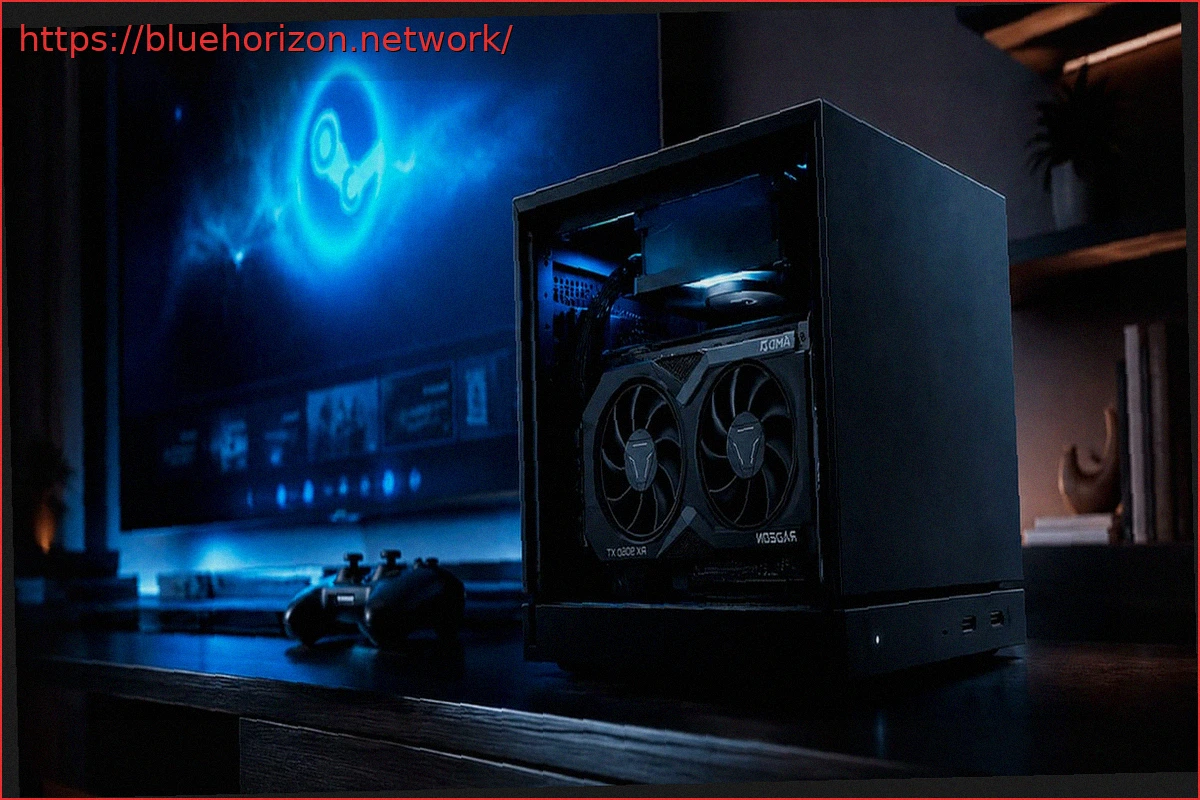
Following the disappointment of the original Steam Machine, Valve has taken a significant step towards enabling any user to transform their computer into a Steam Machine running SteamOS. The company has transitioned SteamOS from being exclusively for the Steam Deck and its own devices. Valve has updated the public installation ISO for SteamOS 3.8 to include beta support for dedicated AMD Radeon graphics cards.
Essentially, this update opens the door for any user to build their own “Steam Machine” using conventional PC hardware, provided the GPU is from AMD. Until now, public support was primarily focused on the Steam Deck, AMD-powered handhelds, and specific devices like the Lenovo Legion Go and ASUS ROG Ally/Ally X. Consequently, users seeking a smoother gaming experience often resorted to Linux distributions geared towards gaming, such as Bazzite or Cachy OS. Now, those with an AMD GPU can directly transition to SteamOS.
With SteamOS 3.8, a Dedicated AMD Radeon GPU Steam Machine Makes Less Sense Compared to a Custom PC
The most significant novelty in SteamOS 3.8 for us is the recent addition mentioning support for ‘AMD Radeon discrete/dedicated GPUs.’ This signifies that SteamOS is no longer confined to the integrated APUs found in handheld consoles; it is now beginning to support desktop configurations with a dedicated AMD Radeon graphics card. In practice, this allows for the creation of a living room PC running SteamOS, offering a console-like interface and direct access to the Steam ecosystem, without the necessity of purchasing Valve’s official Steam Machine.
Valve itself had previously indicated that SteamOS 3.8 would allow the use of the same operating system found on the Steam Machine on custom living room PCs. However, the crucial detail is that, for now, official support is limited to AMD GPUs. Valve continues to work towards expanding compatibility with more hardware in the future, but at present, Intel and NVIDIA are still excluded from full official support. At least Valve announced this week that it is working with NVIDIA to also offer this support.
This move aligns with the release of SteamOS 3.8.10, a stable update that already includes initial support for future Steam Machine hardware. Furthermore, Valve has updated the underlying Arch Linux base system, improved graphics drivers, added preliminary support for HDMI VRR on devices with native HDMI output, and enhanced frame pacing with VRR, all of which are particularly relevant for PCs connected to televisions or gaming monitors.
Why Should You Consider a Steam Machine Now?
If you value simplicity and desire a very compact system for your living room, the Steam Machine is undoubtedly a good option. Especially if you already have a main gaming PC and are looking for an extension of it to enjoy couch gaming without worrying about graphical fidelity. Outside of this specific scenario, it is very difficult to justify purchasing a Steam Machine.
Thanks to SteamOS 3.8, you can now have a SteamOS computer featuring a Ryzen 5 5600, a Radeon RX 9060 XT 16 GB, and 32 GB of RAM for the price of a Steam Machine. You’ll essentially be paying the same price but in a larger form factor. In return, you receive a performance improvement ranging from 60% to 100% depending on the game. The Steam Machine struggles to run games at 1080p or 2K at over 30 FPS unless graphical settings are low to medium and AMD FSR is utilized. This falls far short of Valve’s promises of 4K at 60 FPS. While achieving this is possible, it requires significant tinkering with settings (graphics, scaling, and frame generation).
As a simple reference, a system with a Radeon RX 9060 XT would be comparable to the PlayStation 5 Pro. The Steam Machine would be akin to the PS5 running a game in Performance Mode, meaning lower visual quality to achieve at least fluidity. In contrast, the PS5 Pro offers higher visual quality with the same fluidity.