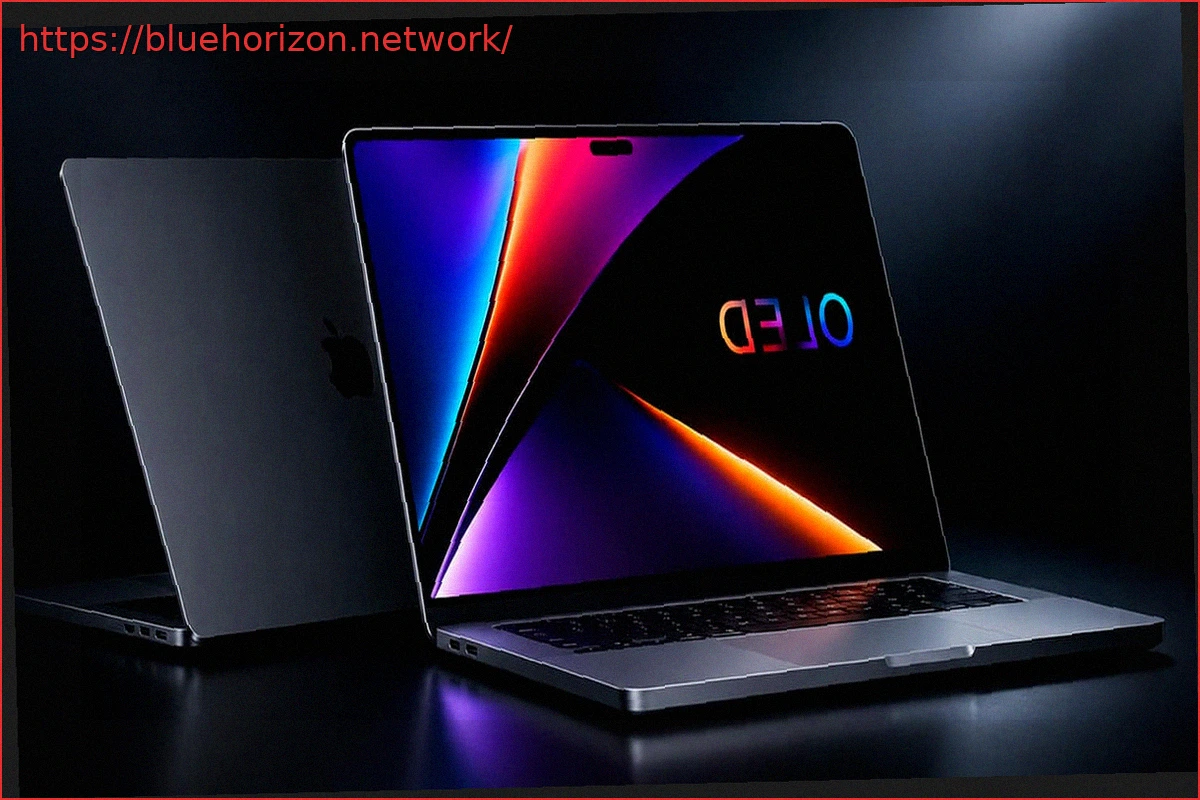
Samsung Display appears to have overcome a major hurdle for the first MacBook Pro with an OLED screen: stable production of large laptop panels. According to The Elec, Samsung’s OLED Gen 8.6 panel line for IT devices has already achieved a yield of over 90%, with some individual processes nearing 95%. This figure is considered by the industry to be mature enough for stable mass production.
The challenge lies in the fact that these panels are not comparable to the OLEDs found in an iPhone. Laptops require a much larger surface area, greater uniformity, sustained brightness, increased resistance to static images, and a longer lifespan. Therefore, the panel destined for the MacBook Pro will utilize a more advanced structure, featuring tandem OLED with two emissive layers, a glass substrate, thin-film encapsulation, and an oxide TFT backplane. This architecture is designed to enhance brightness, efficiency, and longevity, but is also more difficult to manufacture with a good yield rate.
MacBook Pro OLED Panels to Begin Manufacturing as Early as Next Month
The report indicates that Samsung Display could begin shipping Gen 8.6 OLED panels starting in June 2026. These will primarily be for future 14-inch and 16-inch OLED MacBook Pros. Production for this year is estimated to be around 2 million units. It’s important to note that this refers to the mass production of the panels themselves. After manufacturing, they undergo module processing before reaching Apple’s assembly line. Typically, several weeks pass from glass introduction to final shipment, leading to speculation that these devices might be announced as early as October.
This advancement is significant because Samsung’s Gen 8.6 line was specifically developed to produce larger OLED panels more efficiently than traditional mobile-focused lines. Samsung has reportedly invested approximately 4.1 trillion won in this infrastructure, with a planned total capacity of 15,000 substrates per month. Currently, only half of this capacity is in operation: 7,500 substrates per month. If demand for the OLED MacBook Pro and other IT products remains strong, Samsung could activate the second half of its capacity to rapidly scale up production.
In practice, this reinforces the ongoing transition of the MacBook Pro line to OLED technology. Current models still feature Liquid Retina XDR displays, offering 1,000 nits of sustained brightness in HDR, peak brightness of up to 1,600 nits, and ProMotion up to 120 Hz, according to Apple’s official specifications for MacBook Pro M5 Pro/M5 Max models. The shift to OLED promises perfect pixel-level blacks, superior true contrast, potential thickness reduction, and improved response times. However, Apple will need to carefully balance cost, power consumption, sustained brightness, and the risk of image retention.
This Major MacBook Pro Overhaul Could Arrive by the End of This Year
Leaks suggest that the MacBook Pro redesign was initially anticipated for late 2026. However, previous reports from Bloomberg indicated a potential delay into early 2027, partly due to production and supply chain challenges. Respected analyst Ming-Chi Kuo and journalist Mark Gurman had placed the rumored touch-enabled OLED MacBook Pro in a timeframe between late 2026 and early 2027. The potential delay was linked to the difficulties in OLED panel production. But with panels expected to ship to Apple next month, this could help avoid a launch postponement.
Another significant point is the potential introduction of a touchscreen. Ming-Chi Kuo had previously indicated that the OLED MacBook Pro would enter mass production by late 2026 with touchscreen technology. This would represent a historic shift for the MacBook range. According to the most prevalent rumors, this redesign might also include a slimmer chassis, the elimination of the notch in favor of a Dynamic Island-like solution, and chips from the Apple M6 family. Consequently, these devices are poised to offer a substantial leap, across all aspects, compared to the current device family.