According to recent reports, NVIDIA is gearing up to launch two new GeForce RTX 5060 Ti and RTX 5060 models equipped with 9GB of GDDR7 VRAM. While this might suggest an upgrade over the current 8GB VRAM models, it’s important to note that all that glitters is not gold. Despite the increased memory capacity, these are actually inferior models.
The reason behind this configuration is the adoption of new 24Gb GDDR7 chips, each equivalent to 3GB per chip. Samsung officially unveiled these chips in October 2024, announcing validation with major GPU clients and subsequent commercialization. Micron, on the other hand, was already promoting its 24Gb GDDR7 chips in 2026, boasting speeds of up to 36Gbps and higher densities for future GPUs. NVIDIA is even already selling GeForce RTX 50 laptops with capacities that align with this new density, such as the 24GB GDDR7 GeForce RTX 5090 Laptop. This reinforces the idea that 3GB modules are a real design tool and not just a hypothesis.
GeForce RTX 5060 Ti and RTX 5060 with 9GB Offer More Capacity but Will Be Slower
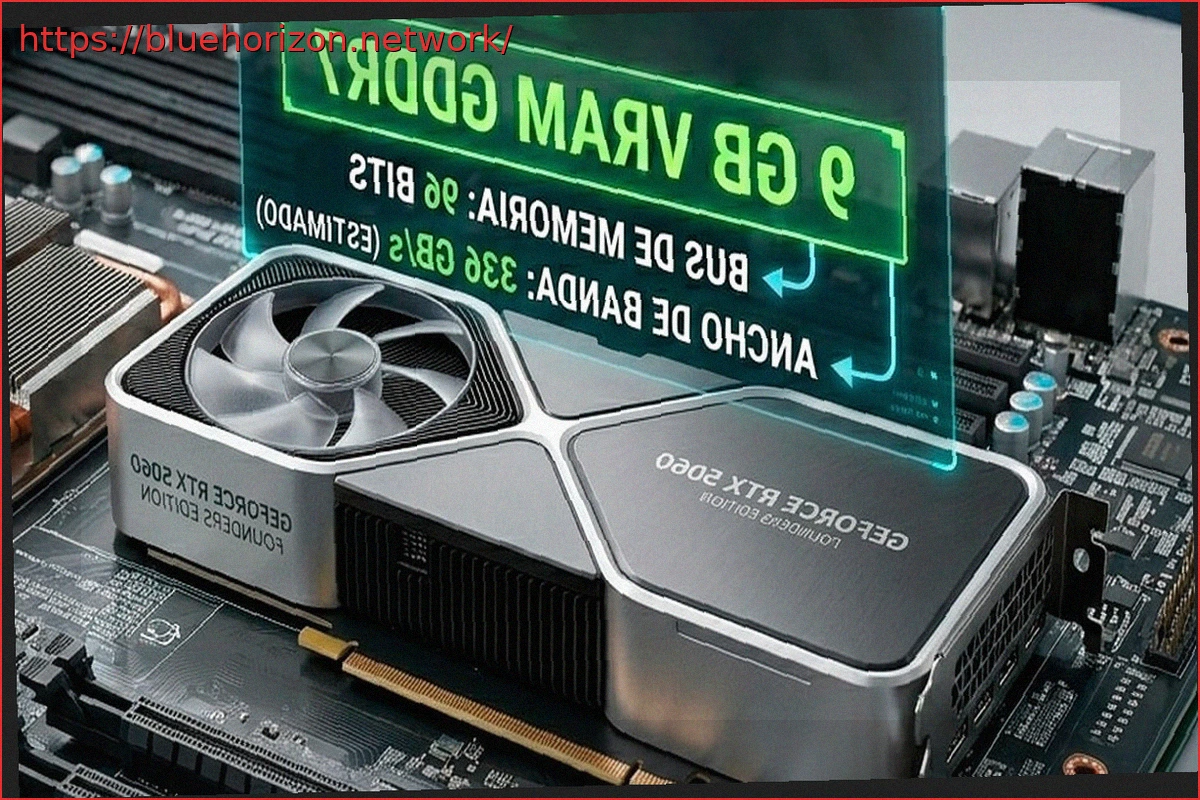
Compared to the current GeForce RTX 5060 Ti and RTX 5060 models with 8GB of VRAM, NVIDIA would transition from a configuration of 4 chips on a 128-bit interface to 3 chips on a 96-bit interface. If the memory speed remains at 28 Gbps, the memory bandwidth would drop to 336 GB/s. Even if memory at 30 Gbps were used, the bandwidth would still decrease to 360 GB/s. For context, the current GeForce RTX 5060 offers an official bandwidth of 448 GB/s. This would represent an approximate 25% reduction at the 28 Gbps scenario. Therefore, while 9GB might seem like an improvement, it’s actually a ‘deterioration.’ You gain more capacity but with significantly lower bandwidth.
This adjustment in memory capacity, coupled with a drop in bandwidth, points towards a segmentation and supply chain maneuver. Similar rumors about a GeForce RTX 5050 with 9GB of GDDR7 memory and the same 96-bit bus circulated in March, suggesting a broader NVIDIA strategy around 3GB GDDR7 chips. The underlying logic would be twofold: to alleviate pressure on certain memory configurations and, at the same time, to be able to market “more VRAM” without redesigning the entire range. Of course, this move will be very attractive for marketing and less informed consumers.
Aside from the memory configuration, these graphics cards would be identical to their original counterparts. This means the 16GB, 9GB, and 8GB GeForce RTX 5060 Ti models feature the same GB206 graphics chip with 4,608 CUDA Cores. The 9GB and 8GB GeForce RTX 5060 models have the same 3,840 CUDA Cores. Finally, the 9GB and 8GB GeForce RTX 5050 models possess the same 2,560 CUDA Cores. The key difference is that all 16GB and 8GB models offer a 128-bit interface, while the 9GB models are the outliers, featuring a 96-bit interface.