New generations of processors and graphics cards typically promise improved performance and efficiency over their predecessors. While this is generally true for PCs, the performance in laptops is heavily dependent on the specific model, cooling capabilities, and power consumption. It turns out that using the latest technology isn’t always the best option, as the Razer Blade 16, updated for 2026 with Panther Lake, exhibits lower performance than the 2025 version equipped with AMD.
Even with a high-end laptop, you’re not guaranteed the performance you expect. Laptop components, such as graphics cards, operate within specific TDP (Thermal Design Power) limits, and various configurations exist. This means some laptops will perform significantly better than others due to higher TDPs or different component options. The same applies to CPUs, with some laptops achieving higher Boost frequencies by allowing for greater TDPs.
Razer Blade 16 2026 Disappoints with Worse Performance Using Core Ultra 9 386H Instead of AMD
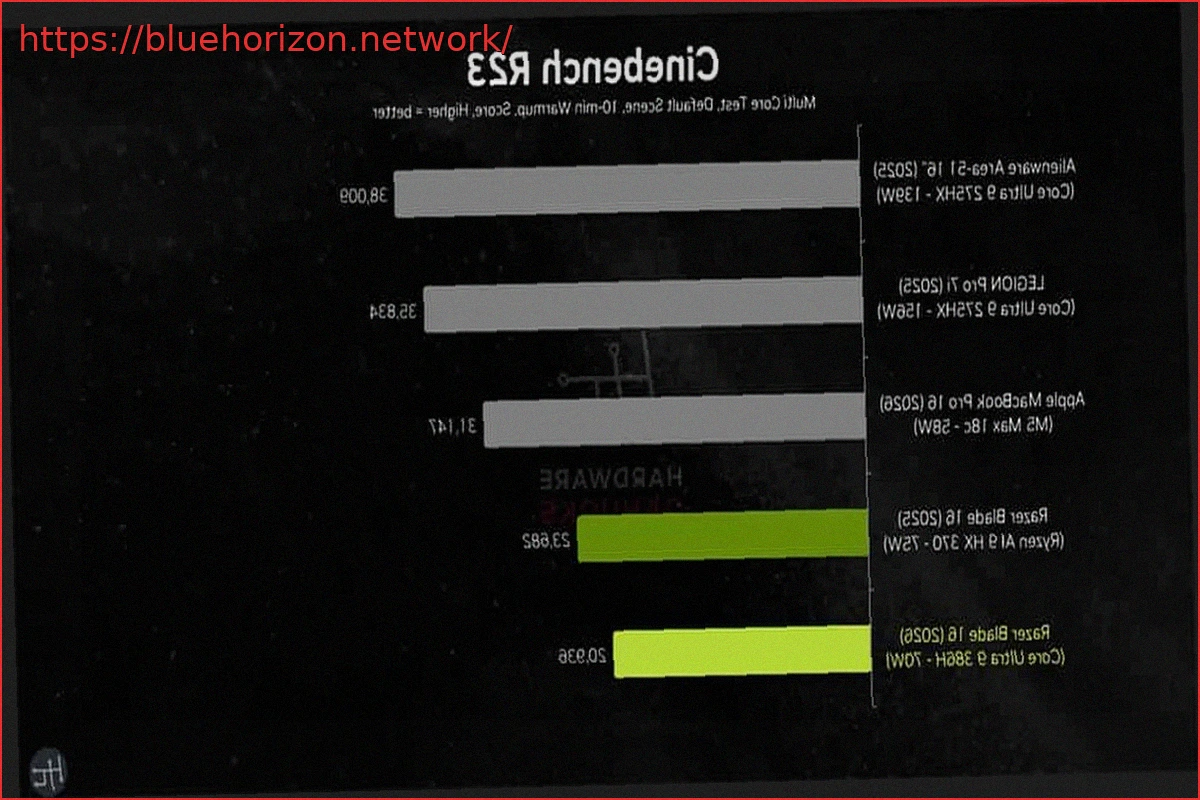
Laptops are constrained by their cooling systems. To accommodate high-end components in a thin and light chassis, compromises in performance are often necessary. This is the case with laptops like the Razer Blade 16, which in its 2025 version boasted a Ryzen AI 9 and an RTX 5090 within a mere 14.9 mm thickness. Consequently, the laptop’s performance is lower than others, especially in CPU-intensive tasks, as seen in Cinebench R23. Surprisingly, the 2026 Razer Blade 16, updated with Intel Panther Lake, delivers worse performance.
The benchmark data shows a drop from 23,682 points with AMD to 20,936 points with the new Intel processor, approximately a 10% decrease. The M5 Max is nearly 30% faster, and the Alienware at 139W is almost twice as fast as the Panther Lake at 70W.
In Cinebench 2024, the difference is much smaller, with the Core Ultra 9 386H achieving 1,232 points in multi-core compared to the Ryzen AI 9 HX 370’s 1,283 points in multi-core. However, the Core Ultra 9 275HX at 139W scores nearly double with 2,169 points, and the M5 Max scores 2,224 points at 58W. The same trend is observed in Blender, with a 10% difference between the new Intel Panther Lake and AMD Strix Point, while other laptops render almost twice as fast. In Photoshop, performance is only about 10% lower than the others for some reason, with the M5 Max outperforming all others.
Not All Negative: Intel Achieves 7 More Hours of Web Browsing Battery Life Due to Lower Idle and Low-Load Power Consumption
When it comes to gaming, the Intel Panther Lake version of the Razer Blade 16 again shows weaker performance. In Indiana Jones, it achieved an average of 112.3 FPS and 88.2 FPS minimum, compared to the Ryzen AI 9 HX 370’s average of 121.6 FPS and 102.8 FPS minimum. Alan Wake 2 shows similar results, with the Legion Pro 7i leading in performance, especially in minimum FPS, thanks to its higher CPU TDP. In more CPU-dependent games like Rainbow 6: Siege X, the Legion Pro’s Core Ultra 9 275HX delivers 50% more minimum FPS compared to the 2025 Razer Blade’s Ryzen, and that version is better than the 2026 model.
Moving on to power consumption, the Core Ultra 9 386H Panther Lake consumes less power than the Ryzen AI 9 HX 370, although it generates higher temperatures in most cases. The GPU, on the other hand, is better cooled and runs a few degrees cooler. Interestingly, despite criticisms of Razer, Hardware Canucks is promoting its Cooling Pad, which can reduce temperatures by a few degrees and increase CPU and GPU frequencies by 100 to 200 MHz.
With this addition and lower temperatures, it’s possible to outperform the 2025 version in Cyberpunk 2077. While Panther Lake loses some performance, not everything is bad. Due to lower power consumption and frequencies, especially at idle, the new Razer Blade 16 2026 offers significantly longer battery life. Here, we see an increase from 10 hours and 15 minutes for the 2025 model to 17 hours and 20 minutes (+70%) for the 2026 model during Internet browsing.