
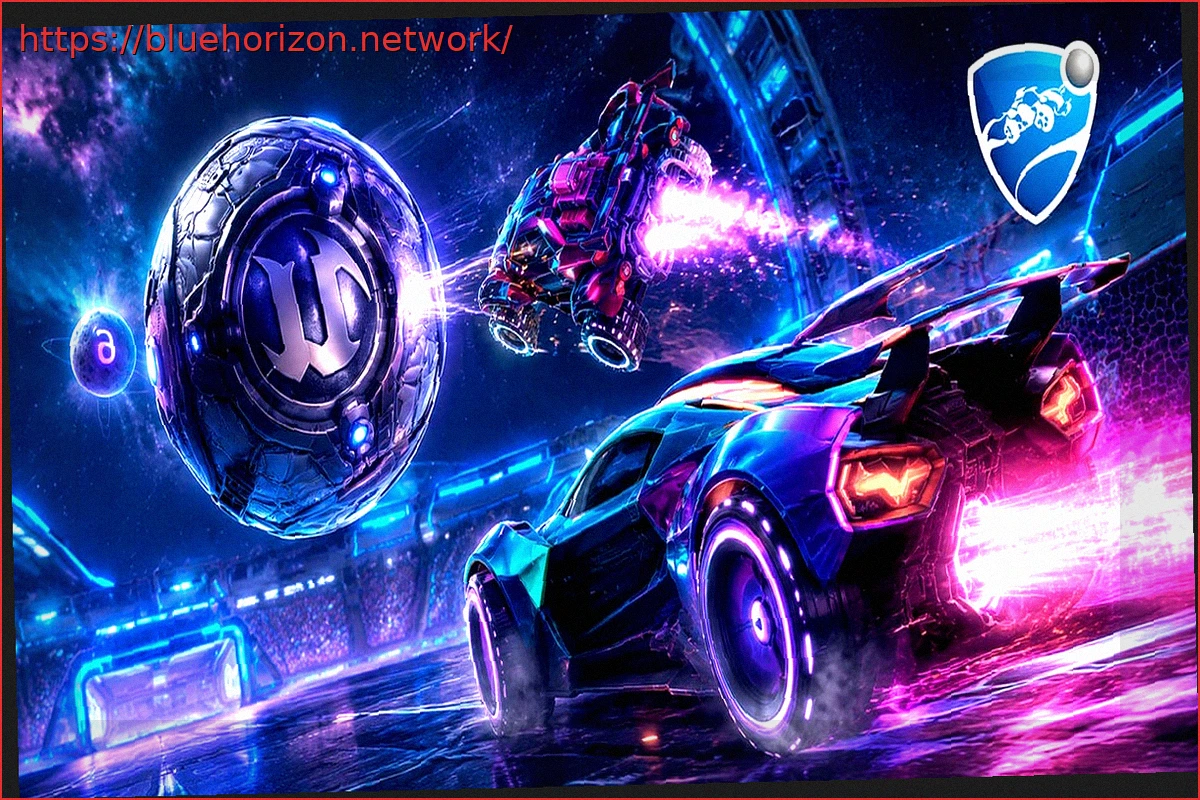
Epic Games and Psyonix have announced that the popular game Rocket League will be updated to the Unreal Engine 6 graphics engine. This revelation was made during the Rocket League Championship Series 2026: Paris Major, accompanied by a teaser highlighting the visual enhancements expected with the transition to the latest version of the engine. The official Rocket League website now features the message, “New era. New engine. This is Rocket League,” alongside a link to the trailer, confirming this is more than just a routine seasonal update.
The significance of this announcement lies in the fact that Rocket League has been running on Unreal Engine 3, a considerably old technology for a game originally launched in 2015. Psyonix, the studio behind the game, had previously acknowledged that migrating the engine was a long-term project. However, this is the first public confirmation of a version of the game moving beyond Unreal Engine 3. The teaser shown at the Paris Major marks this pivotal moment: Rocket League will leap directly to Unreal Engine 6, bypassing a publicly visible transition to Unreal Engine 5.
The Leap to Unreal Engine 6 Will Drastically Increase Rocket League’s System Requirements
Currently, the showcased aspects of Rocket League powered by Unreal Engine 6 serve more as a statement of intent than a detailed technical specification. Details regarding system requirements, release dates, specific improvements, and console compatibility have not yet been disclosed. Neither Epic Games nor Psyonix has provided in-depth information about the engine or the update, beyond linking Rocket League with Unreal Engine 6.
What makes this particularly interesting is that this move could extend far beyond mere graphical improvements. Tim Sweeney had previously hinted that Unreal Engine 6 would represent a convergence of Unreal Engine 5, Unreal Editor for Fortnite, and Epic’s creative ecosystem. In this vision, UE6 aims not only to enhance rendering but also to unify tools, streamline the creation of interoperable experiences, and address historical engine limitations, such as the reliance on single-threaded simulation processes.
For Rocket League, this transition presents a delicate challenge. It is a competitive game where the community places immense value on performance, precision, low latency, server stability, and consistent physics. While an engine migration can introduce better graphics, lighting, reflections, more detailed environments, and potentially a more modern technical foundation for future content, any noticeable alteration in the “feel” of the car, the ball, or collisions could alienate players. Therefore, despite the ambitious leap to UE6, Psyonix must demonstrate that this modernization does not compromise the game’s core playable identity.
It’s Striking That This Game, Rather Than Fortnite, Is the First Linked to the Latest Engine Version
Rocket League is a franchise with a solid user base but built on older technology. For context, Rocket League consistently sees between 120,000 to 140,000 daily concurrent players. Updating it to Unreal Engine 6 will allow for a relaunch of the game as a technical showcase for the new engine, while simultaneously strengthening Epic’s ecosystem alongside Fortnite, UEFN, and its creation tools. However, an increase in system requirements also carries a potential downside: it may alienate users with previous-generation consoles or less powerful computers.
Consequently, even with the upgrade to Unreal Engine 6, it’s logical to assume Psyonix will prioritize optimization and a wide range of graphical adjustment options. This approach would ensure that with graphics set to minimum, the game feels and looks comparable to the current Unreal Engine 3 version of Rocket League, thereby maintaining current compatibility across all platforms. Additionally, consideration will likely be given to handheld devices like the Steam Deck, ASUS ROG Ally, MSI Claw, and similar platforms.
The entry Rocket League will be one of the first games to make the leap to the Unreal Engine 6 graphics engine first appeared on El Chapuzas Informático.