
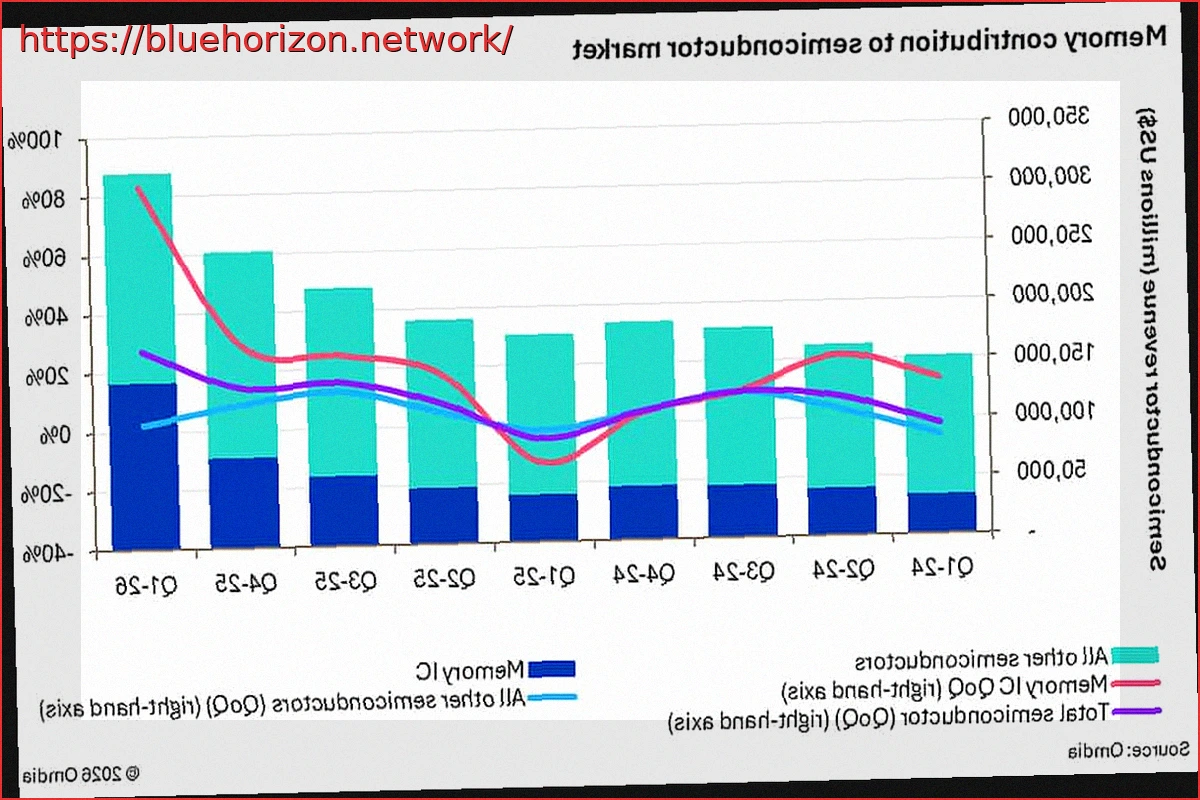
The global semiconductor market began 2026 with a milestone previously considered highly improbable. According to Omdia, the sector’s revenue exceeded $300 billion in Q1 2026, marking a substantial 27% increase compared to Q4 2025. The research firm highlights this as the most significant quarterly advancement since it began tracking the market quarterly in Q1 2002, with memory components playing a pivotal role in this surge.
The quarterly figures reveal a distinct shift in market composition, as memory has gained significant traction, deviating from the industry’s typical patterns and propelling the market into a new dimension.
Omdia’s report indicates that memory revenue experienced an impressive growth of over 80% quarter-over-quarter, far outpacing the rest of the market. This acceleration has led to DRAM and NAND now accounting for over 40% of all semiconductor market revenue in Q1 2026, a sharp contrast to the historical average, which typically hovered around 20%. This development is remarkably significant when viewed objectively; in essence, memory has transitioned from being an important segment to becoming the primary engine of the quarter’s growth.
Within the memory segment, NAND proved to be the most dynamic category. Omdia reports that this segment generated nearly $48 billion in revenue during Q1 2026, with a remarkable quarterly growth of 96%. Adding to this impressive performance, the average selling prices for NAND experienced a sequential increase of 95%. The research firm attributes this trend to three key factors: demand stemming from Artificial Intelligence, the robust performance of data centers, and supply chain constraints.
In stark contrast, semiconductors outside the memory category saw only modest growth. Non-memory semiconductors grew just over 2% quarter-over-quarter in Q1 2026. While this figure is not insignificant, it’s noteworthy considering that the first quarter of the year historically experiences a decline of approximately 4% in this market segment.
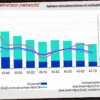
Omdia’s data clearly illustrates this disparity, showing a more contained evolution for non-memory semiconductors and a pronounced upswing in the Memory IC segment, which collectively pushed the total market revenue above $300 billion.
Looking ahead to Q2 2026, Omdia anticipates that the market will sustain its growth trajectory, albeit at a slower pace than in the first quarter. The firm predicts that the first half of 2026 will surpass $700 billion in revenue, and the total market is on track to exceed $1 trillion this year. If these projections hold true, 2026 will be recognized as one of the most robust years experienced by the chip industry.