
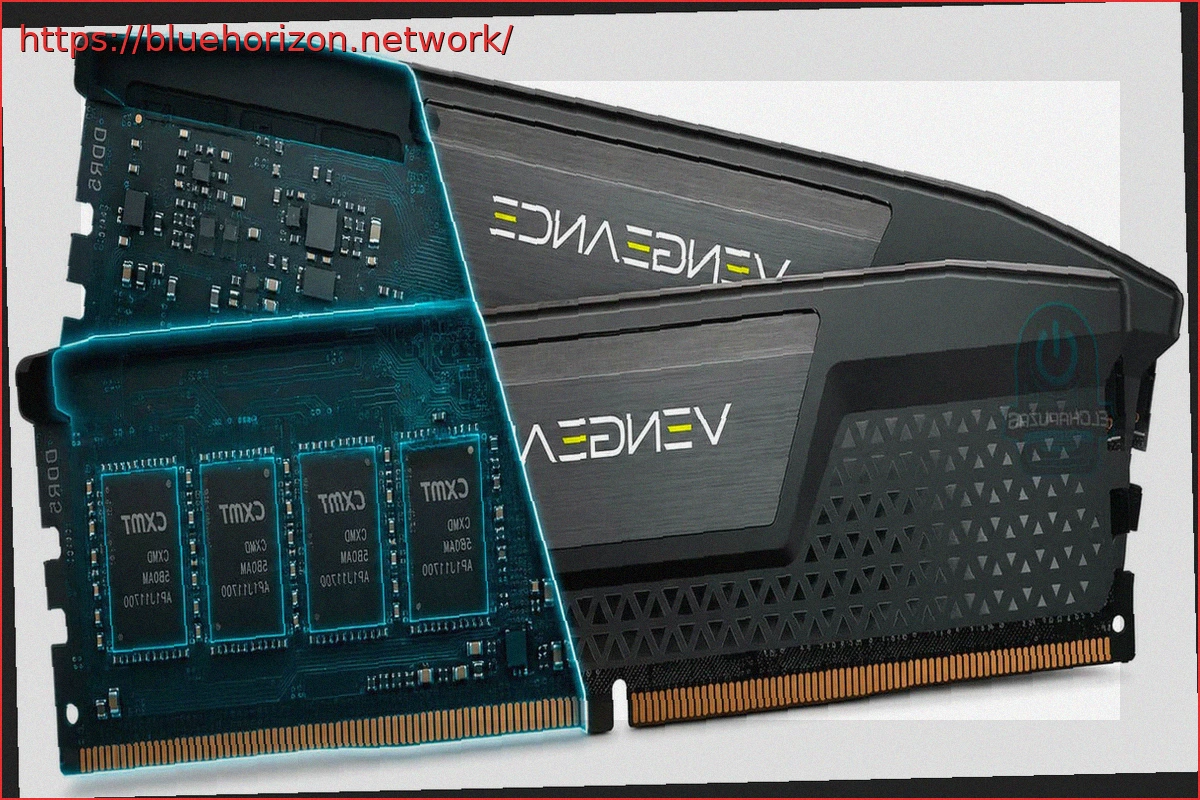
CORSAIR, a prominent name in PC gaming memory, has been observed to be utilizing DRAM chips from ChangXin Memory Technologies (CXMT). This discovery was made on CORSAIR Vengeance DDR5 memory modules. The information stems from screenshots shared by leaker wxnod, where CPU-Z identifies the memory as being manufactured by ChangXin. The specific module identified is a 16GB DDR5-6000 unit, featuring compatibility profiles for Intel XMP and AMD EXPO, a voltage of 1.35v, and the model number CMK5X16G3E60C36A2-CN.
This development is significant because CXMT chips have previously appeared in a considerable number of DDR5 modules, but predominantly in modules from Chinese brands or those with less international exposure. Now, the shift is occurring within CORSAIR’s Vengeance line. This signifies not just Chinese memory being sold under local brands, but Chinese chips appearing in a product associated with a global brand in the PC ecosystem. CORSAIR typically relies on established suppliers like Samsung, SK Hynix, or Micron, making the presence of CXMT indicative of a fundamental change in the DRAM market.
CXMT Memory Chips in CORSAIR Vengeance DDR5 Following US Easing of Restrictions
This move aligns with recent trends. The demand for memory for artificial intelligence applications, particularly HBM and other high-margin solutions, has strained the availability of conventional DRAM for PCs, laptops, and consumer components. As early as February, it was reported that HP, Dell, Acer, and ASUS were considering sourcing Chinese memory due to global shortages. HP and Dell were evaluating CXMT DRAM, while Acer and ASUS were exploring options through manufacturing partners.
This is where geopolitical context becomes relevant. In February, the United States briefly published and then withdrew an update to the Section 1260H list. In essence, it removed the blockade on Chinese companies like CXMT and YMTC. This move served to confirm, once again, that the United States, its companies, and the rest of the world require memory manufactured in China. In practice, this provided a clear indication. Although the US aims to curb China’s technological advancement, Western industries are also beginning to depend on Chinese memory to alleviate price and supply pressures. For the US, barring CXMT was politically convenient when Chinese memory was driving down prices. However, the scenario has now changed with the scarcity of DRAM and PC manufacturers seeking alternatives.
Furthermore, similar developments are observed in the European Union. Europe is now lifting its ban on China’s largest semiconductor manufacturer. Essentially, without this Chinese company, the European automotive industry has warned that it would face a semiconductor shortage within weeks without China. This is why efforts are now underway to dismantle barriers to allow this Chinese company to supply chips to Europe and avert a crisis in the automotive industry.
Thanks to the AI Boom, CXMT is Flourishing and Accelerating Growth
As Chinese companies are experiencing record revenues, companies like CXMT have accelerated their development roadmap. In November 2025, the company unveiled its new family of DDR5 and LPDDR5X memory, featuring DDR5 modules up to 8,000 MT/s and densities up to 24 Gb. They also offer various form factors, including UDIMM, SODIMM, CUDIMM, RDIMM, MRDIMM, and TFF MRDIMM. This demonstrates that CXMT is no longer confined to basic, low-cost products but is aiming to cater to both consumer PCs and workstations and servers. This explains why CORSAIR is now turning to CXMT for gaming-focused RAM.
In essence, the AI boom has disrupted the consumer and market. However, in the long run, this translates solely to benefits for this sector. The reason is that Chinese manufacturers have seen their revenues multiply. These revenues are being reinvested to accelerate both their development roadmap and increase production by expanding their current production chains and building new factories. This means that in the near future, China may once again dominate the memory industry by driving down prices. The difference this time is that it will do so with the most advanced and fastest chips capable of competing head-to-head with existing competitors.