As a video game enthusiast, you’ve likely encountered titles built with the Unity game engine. It’s the most prevalent choice for independent developers, as well as AA and even AAA studios, often for mobile game development. Among the most popular games utilizing the Unity engine are highly played gacha titles such as Genshin Impact, Honkai: Star Rail, and Zenless Zone Zero (ZZZ). Now, a compelling comparison of Unity vs. Godot engines in terms of graphics and performance has emerged, as a developer recreated the exact same game in both, with surprising results.
Throughout the history of video games, countless graphics engines have been developed. Of those, only a select few have endured over time. Graphics engines require continuous updates to keep pace with new generations and evolving expectations in graphics and functionality. While some studios develop their own graphics engines, they can sometimes become outdated, forcing them to adopt more modern engines. This is where they often turn to the most popular options like Unreal Engine, Unity, and CryEngine, though the latter has seen limited use in recent years.
Unity vs. Godot Engine: A Side-by-Side Game Comparison Reveals Surprising Outcomes
Within the niche of readily available game development engines, Godot Engine stands out. It’s not only a free graphics engine but also cross-platform and open-source. With these advantages, Godot is often likened to the ‘Linux of graphics engines,’ and indeed, it’s used by a smaller percentage compared to the ‘Windows graphics engines’ like UE5 and Unity.
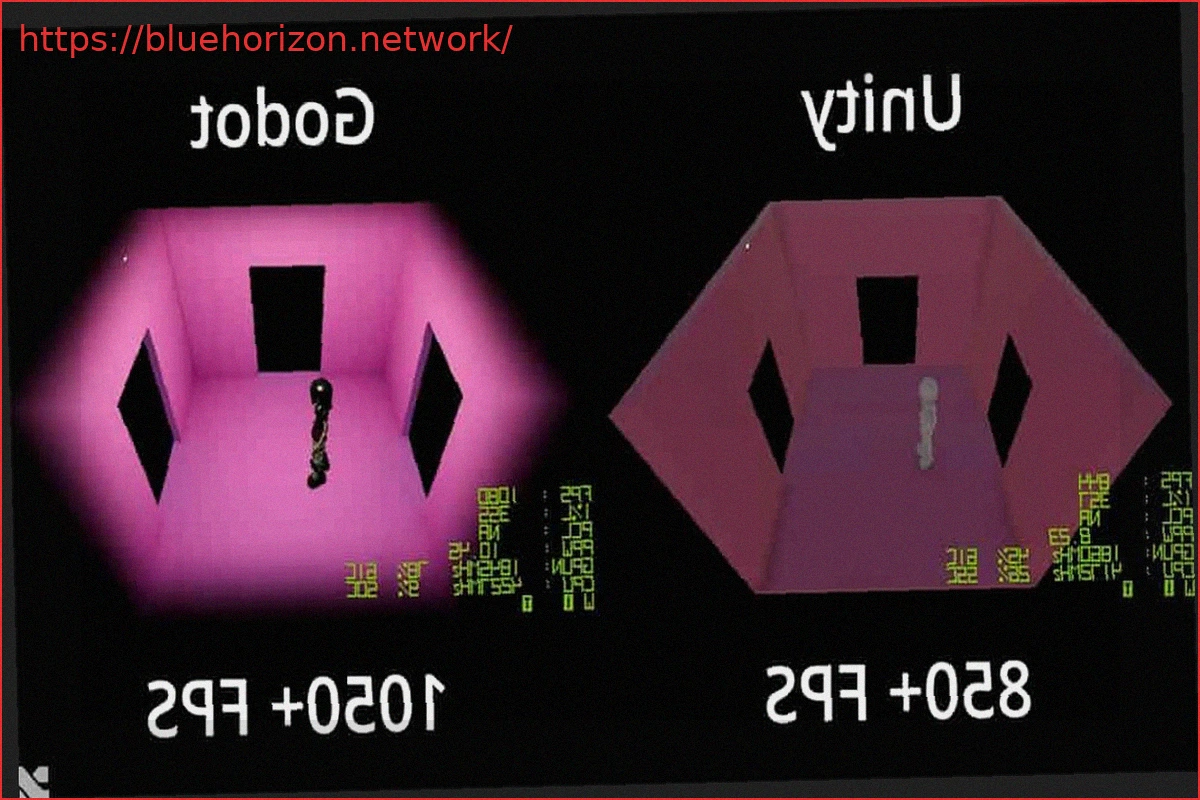
YouTube creator Thomas Grové set out to test Unity and Godot to determine which is the superior game engine. For this comparison, he used a horror game he developed himself. The game features several environments, a fully controllable character, a camera system with scene transitions, interactable objects with physics, and a custom triplanar dither shader. The comparison began with a fundamental, yet significant, factor for some: engine size. Here, Godot utterly demolishes Unity, occupying a mere 164 MB, while Unity reaches a staggering 20.1 GB – over 100 times larger. Next, engine startup speed, where Godot is considerably faster, taking only 13 seconds, while Unity requires 1 minute and 20 seconds.
To Many’s Surprise, Godot Engine Emerges as the Winner, Outperforming Unity in Nearly All Tests
While Godot’s speed and lightweight nature might suggest a compromise in graphics, the comparison reveals distinct results. Unity presents much grayer scenes with simpler lighting, although it seems to offer slightly better aliasing in return. Godot again takes the lead here, and with plans to implement Path Tracing in the engine in the future, it holds significant potential. Moving on to the workflow of each engine, Unity clearly has more tools, and they are more polished, excelling in areas such as the graphics pipeline, 3D model handling, and animations.
Regarding script compilation, Godot took only 0.5 seconds, while Unity lagged at 15 seconds, making it 30 times faster. The next crucial aspect is build size and export time, especially important as a game develops and is tested. This is somewhat of a tie: Unity optimizes size, while Godot requires manual selection of included features. However, Godot is significantly faster, taking only 2 seconds for export compared to Unity’s 15 minutes.
Subsequently, launching the game reveals Unity to be 5 times slower. In terms of performance/FPS, Unity achieves a higher frame rate, boasting around 700 FPS versus Godot’s 500 FPS, but this comes with inferior graphics. In fact, in another test, Godot also wins in FPS. Upon concluding the comparison, it’s evident that Godot surpasses Unity in almost every aspect, presenting itself as the superior option for developers, despite acknowledging Unity’s robustness and superior tooling.