
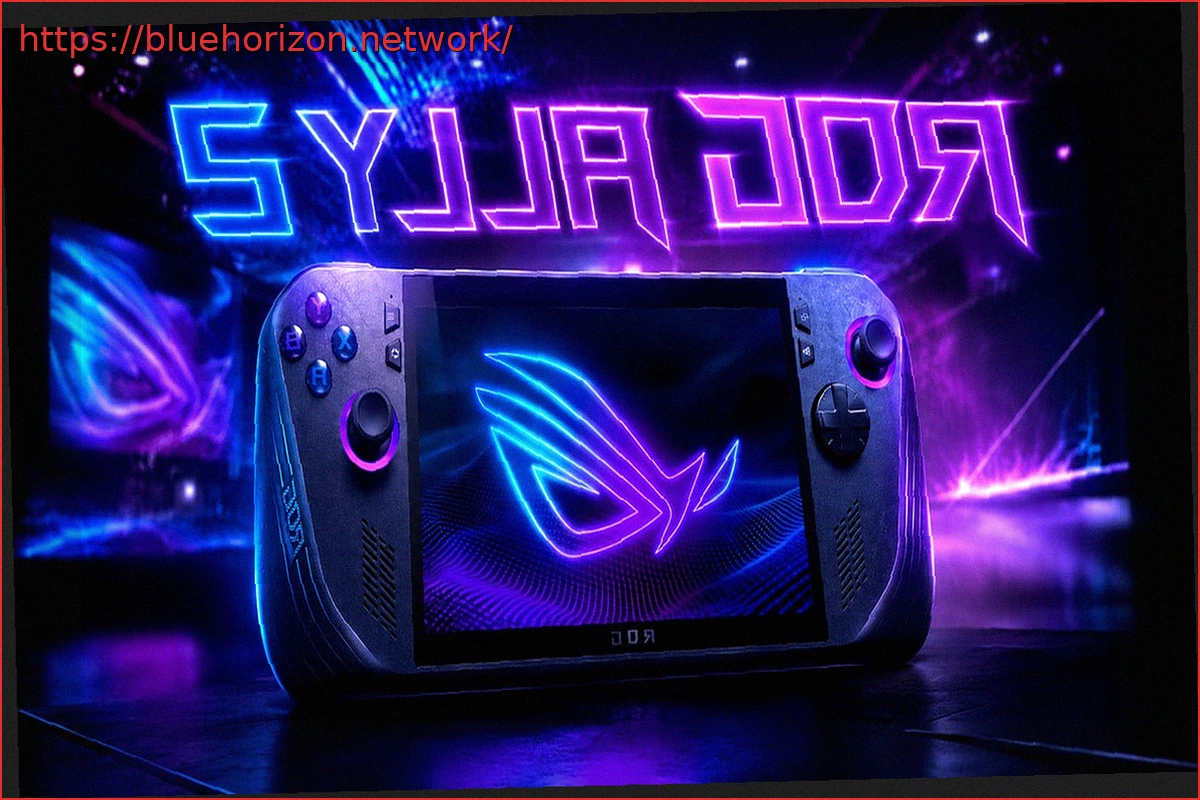
According to the latest rumors, ASUS could leverage Computex 2026 to showcase a new handheld console: the ROG Ally 2. This information originates from German YouTuber Steam Dad, who specializes in handheld consoles, hinting that ASUS has something “next-gen” prepared for the Taipei trade show. Computex is officially scheduled from June 2nd to June 5th, 2026, so the timeframe aligns with the statement that more will be known “probably in two weeks.” This is particularly significant as it is the most important technology event in the world, implying the announcement of a substantial number of new components or devices.
At this early stage, it’s too soon to discuss specifications. No details are available regarding the hardware it will use, its display, price, battery, or even its commercial name. This suggests we might be looking at an entirely new ASUS ROG Ally 2. However, it’s also possible that it could be a minor update to its current lineup. This is because, as far as is known, AMD does not have new generation hardware ready for these devices. However, if ASUS turns to Intel, as MSI has done, we could also see a console from ASUS based on an Intel Panther Lake chip.
Will it be an ASUS ROG Ally 2 or a Disappointing Minor Revision?
The context makes this rumor interesting. The ROG Ally range already saw a significant evolution with the ROG Ally X, and later with the ROG Xbox Ally and ROG Xbox Ally X models, developed in conjunction with Microsoft to offer a more console-like experience on Windows 11. ASUS describes these models as Windows devices with a full-screen Xbox interface, access to PC libraries and game stores, and integration with Xbox Game Bar.
In terms of specifications, the current ROG Xbox Ally X is already a quite recent and powerful model, featuring an AMD Ryzen AI Z2 Extreme with an 8-core Zen 5 CPU, RDNA 3.5 graphics with 1,024 Stream Processors, an integrated NPU, 24GB of LPDDR5X RAM at 8,000 MT/s, a 1TB M.2 SSD, and an 80 Wh battery. The standard ROG Xbox Ally, on the other hand, uses a much more modest Ryzen Z2 A, 16GB of LPDDR5X RAM at 6,400 MT/s, a 512GB SSD, and a 60 Wh battery.
This brings us back to the initial question. What can ASUS possibly reveal that truly deserves the label “next-gen”? This move would only be possible if ASUS has struck a deal with Intel. Computex will be the venue where we will first see consoles or handhelds featuring Intel Arc G3 Extreme chips designed for gaming devices. MSI already has its Claw 8 EX AI+ ready. If ASUS does not turn to Intel, it’s impossible for them to offer a truly next-generation product, unless AMD surprises with a refresh of the AMD Ryzen Z2, as Ryzen Z3 processors are not yet developed.
If ASUS Fails, at Least MSI Will Be There for Those Wanting a True Next-Generation Device
That’s right, if you are eagerly awaiting an ASUS ROG Ally 2 and it doesn’t get announced, or is announced with inferior AMD hardware, you can always turn to MSI. For the MSI Claw 8 EX AI+, we already know it utilizes a very powerful SoC, the Intel Arc G3 Extreme. This is paired with 32GB of RAM at 8,533 MT/s, a 1TB SSD, and an 8-inch IPS display with Full HD+ resolution at 120 Hz.
The downside is the price, as this device has already been leaked twice, with prices around 1,530 euros in Australia, and earlier this month it was seen in Europe for 1,599 euros. These are high prices, but at least they are ‘justified’ when considering that, for example, Lenovo already sells its consoles at even higher prices with much inferior hardware. We can say that these are prices comparable to high-end gaming laptops. However, you can’t comfortably game on a laptop on a bus, plane, subway, or in bed. That portability, miniaturization, comes at a cost. Just as a Mini-PC is more expensive due to compressing all the hardware into a much smaller form factor.
Therefore, it will be interesting to see if ASUS has reached an agreement with Intel to announce the ROG Ally 2. If not, it’s better that it isn’t announced. Announcing a ROG Ally 2 with a refresh of the AMD Ryzen Z2 would be better left unannounced. Alternatively, a ROG Ally X with some minor improvements could replace the original model without a significant price increase. However, such a launch wouldn’t qualify as ‘next-gen’ to justify its release. For instance, one might consider using an OLED panel, but it would still be a questionable launch.