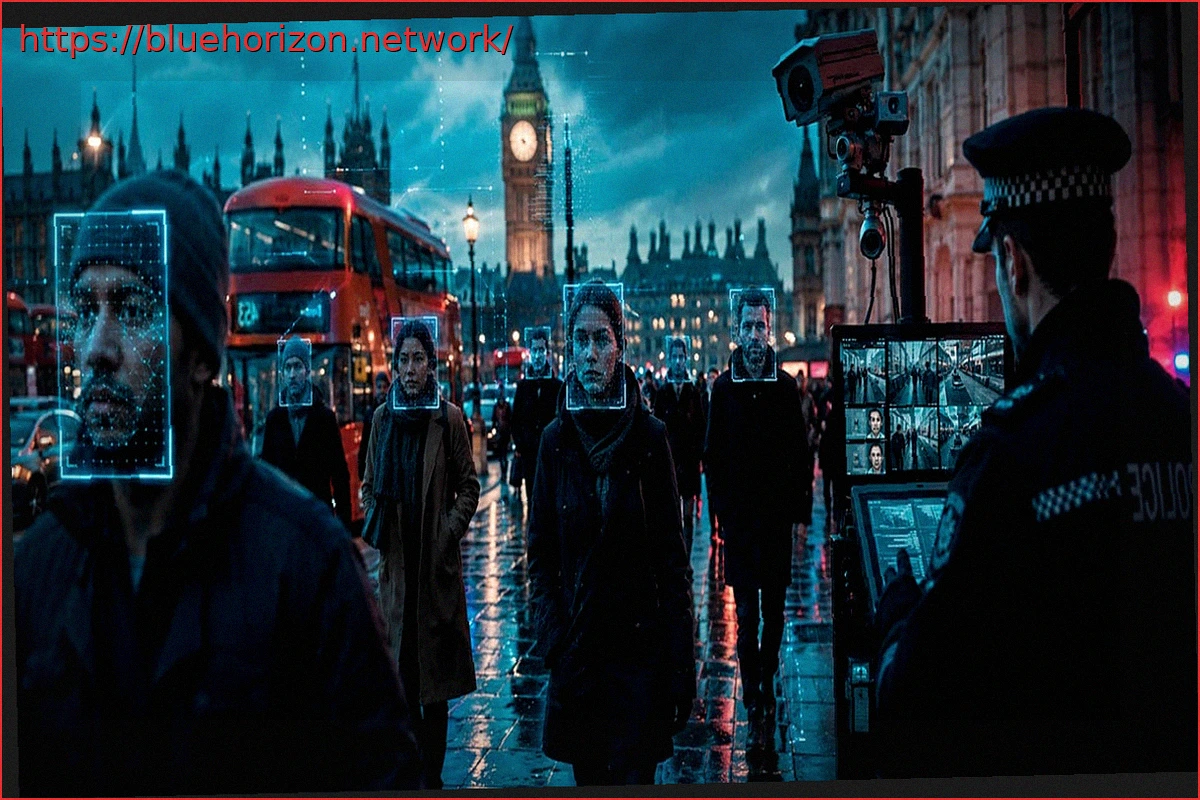
London is rapidly transforming into a surveillance state, with facial recognition technology at the forefront. The British capital has become a significant European hub for real-time police facial recognition, where the faces of pedestrians, tourists, shoppers, and workers are scanned daily.
Specifically, the government has deployed temporary cameras on a street in Victoria, enabling the Metropolitan Police to scan the faces of everyone passing by in real time. This live facial recognition system compares scanned faces against a police watchlist. Essentially, it’s an automated, live identification system where each face is converted into a biometric template and matched against a database of approximately 17,000 individuals, primarily those with images taken while in police custody.
UK Police Defend Real-Time Facial Recognition as a Disruptive Technology
In response to public concerns, the Metropolitan Police (Met) asserts that this technology is a transformative tool for identifying suspects who might otherwise evade detection. According to Reuters, since early 2024, the system has reportedly aided in the arrest of around 2,500 wanted individuals, including those implicated in serious crimes. Recent operations in Victoria and Tottenham have resulted in six arrests for offenses such as death threats, breach of a court order, and knife possession.
The police’s rationale is straightforward: if a person wanted for serious offenses is in a public area, the system can detect them within seconds. Lindsey Chiswick, head of facial recognition at the Met, highlighted a case where a convicted sex offender was identified while accompanying an eight-year-old girl, leading to his re-imprisonment. The police view these instances as justification for the deployment, portraying it as a precise tool against individuals already sought by law enforcement, rather than indiscriminate surveillance for abstract purposes.
However, the technical reality is that to find a wanted person, the system must scan everyone passing by. This creates a conflict at the political and legal levels. Critics argue that live facial recognition fundamentally challenges the traditional principle of presumed innocence. By scanning every individual’s face, everyone is temporarily entered into a database that the system must then discard. Organizations like Big Brother Watch and other civil liberties groups warn that this practice could normalize mass surveillance in public spaces.
Police Also Argue Minimal Intrusion
The Met emphasizes that the intrusion is minimal, stating that biometric templates of individuals who do not match the watchlist are immediately destroyed. They also claim a very low error rate. In the 12 months leading up to September 2025, their annual report documented 3.14 million scanned faces, resulting in 2,077 alerts. Of these, 2,067 were accurate, and only 10 were false. Furthermore, no arrests were made based on these false alerts. During that period, 962 arrests were linked to live facial recognition deployments.
Significantly, the technology was first used during a protest on May 16th, at an anti-immigration march in London. The Met justified this deployment based on intelligence indicating a potential threat to public safety. They also stated that cameras were positioned at approach points rather than on the main route. However, for activists, crossing this line fundamentally alters the nature of the system, especially in a country where arrests and even prison sentences are not uncommon for individuals expressing criticism of the country’s immigration policies on social media platforms like X.
The privacy advocacy group Big Brother Watch was particularly critical before this deployment, warning that biometric screening should not become a prerequisite for exercising freedom of expression. Their concerns extend beyond algorithmic errors to the chilling effect of such technology: individuals may avoid attending demonstrations if they know their faces will be scanned by the police.
Is London’s Large-Scale Facial Recognition Legal?
Regarding legality, the Met received significant backing in April when the British High Court dismissed a legal challenge brought by activists. The court ruled that the London police’s facial recognition policy was lawful. The lawsuit had argued that the system infringed upon privacy rights and the freedoms of expression and assembly protected by the European Convention on Human Rights. The court, however, did not find these rights to have been violated.
Following this setback, the British government initiated a consultation process to develop a new, specific legal framework for facial recognition, biometrics, and similar technologies in policing. The consultation aims to define which technologies should be covered, which agencies can use them, under what conditions, and with what safeguards for privacy, rights, and proportionality.
The core issue is that the UK is rapidly advancing in a technology that currently relies on a combination of general laws, police guidelines, and internal policies, rather than a specific primary law dedicated to police facial recognition. The British Parliament has acknowledged the existing framework as a series of regulatory “patches” that the government intends to consolidate for greater clarity and to keep pace with technological advancements.