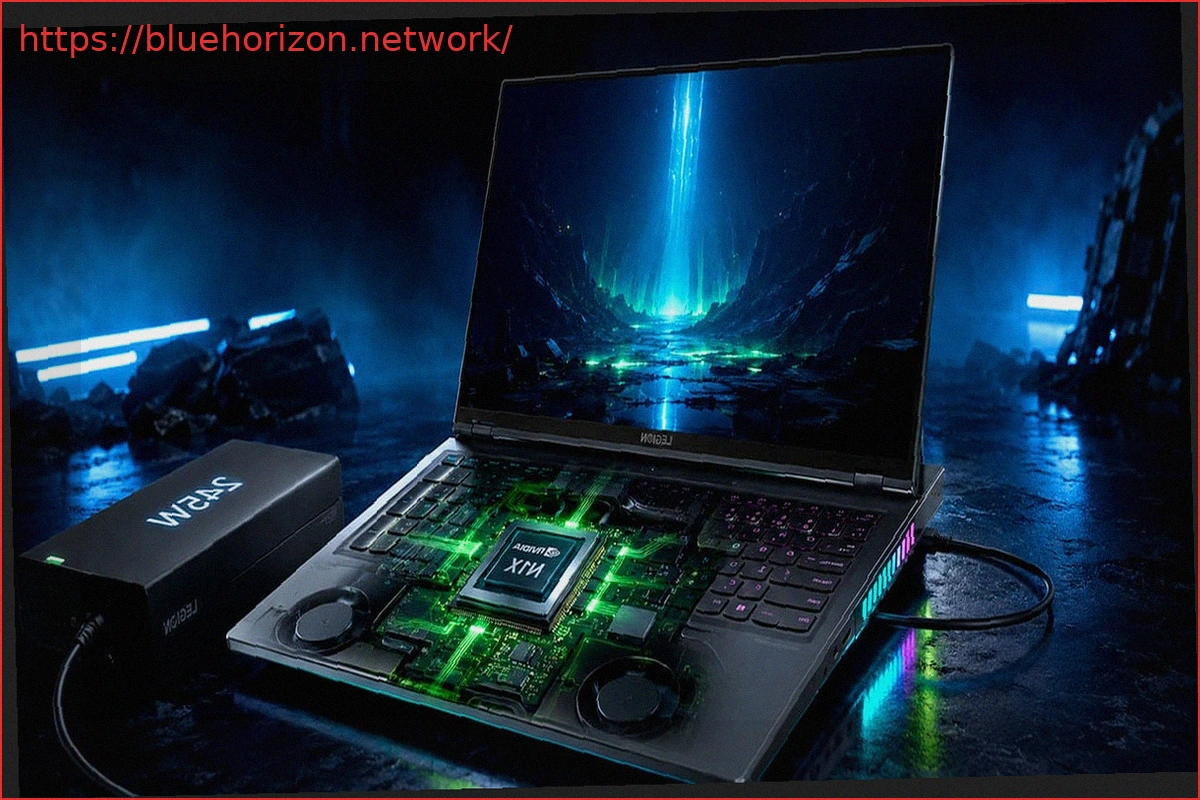
New information has emerged regarding the Lenovo Legion 7 15N1X11, a gaming laptop that will utilize the NVIDIA N1X SoC. The details are currently basic, with the device being listed as compatible with a 245W charger. Specifically, the charger is identified as a Lenovo Slim Tip, operating at 20V and 12.25A, which precisely calculates to a maximum power output of 245W.
Crucially, the 245W charger specification doesn’t imply the NVIDIA N1X chip alone consumes that much power. Instead, it indicates that the laptop will be positioned in a similar power class to a Legion 7 equipped with a dedicated NVIDIA GeForce RTX 5070 Laptop GPU. This places it firmly in the category of high-end gaming laptops. Higher-tier configurations, up to 400W, are reserved for models featuring GeForce RTX 5080 or RTX 5090 graphics.
This development is significant because the NVIDIA N1X is shaping up to be quite different from conventional gaming laptops that typically feature x86 CPUs and dedicated GPUs. Previous leaks already linked the Legion 7 15N1X11 model to an NVIDIA platform for laptops. Lenovo’s naming convention often uses a letter after the screen size to denote the platform: ‘A’ for AMD, ‘I’ for Intel, ‘Q’ for Qualcomm, and in this case, ‘N’ for NVIDIA. While other Lenovo devices with N1 and N1X were mentioned in prior leaks, the Legion 7 stands out due to its gaming focus.
The technical key lies in the expectation that N1X will be an ARM SoC with integrated NVIDIA Blackwell graphics. This diverges from the standard combination of an Intel or AMD processor paired with a dedicated GeForce GPU. If the chip is indeed derived from the GB10 Grace Blackwell used in NVIDIA DGX Spark systems, it could combine a 20-core ARM CPU with an integrated Blackwell GPU. NVIDIA has officially confirmed that DGX Spark utilizes the GB10 Grace Blackwell superchip, offering up to 1 petaFLOP of FP4 performance for AI and featuring 128GB of unified memory. Its documentation also details a 20-core ARM processor, 128GB of unified LPDDR5X RAM, a 256-bit bus, and 273 GB/s of bandwidth.
NVIDIA has not yet officially announced its N1 and N1X chips. The official unveiling is anticipated on June 1st in Taiwan, coinciding with Computex Taipei. However, based on current information, a technical relationship between the N1X chips and GB10 appears plausible. In essence, this could be seen as a ‘Windows equivalent’ of Apple Silicon – an SoC with an Arm CPU, powerful integrated graphics, and unified DRAM for the system and GPU. In this specific instance, the memory is soldered onto the motherboard rather than being integrated directly into the chip.
The laptop’s power consumption aligns with performance expectations. Benchmarking software Geekbench previously revealed an early sample of the NVIDIA N1X, the most powerful version of the chip, featuring a 20-core CPU and a GPU with 48 SMs, equating to 6,144 CUDA cores – the same figure as the desktop GeForce RTX 5070. In this benchmark, the Arm CPU demonstrated performance comparable to an AMD Ryzen 7 9800X3D.
The Lenovo Legion 7 with the N1X chip is poised to be one of the first laptops in its class: running Windows on ARM, featuring an ARM CPU, integrated Blackwell GPU, and a gaming-centric design. Until now, Windows on ARM has primarily been found in ultra-thin laptops focused on battery life, productivity, and local AI, particularly from Qualcomm. A Legion with NVIDIA N1X suggests a new direction: leveraging ARM not just for efficiency, but to create a gaming or professional machine with a far more ambitious integrated GPU than traditional iGPUs.
However, software remains a significant question mark. Microsoft has substantially improved Windows 11 on ARM with Prism, its emulator for x86 and x64 applications, and official documentation states that Windows 11 on ARM can run x86/x64 applications transparently through emulation. Nevertheless, clear limitations are noted. For starters, certain games may not function if they rely on DRM or anti-cheat systems not adapted for Windows on ARM. Additionally, some peripherals or applications with specific drivers might require ARM64 versions. Therefore, while the NVIDIA N1X may be a potent chip, if Windows on Arm proves to be a bottleneck, we could soon see numerous comparisons with Linux gaming-focused distributions such as SteamOS, Bazzite, or CachyOS.