
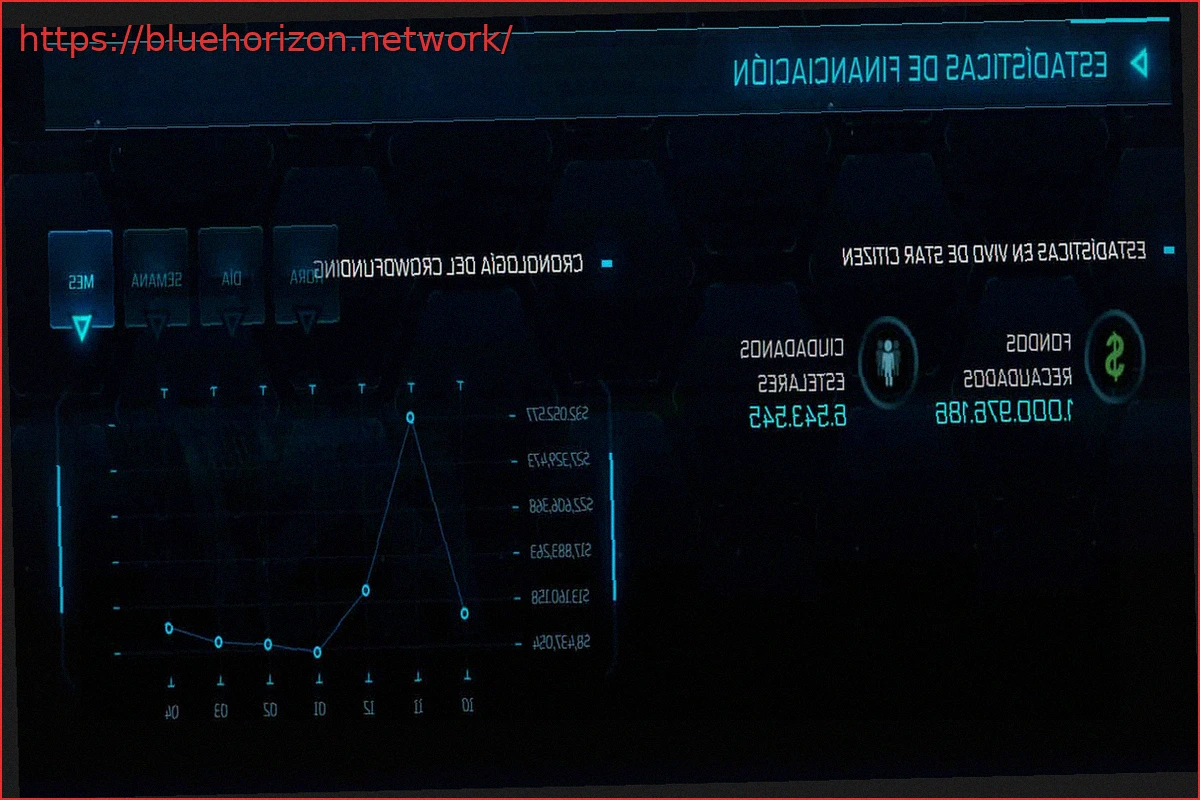
Star Citizen is gradually taking shape, and a clear indicator of its progress is the project’s achievement of surpassing the $1 billion mark in crowdfunding. This is a practically unprecedented figure in the video game industry, comparable only to titles that have revolutionized the market, such as Grand Theft Auto VI. Rumors suggest GTA VI’s development cost could range between $1 billion and $1.5 billion, potentially soaring to $3 billion with Rockstar Games’ extensive marketing campaign.
According to Roberts Space Industries, their funding tracker is publicly available, showcasing funds contributed by users directly towards the development of Star Citizen and Squadron 42. Star Citizen’s milestone surpasses even that of GTA VI. The game originated as a community-funded project in 2012. The official website still displays the initial funding goals, which were a modest $2, $2.5, $3, or $6 million, promising features like additional star systems, multiplayer module access, new ships, simulation peripheral compatibility, and Squadron 42 enhancements. From today’s perspective in 2026, the contrast is stark: what began as an ambitious crowdfunding campaign has evolved into a constant funding machine for over thirteen years.
Star Citizen: A Game of Persistent, Open Development
Star Citizen’s unique characteristic is that it has never followed a traditional release model. Cloud Imperium Games has established a form of persistent, open, and monetized development, where players purchase access packages, ships, digital items, subscriptions, and other content while the game remains in its alpha phase. In its 2023 financial report, the company clarified that the “Pledges/Sales” line item directly reflects the public funding tracker and includes sales of starter packs, early access, ships, and playable digital items.
However, this record again highlights the project’s inherent contradiction. Star Citizen has raised more than almost any other known blockbuster in the sector, yet it still lacks a release date for a 1.0 version. At least, its anticipated single-player campaign, Squadron 42, starring Hollywood actors, is still slated for 2026, though the project’s history of delays always casts a shadow over any announced date. Squadron 42 will offer an experience within a ‘controlled’ Star Citizen environment and is expected to draw many players into the main game.
Financial reports indicate that raising vast sums doesn’t necessarily translate to large profit margins. In 2023, Cloud Imperium reported revenues of $143 million but incurred costs of $163 million, resulting in a loss of $20 million after capex. The company attributed this increased expenditure to development expansion in the UK, allocating more resources to Squadron 42, the acquisition of the studio Turbulent, and growth in staff and infrastructure.
Beyond Criticism, Players Sustain This Game
While Star Citizen may face external criticism, it stands as a testament to how a community can sustain a project of an impossible scale for a traditional independent studio over many years. For its critics, it exemplifies how a production can become a perpetually unfinished product, generating massive revenue without the commercial pressure of a final release. Nevertheless, those actively involved and playing the game recognize its continuous progress and monthly improvements.
It’s also noteworthy that approximately 6.6 million players have contributed to the project. This ranges from purchasing basic access packs with a ship to “whales” who have spent tens of thousands of euros on real-money ship purchases. While most ships can be acquired with in-game currency, the most powerful ones, particularly those intended for alliances (capital ships), are purchased with real money. Significantly, this funding record was achieved during DefenseCon 2956, an event offering free access and ship trials from various manufacturers, serving as a common entry point for new players, including the author.
The true significance of this news is that Star Citizen is no longer just competing in terms of revenue with other video games; it is now competing with the budgets of major audiovisual productions. It achieves this through a remarkable anomaly: the majority of its funding comes directly from players who have continued to finance a decade-long promise. Whether the project will be remembered as a revolution in open development or the biggest crowdfunding cautionary tale will depend on two factors: first, the successful and polished release of Squadron 42 in 2026; and second, whether Star Citizen 1.0 can justify over a decade of community investment.