
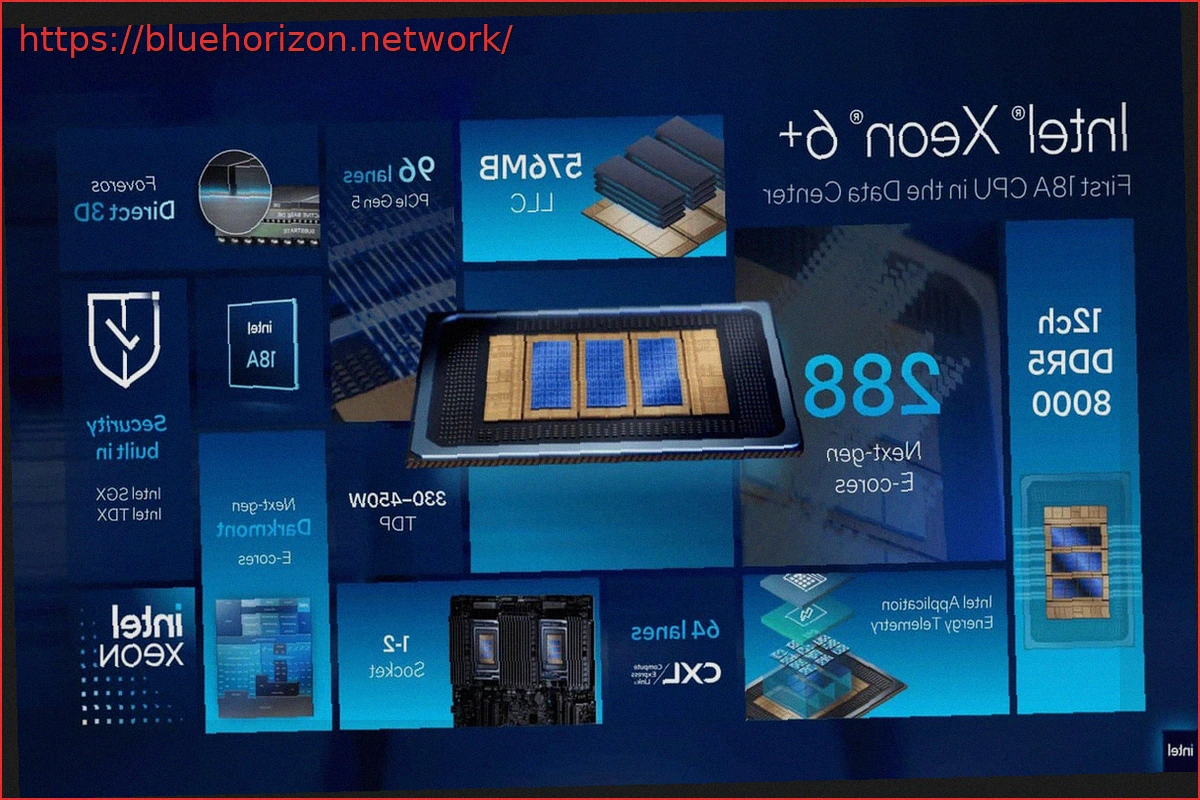
Intel has officially unveiled its new Xeon 6+ processors, internally known as Clearwater Forest. This family of server processors focuses on core density, energy efficiency, and highly parallelizable workloads. The top-tier model is the Intel Xeon 6990E+, featuring a configuration of 288 Darkmont cores, which are efficient (E-Cores). This CPU positions Intel aggressively in the market for data centers, cloud, telecommunications, microservices, and deployments where performance per watt consumed is prioritized over raw single-thread power.
The core strategy of Clearwater Forest is not to directly compete with AMD EPYC’s more powerful, larger cores. Instead, Intel is pursuing a strategy of a very high number of efficient cores. Since these are E-Cores, they do not feature Hyper-Threading technology. This means up to 288 physical cores, contrasting with processors like the AMD EPYC 9965, which offers 192 cores and 384 threads. The Intel Xeon 6990E+ will be available in 330W and 450W versions, both maintaining 288 cores, 576MB of L3 cache, support for 12 channels of DDR5-8000, 96 PCIe 5.0 lanes, six UPI links, and compatibility with single or dual-socket systems. The difference between these versions lies in the core frequencies.
Intel Xeon 6+ Are the First Server Processors Built with Intel 18A Lithography
Indeed, the Clearwater Forest processors are significant as they mark the debut of the Intel 18A node in server processors. Intel had previously indicated that Xeon 6+ would be its first server processor manufactured using this node, which combines technologies like RibbonFET and PowerVia, along with advanced Foveros packaging. The chip design integrates 12 compute chiplets using Intel 18A, three base chiplets on Intel 3, and two I/O chiplets on Intel 7, all connected using packaging technologies such as Foveros Direct 3D and EMIB.
Another relevant feature is Intel Application Energy Telemetry (Intel AET). This technology allows for the measurement of energy consumption associated with specific applications, virtual machines, or workloads, not just the overall system consumption. In data centers with thousands of servers, this can be valuable for deciding where to place a workload, identifying power-hungry applications, or optimizing the energy costs of an entire fleet. Intel presents this as a hardware-level visibility tool, more precise than purely software-based estimations.
Higher Performance with Lower Power Consumption Impact
In terms of performance, Intel claims that the Xeon 6990E+ offers up to 2.26 times higher average performance than the previous Xeon 6780E and up to 1.55 times better performance per watt. Compared to the AMD EPYC 9965, Intel reports up to 1.3 times higher performance per watt at 40% CPU utilization, along with improvements in per-thread performance and per-thread-per-watt performance in selected workloads.
The AMD EPYC 9965 is a processor with 192 Zen 5c cores, 384 threads, 384MB of L3 cache, 12 channels of DDR5-6400, 128 PCIe 5.0 lanes, and a TDP of 500W. Intel, on the other hand, raises the bar to 288 physical cores without SMT, with fewer PCIe lanes but DDR5-8000 memory and a stronger focus on efficient core density. Thus, AMD maintains a clear advantage in logical threads and PCIe connectivity, while Intel aims to win in physical density, efficiency at partial loads, and server consolidation.
Commercially, Intel emphasizes that its Xeon 6+ processors are ideal for replacing many older servers with fewer modern machines. This not only saves space but also reduces expenses by lowering energy consumption. This argument is particularly important for cloud operators, telecommunications companies, and large enterprises where electricity costs, cooling, and physical space are almost as critical as raw performance.