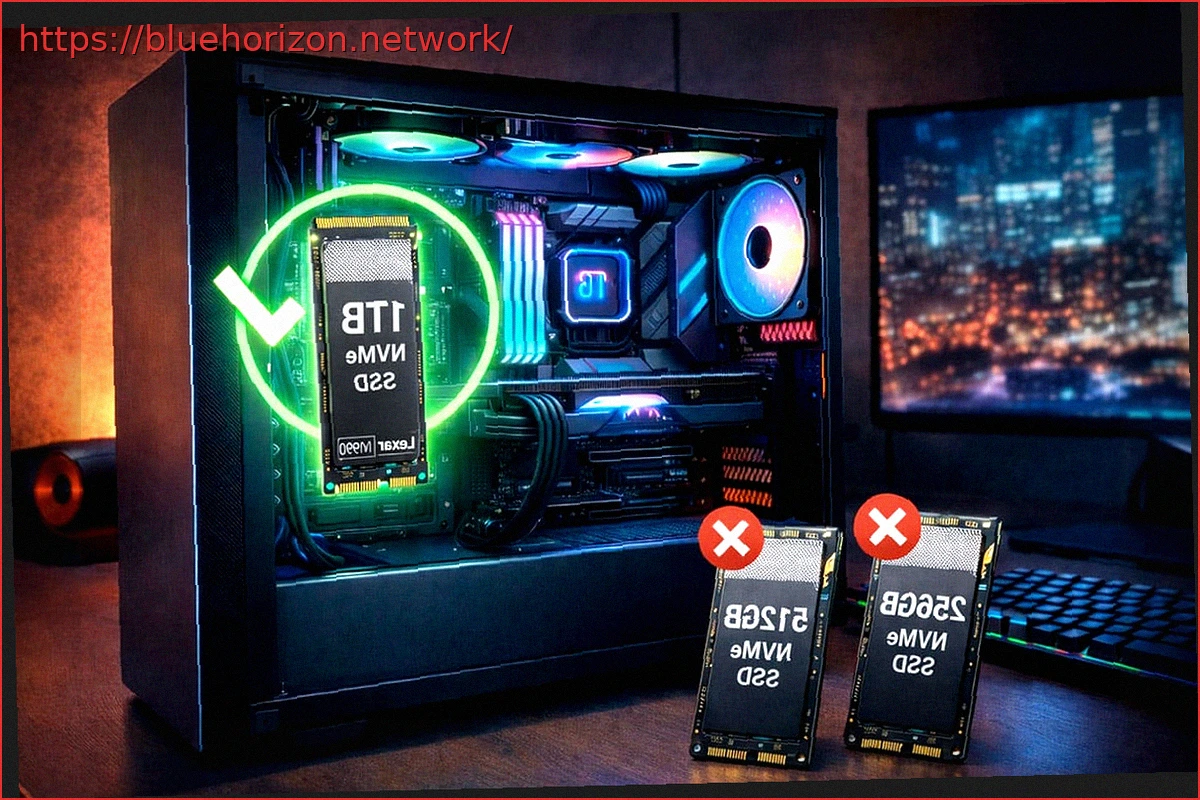
Grace Su, Lexar’s representative in Europe, revealed that users are more accepting of reduced RAM capacity. However, this sentiment is entirely different when it comes to SSDs with less than 1TB of storage. Su explained that the company had planned to secure lower-density NAND Flash memory to continue offering products with smaller capacities. Examples of these products included low-capacity microSD cards, more modest RAM kits, and smaller SSDs. This decision was made after observing that the memory shortage was unlikely to resolve soon and that distributors and customers were finding prices increasingly unaffordable. Lexar’s reasoning was straightforward: if everything becomes more expensive, the market should shift towards lower capacities. However, they were mistaken about SSD users.
Lexar noted that this strategy was successful for RAM and memory cards, as there was demand for smaller capacities. In contrast, the plan for SSDs did not work out. Models with 256GB and 512GB sold significantly less than anticipated, to the point where Lexar realized that end-users simply did not want to purchase them. The market sentiment is that if users have to pay a premium for an SSD, it must be worthwhile, and for capacities below 1TB, many users feel it is not a good investment, especially for gaming or professional use.
1TB SSDs Hold Significant Psychological Weight Compared to 512GB
Psychology plays a role because a 1TB SSD is perceived as a clearly superior category to 512GB, not just as double the space. Practically, this difference is also notable. A 512GB SSD in 2026 can quickly become full by installing just a few modern games like Call of Duty: Warzone, which requires over 125GB of storage. The current popular game, Crimson Desert, also occupies 125GB. Essentially, the situation is similar to consoles. Grace Su mentioned that some users even stated they would prefer to return to mechanical hard drives rather than pay more for a 512GB SSD.
Curiously, this logic has not been replicated in memory cards. Demand for smaller capacities has reappeared there, with some customers returning to purchase 32GB and 64GB cards, even though the market had clearly shifted towards 128GB and 256GB in 2025. This indicates that consumers are more willing to accept lower capacities on a card than for their primary PC storage.
512GB SSDs still find a place in the professional and business sectors. System integrators and B2B clients are more flexible because their priority is not the “ideal purchase” but rather completing a full system within a specific price range, such as a laptop or desktop for 1,000 euros. In this context, installing 512GB still makes sense if it helps achieve the economic target. Finally, according to Lexar, PCIe 5.0 SSDs remain too expensive and represent less than 10% of the market, with PCIe 4.0 being the standard option for most.