Warranty Week has published a striking analysis of NVIDIA and AMD’s discrete GPU warranty costs as of 2025, and the data is concerning. A notable aspect of the report is its inherent ambiguity, as it conflates discrete GPUs (as separate chips from the CPU) with complete graphics cards and with system integrators who purchase these chips to build their own models. This distinction, seemingly minor, is crucial, especially since the report does not specify whether NVIDIA’s warranty payout figures pertain to RTX or RTX PRO models.
The core issue is that this is not a clear-cut table of gaming cards sold to end-users. Instead, it’s a warranty cost analysis compiled by Warranty Week that bundles various elements together. The interpretation is complex and imprecise, seemingly assuming that “discrete GPU” also encompasses “discrete graphics card.” This is a flawed premise, as the two are not interchangeable.
NVIDIA Skyrockets Discrete GPU Warranty Payouts, AMD Follows Suit
To clarify the report’s findings, which are not without controversy, Warranty Week initially defines a discrete GPU as a graphics chip separate from the CPU, designed for demanding tasks in AI, gaming, and mining. Intel is mentioned as attempting to enter this market but is excluded from the study due to its lack of published warranty expenses. Up to this point, the information is relatively easy to grasp, as the study compares two companies within the discrete GPU market.
The complexity arises when the report includes AIC partners – brands like ASUS, MSI, GIGABYTE, PowerColor, Sapphire, Zotac, and PNY. These companies purchase NVIDIA or AMD GPUs and then design their own graphics cards, including their PCBs, cooling solutions, and offering their own warranties.
This is where the real controversy lies, sparking significant debate. Warranty Week states that these system integrators offer their own limited warranties, while NVIDIA and AMD’s limited warranties cover discrete GPUs used by the end-user, not chips integrated into larger graphics cards sold by other manufacturers.
In simpler terms, the report does not provide a clear overview of the entire gaming graphics card market, nor does it offer a straightforward count of chips failing before assembly. Instead, it aggregates warranty costs already accounted for in the financial records of both NVIDIA and AMD.
Are These Increases Due to More GPUs Sold or Higher Failure Rates?
To construct its study, Warranty Week examined annual reports and quarterly financial statements from NVIDIA and AMD. It gathered three key metrics: paid claims, provisions, and the ending balance of the reserve fund. This data was then combined with product sales figures to calculate warranty rates as a percentage of revenue.
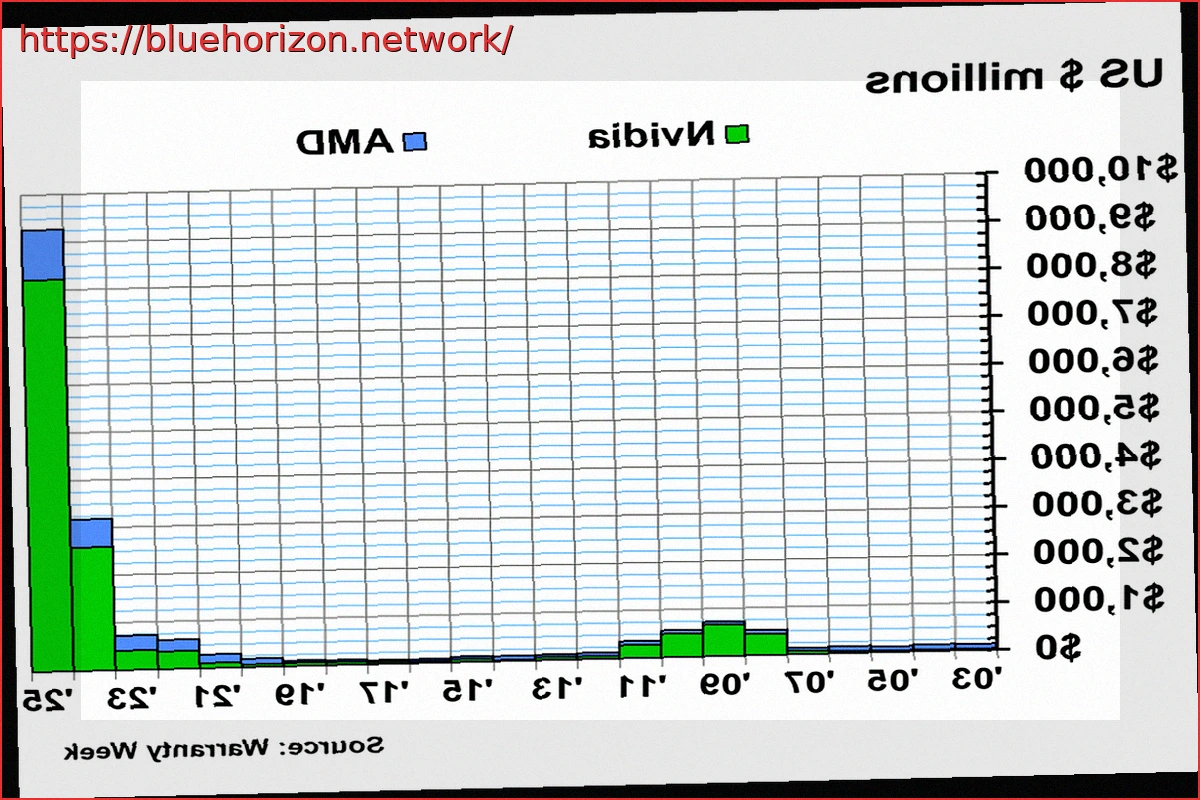
With this necessary clarification, let’s look at the most striking data. In terms of paid claims, AMD’s expenses rose from $110 million in 2024 to $238 million in 2025. NVIDIA’s payments dramatically increased from $81 million to $894 million, which Warranty Week characterizes as a 1000% surge for the green team.
Breaking down NVIDIA’s 2025 quarterly paid claims, the company paid $147 million in Q1, $80 million in Q2, $156 million in Q3, and $511 million in Q4. Regarding warranty claims as a percentage of sales, AMD saw an increase from 0.43% in 2024 to 0.69% in 2025. NVIDIA’s rate climbed from 0.17% in Q1 2025 to 0.90% in Q4, with Warranty Week noting that this rate multiplied by nine compared to Q4 2024.
Provisions show an even more substantial jump. AMD set aside $213 million in 2024 and $358 million in 2025. NVIDIA, on the other hand, provisioned $948 million in 2024 and a massive $2.59 billion in 2025. NVIDIA’s quarterly provisions in 2025 were $428 million in Q1, $870 million in Q2, $220 million in Q3, and $1.07 billion in Q4. As a percentage of sales, AMD closed 2025 with a 1.03% provision rate. NVIDIA recorded 0.92% in Q1, 1.97% in Q2, 0.47% in Q3, and 1.88% in Q4.
Still Unclear: The Split Between Gaming and AI Graphics
How can these impressive figures be explained? Warranty Week suggests two factors contributing to NVIDIA’s and AMD’s increased warranty payouts: higher GPU sales and more expensive repairs due to tariffs and memory shortages.
Unfortunately, the report does not provide a clear breakdown between gaming, Artificial Intelligence, system integrators, and final consumer products. Consequently, we cannot determine the specific portion attributable to RTX cards versus RTX PRO, nor can we account for DGX systems. What is evident, however, is that the figures have skyrocketed, and the report leaves open the question of how much is due to increased sales versus increased failure rates.
Despite this uncertainty, it’s hard to ignore the consistent reports of RTX 40, RX 9070 XT with 12V-2×6, and RTX 50 cards failing – often publicly. These are not isolated incidents; they are a recurring pattern. This number doesn’t even include users who quietly seek resolutions from retailers, manufacturers, or directly from NVIDIA or AMD.
Therefore, it’s difficult not to suspect that gaming graphics cards, particularly high-end models, as well as AI hardware, are failing at a significant rate due to the reasons previously discussed countless times. What percentage of these failures corresponds to each sector remains a missing piece of the puzzle, and it’s highly unlikely that either AMD or NVIDIA will reveal this information, unless an AIC partner chooses to disclose it publicly, which is also improbable.