
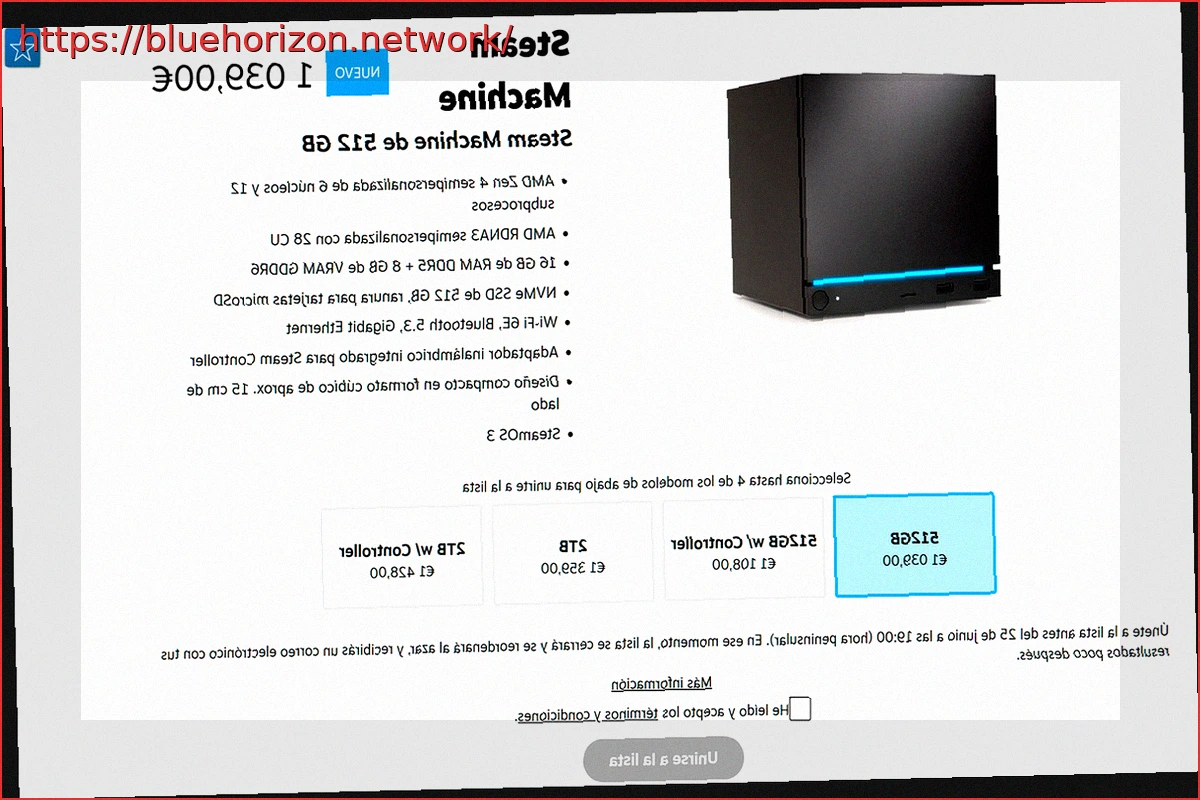
The rumors have materialized: the Steam Machine is not only set to be expensive for the hardware it packs but will also launch without a controller to try and keep its price as low as possible. Valve has finally officially announced the price of its Steam Machine, a price that has ultimately disappointed. This living room computer or Mini-PC will launch with a starting price of 1,039 euros in Europe and $1,049 in the United States. This price is for the version with a 512 GB SSD.
The Steam Machine with the included Steam Controller will see its price jump to 1,108 euros. The model with a 2 TB SSD, without a controller, will increase the price to 1,359 euros. In its most complete configuration, with 2 TB and controller included, the price climbs to 1,428 euros. And yes, we are talking about prices that are very comparable to conventional computers. So let’s see if it’s worth it.
Steam Machine: Launch Date Set for June 29th, Starting at 1,039 Euros
The Steam Machine will go on sale on June 29th, although Valve will use a reservation system to manage initial demand. Users can already register their interest, and the queue will be randomly reordered before the first purchase invitations are sent out. With this move, the company aims to prevent the launch from becoming a race against bots and scalpers. The company has already learned quite a bit from the initial launch of the Steam Controller, which sold out in minutes only to appear on numerous websites and platforms by users who took advantage of the scarcity to even sell the controller at double its official price.
The most striking decision is that Valve is not trying to compete with the PlayStation 5, Xbox Series X, or PS5 Pro through an aggressive pricing strategy. The Steam Machine is, for all intents and purposes, a compact PC with SteamOS designed for the living room, and Valve wants to sell it as such. The company argues that subsidizing the hardware would go against its open platform philosophy, as users can install other operating systems, use other peripherals, and are not locked into a closed ecosystem like with a traditional console.
This explains why the price deviates so much from the console market. A PS5 Digital, an Xbox Series X, or even a PS5 Pro are cheaper than the Steam Machine, but they also operate under different business models. Sony and Microsoft can afford very low margins or even occasional losses on hardware because they recoup money through licenses, services, commissions, and games sold within their platforms. Valve, on the other hand, cannot guarantee that someone buying a Steam Machine will exclusively buy games on Steam, or even that they will use SteamOS as their primary operating system.
Is It Really Worth It for the Price?
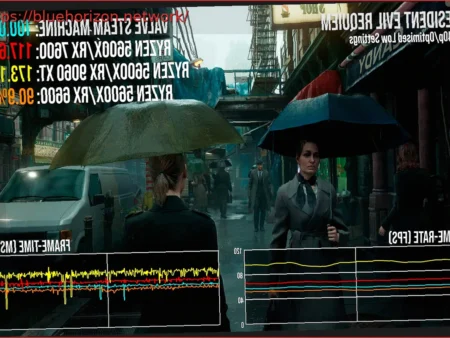
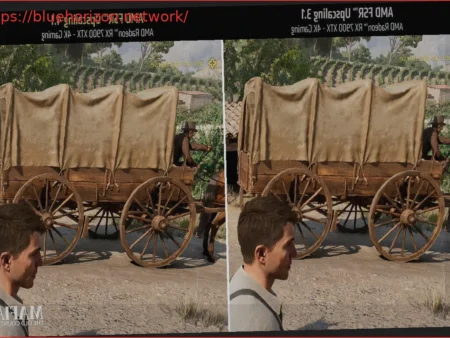
Technically, the offering remains attractive for those who already have a substantial Steam library. The Steam Machine is conceived as a sort of “desktop Steam Deck.” It also relies on semi-custom AMD hardware, SteamOS, and a TV-oriented experience. Valve presents it as a machine capable of gaming at 4K and 60 FPS with the help of AMD FSR upscaling. However, its real-world performance will largely depend on the game, graphics settings, and compatibility under Proton.
In terms of performance, at the CPU level, the Steam Machine offers either an Intel Core i5-12300 CPU or an AMD Ryzen 5 5600G APU. For the GPU, its performance would be slightly inferior to an AMD Radeon RX 7600 and very much on par with an NVIDIA GeForce RTX 4060 or RTX 3060 Ti. For around 1,000 euros, it’s possible to build a PC with an Intel Core i5-12400F processor, an NVIDIA GeForce RTX 4060, 32 GB of RAM (vs 16 GB), and a 1 TB SSD.
Basically, for the cost of the Steam Machine, you can build a more powerful desktop computer. However, with Valve’s device, you are paying for miniaturization and an optimized SteamOS experience. Added to this is the fact that a desktop PC can be upgraded over time, while the Steam Machine cannot. Valve’s advantage will be integration: a simpler, more compact, quieter experience designed for playing from the couch without having to configure a conventional PC.